• Scam Alert. Members are reminded to NOT send money to buy anything. Don't buy things remote and have it shipped - go get it yourself, pay in person, and take your equipment with you. Scammers have burned people on this forum. Urgency, secrecy, excuses, selling for friend, newish members, FUD, are RED FLAGS. A video conference call is not adequate assurance. Face to face interactions are required. Please report suspicions to the forum admins. Stay Safe - anyone can get scammed.

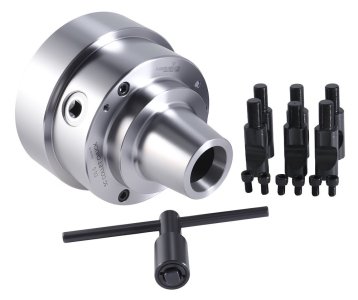
Anyone tried the Accusize 5C collet chuck?

Here is a Youtube video of that procedure by Mr. Crispin, he's a machinist working for Rolls Royce:

You guys are testing my patience. Holy crap I hate you tube. But I watched it.

To my eye, he isn't traversing the full rear face with the grinder, just the inside portion. I must be imagining that.

I also wonder why he paid zero attention to the front nose face. On my lathe that face is just like the rear face making contact after a thou or so of tightening. Recall that this face is where that teeny tiny chip was that I mentioned earlier. Is this face not important too? Or does it just go along for the ride?
 
You guys are testing my patience. Holy crap I hate you tube. But I watched it.

To my eye, he isn't traversing the full rear face with the grinder, just the inside portion. I must be imagining that.

I also wonder why he paid zero attention to the front nose face. On my lathe that face is just like the rear face making contact after a thou or so of tightening. Recall that this face is where that teeny tiny chip was that I mentioned earlier. Is this face not important too? Or does it just go along for the ride?
The front face of the D1-xx spindle nose is not a bearing surface.
 
The front face of the D1-xx spindle nose is not a bearing surface.

All these years, and I didn't know that!

So prolly, that tiny chip did no harm!

Thank you!

Might make a torque adapter today. Seems like a good project for a few days before Christmas!
 
All these years, and I didn't know that!

So prolly, that tiny chip did no harm!

Thank you!

Might make a torque adapter today. Seems like a good project for a few days before Christmas!
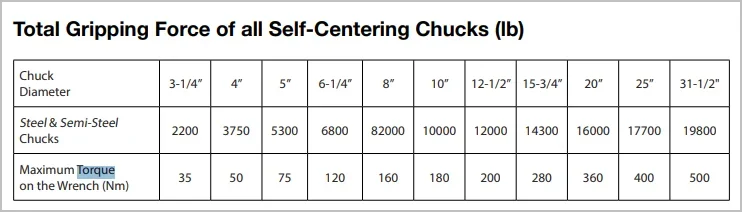
But do you know what torque value is required? I don't. I guess it doesn't really matter that much, as long as they're all even.

I also tighten mine in a wheel bolt pattern. 1-4-2-5-3-6. Twice.

Also the torque requirements for tightening your 3 or 4 jaw chucks are? I have it listed in the owners manual that came with my 3-jaw.
 
The front face of the D1-xx spindle nose is not a bearing surface.
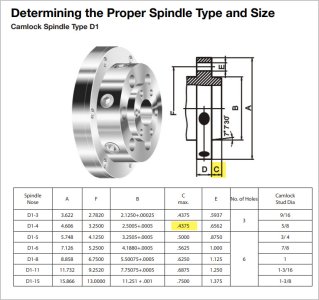
What @RobinHood aluded to and what I have heard is quite different. For me it is not a hill to die on. But here goes: when correctly positioned, the backplate must make intimate contact with the D1-x face., From what I understand, this prevents chuck tilt, and resists axial forces incurred when making large diameter cuts. On my D1-6 Pratt Bernard chucks, there is full contact on my LeBlond lathe, for instance.
I also tighten mine in a wheel bolt pattern. 1-4-2-5-3-6. Twice.
Exactly how I was taught too!

--one last tidbit... Any D1-x chuck must be 'stuck' when releasing the cams, and needs a sharp wrap from a soft hammer to release. Several used lathes I have examined, the owner stoned the taper so it would 'fit right' and the chuck could fall off by itself. Needless to say I ran away from those disfigured lathes.
 
Before doing anything, I took the time to measure my spindle runout. The shop is not warmed up yet but approximately 1 micron on the taper and 1.5 or so on the flat at the outside surface using my Mahr millimess 1 micron test indicator. My cam lock holes intersect the inside relief so I could not take a reliable measurement there. I don't think I'll be touching it.

I then mounted my Bison 5C Collet Chuck and measured its taper runout at about 1 micron. At first I thought that can't be right so I applied a tiny force on the Noga holder and sure enough, very smooth and predictable movement so it isn't sticking. A good example of how I set it up to index on the lowest runout. Still holding great about 9 years after I bought the chuck.

Next I installed a hardinge 1/4" collet with one of my better endmills. Same runout at the base of the endmill but a bit over 3 out near the flutes 1 inch away. Perhaps that would get better with deeper engagement in the collet but then I wouldn't be able to measure at that length. I have no precision rods I would trust for this test. They are on my Kijiji/marketplace search list.

I confess that I can't get the indicator into position for a 90 degree measurement so the results might be very slightly worse. But given the very small measurement, I doubt I could see the difference.

Those results are all turning the spindle by hand using the rear spider.

Of course, the acid test is the concentricity and consistency across length of the parts I turn on it.

All in all, a whole lot better than I remembered. Another reason I love my collet chuck.
 
But do you know what torque value is required? I don't. I guess it doesn't really matter that much, as long as they're all even.

Actually, no I don't. I've always assumed the small t-handle was deliberately sized to prevent overtorquing the cam bolts. Being a big fellow, I've always been gentle with them.

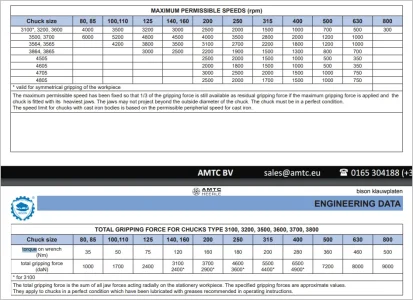
I have not assessed the info @PeterT has provided above yet. This will help me decide what size of torque limiter to acquire.
I also tighten mine in a wheel bolt pattern. 1-4-2-5-3-6. Twice.

I do the same thing but 3x instead. Once to just get them started, again to get them up to 50% or so, and then again to tighten them up.
Also the torque requirements for tightening your 3 or 4 jaw chucks are? I have it listed in the owners manual that came with my 3-jaw.

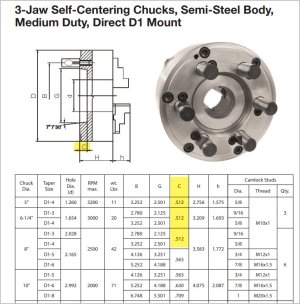
Oh oh....... I didn't know they are different! I'm not immediately able to see why that would be. If the base of the chuck is at least as big as the base of the spindle, shouldn't they all be the same?
 
Here is a Youtube video of that procedure by Mr. Crispin, he's a machinist working for Rolls Royce:


I watched this series from when he started posting it about a month ago... very informative stuff. In the series on grinding theory he specifically tackles alignment with the spindle on two planes. Between these and a few other videos on grinding I think I'm ready to tackle regrinding my spindle nose taper and face if necessary
 
The shop is not warmed up yet but approximately 1 micron on the taper and 1.5 or so on the flat at the outside surface using my Mahr millimess
All in all, a whole lot better than I remembered. Another reason I love my collet chuck.

Bison references their 5C chucks TIR at 0.0004". I think a Hardinge precision collet is 0.0002". End mill shanks, I dunno, maybe 0.0002-0.0005"? So you have 3 potentially cumulative tolerance variation sources downstream of the spindle & you get the same runout of 1 micron (0.000039") at the base of the EM? The chuck is rated 10X more runout than your headstock assembly. You should be thanking the Gods of Probability, or the Asian lathe builders LOL.
 
Last edited:
You should be thanking the Gods of Probability, or the Asian lathe builders LOL.

I certainly agree! You should have seen my face when I saw the numbers. Needle wasn't moving. Had my milliness gone south? Did I adjust it wrong? Was something binding?

Nope nope nope. I even reached over and pushed manually on the nose to see if the needle would move. Yup, it did! So nothing obvious wrong. Can't wait to turn and test a part per @Dabblers suggestion. Not touching anything till then!
 
Interesting that you all forget one simple thing on your mounts. If the lathe mount is worn or damaged, turn it or grind it to spec. No matter what happens it will be true to your machine in that set up.

Scared of turning or grinding, don't be as you are likely only taking of 1/10's of Thousands (maybe up to 0.001) just to clean things up. If you are taking 0.005 you have serious issues that need to be address on your machine and the mount is likely the least of your issues.

Finally, precision and some of the values being chased are not within the realm that most can achieve with the equipment and tooling that we have. This is one of those pet peaves that that gets me upset.

On for those with OCD that work to those levels (and some have posted their projects and work) hats off, you truly understand that you precision is the craftsmanship of your work and skill to get it there and not that of the machine and don;t waste you time chasing something on the mahine that is beyond its limits, but instead work around it to achieve the results.
 
I've heard that the tommy bar T-handle chuck key design is partially intended to limit excessive Gronk torque. The chuck specs seem to support that.

It's not easy to get the really important stuff done this time if year. Too many honey do's.

I can't really make heads or tails of this info Peter. I think these charts are all referring to the torque on the collet tightening mechanism - not the CamLock Studs. The other chart you copied from GTS is similarly suspect.

On a related topic, I looked at the bison catalog you linked to and could not find all the different d1-x mount choices for collet chucks. Have they dropped those?
 
Stefan did a video on his Chinese 5C teardown inspect. Note its 6 years old already so things change. His old lathe had backplate style where chuck is front bolted, so allows adjusting (as long as it stays put). Some guys have made their own Set-Tru-ish plates for D spindle using a semi-finished chuck adapter plate (finished spindle taper turned & D-pins installed). They turn this in-situ with a slightly larger ID relief pocket for a front mount style 5C chuck & then drill tap their own set screws.

Clough42 follow-up video FWIW (of course the question is will Chinese chuck A be the same as Chinese chuck B)

Resurrecting this thread because I’m toying with the idea of getting a 5C collet for my new/old lathe.

The two videos above are interesting in the quality variation between the two seemingly identical 5C collet chucks, one appears near perfect (Stefan), and the other (C42) almost unusable.

Would like to hear from anyone that has purchased. From what vendor they ordered from and if what they received was closer to the Stefan or Clough42 quality?
 
 
I bought a Bison 5C that was on sale on Amazon at the time. It is probably about 13 or 15 years old now.

Appearance wise, it is a lot like what I can see of @whydontu's chuck above and almost identical to the accusize unit here - image copied from their website.


0269-0015-A_1000x.jpg

The accusize is even a D1-5, the same size as mine. I doubt that contributes to its native precision which is downright excellent.

Right out of the box, mine has been a complete delight. The runout on the chuck collet face after selecting the optimum cam lock indexing has always been just a few tenths. I can't see what resolution @whydontu is using above, but my experience is similar. I think that most of his movement is the result of sideways scrubbing of the indicator needle.

Any problem I've ever experienced with my chuck has been due to crummy collets, not the chuck itself. Good collets equal good runout. You get what you paid for with cheap collets.

One thing I'd add. The first task after getting one of these chucks is to pitch the key it comes with. They are extremely irritating. The safety spring always launches the key into dusty corners of the shop where it disappears for months. Instead, make a hex adapter for a driver drill and enjoy the chuck.
 
Bison is predictably good but costs more money. They come up now & again on eBay. Another thing to know is the scroll is typically finer but I dont have experience with other brands.

Ajax has a plain back on sale, 649 USD, supposedly 947 USD regular. (not including back plate)

if you think that's expensive, you better be sitting down for list prices in Canada


Gator might be a good choice, list is higher than Bison sale but lower than Bison list

I've only heard about Atlas/PBA which I think are Asian but high QC standards. Actually I learned a few interesting things about the chuck manufacturing landscape from Ajax, but that was years ago
 
Back
Top