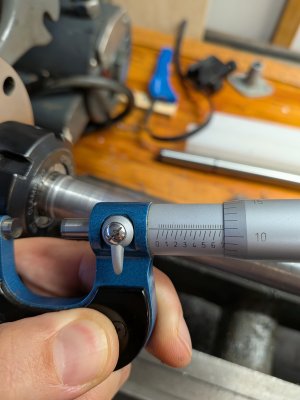
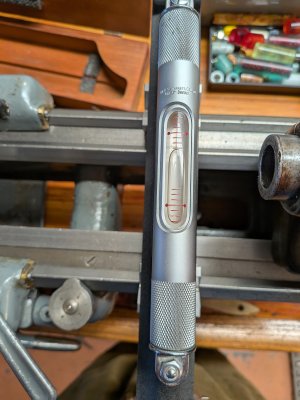
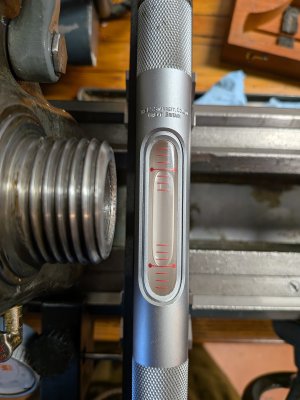
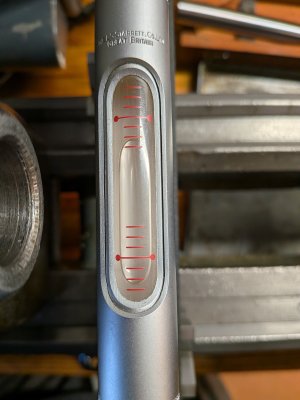
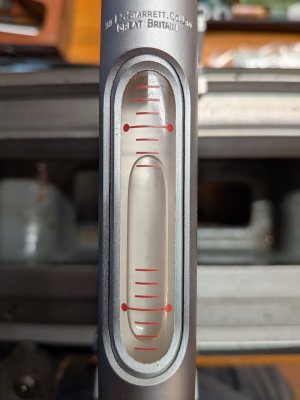
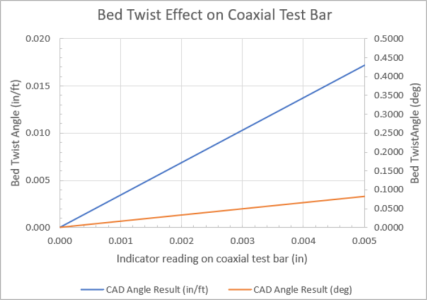
The two videos are with the spindle rotated 180°. As before I think the discrepancy here is in the bar, but I can't say.
Sorry, I just realized I never pressed send on the post below.
After reading subsequent posts, I see that you removed the bar and reseated it in the taper at 180 degrees.
Might be too many cooks in the kitchen here, but IMHO, you should not remove the test bar from the taper. This is my fundamental bitch about using test bars. You can not know how good that taper is. A fleck of dust can disrupt it. You also don't know how good the bar is. And in my own experience and that of a few others, they are usually not very good.
However, it can still be used. You just need to use some very simple math. If I am not mistaken, you already know how to do it. It's just that the assumptions got messed up because you did other things that we didn't know about.
Before we get to that, I'd also like to talk about indicators.
@PeterT said that "The force of indicator plunger is minuscule". Normally, I would agree with that. But in my experience that is not universally true. Some have forces that do distort the work enough to matter. Besides, remember that everything is rubber..... If there is force, there is Deflection ..... PERIOD.
In general, I find that DTIs are much more sensitive and exert less force than plunge indicators. So I much prefer them for this kind of work. I'm not saying that a plunge indicator won't work. Just that a DTI is better.
Back to how to do this.
Put that test bar in the spindle, give it a good solid tap, and then LEAVE IT THERE.
Assuming that the bar is truly round, it's center of rotation (the spindle axis) will always be the half way point between two opposite measurements as the bar is rotated 180 degrees in any plane. A bar that is also concentric with the spindle axis will have no runout.
You still don't know about pointing up or down, but the 180 degree rotation tells you that it's reasonably well aligned horizontally.
Just put the DTI on the top and bottom to get vertical alignment.
One of the problems you might encounter more so with the vertical measurements is a floating carriage resulting from bed wear. Such wear and it's impact are beyond the scope of what we are talking about though. Just be aware of it.