• Scam Alert. Members are reminded to NOT send money to buy anything. Don't buy things remote and have it shipped - go get it yourself, pay in person, and take your equipment with you. Scammers have burned people on this forum. Urgency, secrecy, excuses, selling for friend, newish members, FUD, are RED FLAGS. A video conference call is not adequate assurance. Face to face interactions are required. Please report suspicions to the forum admins. Stay Safe - anyone can get scammed.

Tool Vevor Drill Bit Sharpener Improved

Tool
It makes me realize that 3D printing the collet nut might be more useful than even the collets. Easy way to control the length of the grind.

Brain fart. Woke up realizing that a custom 3D Printed Holder won't work. It's the gauge depth during setup (for more grind) or during use (for less grind) that has to change, not the holder. A longer or shorter holder won't change the drill grind. It indexes to the gauge set points regardless.
 
Brain fart. Woke up realizing that a custom 3D Printed Holder won't work. It's the gauge depth during setup (for more grind) or during use (for less grind) that has to change, not the holder. A longer or shorter holder won't change the drill grind. It indexes to the gauge set points regardless.
print collet holders with different depths
 
print collet holders with different depths

That was my initial thinking. Then I realized that the gauge and grind stations will simply take that into account and change nothing. The change has to take place between setting and using. Either set long and use normal, or set normal and use long. Both require a shim or some similar adjustment.
 
Why do some drill bits just have a round shank and not the three flats? Even a new/sharp drill just catches and spins in the chuck, without the the three flats

Before I waste money on a sharpener, just toss the round shank bits? Is that a sign of a cheap drill bit?
 
Why do some drill bits just have a round shank and not the three flats? Even a new/sharp drill just catches and spins in the chuck, without the the three flats

Before I waste money on a sharpener, just toss the round shank bits? Is that a sign of a cheap drill bit?

Round = sign of cheap? Definately not. If I had to guess 90% of drills are round shank, no facets. I'm talking typical machinist /metalworking tooling where they have well established gripping capability; chucks, collets whatever. Only think I can think of with facet shanks is is more utility orientated where you have big holes + small shank ratio and/or generally lower grade chuck retention (hand drills). For sure facet are popular for woodworking (grabby) or metalworking hole saws (high dia: shank ratio) but also weekend warror drills. Nothing wrong with facet. It actually takes more grinding operations to make one (accuratelly) so guessing market-specific? Some (most all?) of the facets I've seen still leave some original round shank surface so I's assume any of the sharpener collets would hold properly on that surface, the facet just isnt used. The sharpener itself sees nothing for torque so shouldnt be an issue?
 
Last edited:
Round = sign of cheap? Definately not. If I had to guess 90% of drills are round shank, no facets. I'm talking typical machinist /metalworking tooling where they have well established gripping capability; chucks, collets whatever. Only think I can think of with facet shanks is is more utility orientated where you have big holes + small shank ratio and/or generally lower grade chuck retention (hand drills). For sure facet are popular for woodworking (grabby) or metalworking hole saws (high dia: shank ratio) but also weekend warror drills. Nothing wrong with facet. It actually takes more grinding operations to make one (accuratelly) so guessing market-specific? Some (most all?) of the facets I've seen still leave some original round shank surface so I's assume any of the sharpener collets would hold properly on that surface, the facet just isnt used. The sharpener itself sees nothing for torque so shouldnt be an issue?
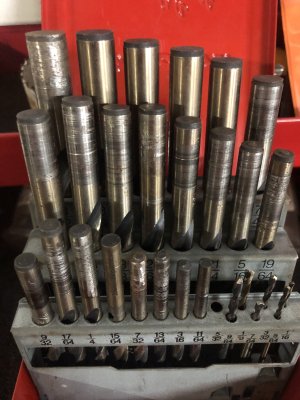
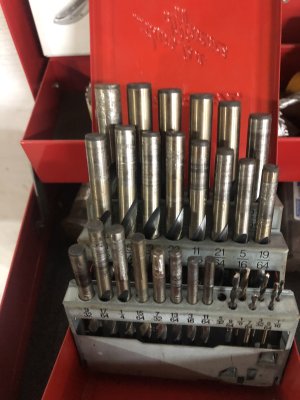
IMG_6895.jpegIMG_6896.jpegI inherited these, and I'm not sure why the middle four at the back look new, but the rest are all galled. You would try saving these and sharpening them?
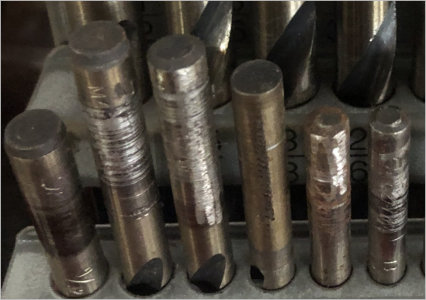
 
Tough call without knowing about the quality. If they are decent steel & axially straight, then as long as the sharpening collet can grip the shank accurately enough you have nothing to lose by resharpening. Some of those shanks look effed up with a hand grinder, so if the collet grip is cockeyed, then the tip grinding will be cockeyed. If I had to guess, someone had these in a tired or cheap chuck. Maybe spinning them at aggressive RPM & feed in tough materials. Usually like a hand drill but you could abuse them in any machine. I wouldn't buy a sharper FOR those drills, buy one because you want a lifelong tool to sharpen & maintain your drills. These can be your practice set.

I dont have a dedicated sharpener but once I had a reliable mechanism to grip drills with high precision (in a tool cutter grinder) only to be dismayed the points were not coming out symetric by a long shot, I had a close look at runout & that explained everything. They were bananas. No sharpener is going to fix them. A lot of hardware store & big box store stuff is warped garbage despite pretty gold coating 9which flaked off anyway) & more modern tip profiles. Not all are like that & its impossible to confirm until you get them home. But a 64 piece set for $16 regular price is probably a clue. In all fairness everyone needs a weekend warrior abuse set for fixing the fence, encountering cement, loaning to a sketchy neigbour, drilling through abrasive drywall etc. But if you expect to make accurate holes in metal they need to be decent quality. Sadly a lot of the old school HSS USA brands we could trust in the past are a fortune & just not worth the cost new. So you have to go by word of mouth of a specific brand.

1795048271438.png
 
I should run the part numbers to try to figure out what quality they are. Supposedly the whole set could be $600-1000 dollars now, to buy new. Tool truck dude said any drill over 1/4" is $20-22 pretty quick to replace. 🙄

I inherited them, so I'm not married to them, but if they are quality I'll put some time and money into the set I guess
 
There's no part number but they're marked "snap on M42", google came up with m42 is 8% cobalt. It's a 29 pc set, doesn't really tell me if it's cheap or expensive
 
There's no part number but they're marked "snap on M42", google came up with m42 is 8% cobalt. It's a 29 pc set, doesn't really tell me if it's cheap or expensive
That sounds like a pretty good set to me!

Drilling is a roughing operation. There is no guarantee that a drill makes a hole that is:
a) on size
b) straight
c) round

BTW, the shanks are intentionally made of softer steel so that the chuck jaws can grip. I had a few drills that had heavy burrs on the shank so I stuck them in the lathe chuck with the shank protruding and then gave them a lick with a file to knock the high spots off. I think they work well enough.

Craig
 
A common issue is trying to upsize holes in something like plate steel with a hand drill. You drill a 1/4" pilot hole. Then bring out the bigger drill. Typically the RPM is too fast for that diameter but often the only way to make chip progress because it lacks torque at preferrable lower rpm. Then drill breaks through the hole, edge catches in the drill gullet & spins in the chuck. The jaws are typically harder so makes those nice chowder rings which means even less effectve grip the next time out. If you had the exact same stock with exact same drill in a milling machine, no possibility to go off-axis or for the drill to 'back float' like hand held or even drill press, high odds the hole cuts with no drama.

1795056850678.png1795056873597.png
 
If you examine the drill bit looking at the cutting end straight on, you can often tell that the web is not centered. That's the most common quality problem.

Like others, I'd bet those are quality drills.

I use a small grinder to remove shaft burrs. It often leaves a little flat spot but that doesn't matter functionally. The burr is much worse and the alternative is the trash bucket.

As far as a collet based sharpener goes, all of them that I have seen grip the drill by the flutes. So shank defects or hex flats or whatever don't matter.

I'm with @PeterT. I wouldn't buy a sharpener just for this set. It wouldn't pay. A sharpener only makes sense if you have lots of drills to sharpen.
 
As far as a collet based sharpener goes, all of them that I have seen grip the drill by the flutes. So shank defects or hex flats or whatever don't matter.
Good point. Oversight on my part. Makes total sense that the actual drill stickout will be relatively short as a function of the grinder/indexing assembly, so the collet is gripping on the flute lands, not the shank. And I suppose by default, will also deal with any banana axis better in terms of grinding point concentricity, but ultimately the chuck grips the shank so will still come into play if present.
 
Back
Top