• Scam Alert. Members are reminded to NOT send money to buy anything. Don't buy things remote and have it shipped - go get it yourself, pay in person, and take your equipment with you. Scammers have burned people on this forum. Urgency, secrecy, excuses, selling for friend, newish members, FUD, are RED FLAGS. A video conference call is not adequate assurance. Face to face interactions are required. Please report suspicions to the forum admins. Stay Safe - anyone can get scammed.
  • The 2026 Calgary Area Meetup is set for Saturday May 30th at 10am. The signup thread is here! Robinhood has graciously offered to host the meetup again this year. Please note that you MUST RSVP to the notice linked above if you wish to come.

Really ?

Ya who knows. I've taken it as best offer, but then the time frame or other offers are disclosed publicly.
I recently sold something where I put a price and OBO. I had people offer me lower and I said "no thanks not at this time, if I still have the item in 6 months I sure I will change my tune". I had two guys that said at the same time they would take the item at my price. I let them both know and one guy immediately offered more. I told the other buyer and he said fine sell it to him thanks. Funny thing is the guy that offered more than my asking price initially offered me less and I turned him away.

As the seller you had the high ground of a mini bidding war between 2 motivated buyers. The low OBO gotta go in a bidding war.

The guy I was dealing with had an item that has been posted for at least a month.

Here's how it went:

I communicated via Kijiji that I was interested. We agreed on a time and place (his place). He asked to let him know when I was coming. I did exactly that. I arrived at the time I said I would be there. No discussion of money, yet. I pull up, get out, and polite introductions are made. A firm handshake is given. We're off to view the item in his garage. Looks great. Time to dance. I say,"Let's make a deal. What do you want for it?"
He replies, "Well I paid $90 brand new so I think it's worth $50."
I counter, "How about $40?"
He replies, "No, it's worth $50."
I counter his no-counter with, "But in your ad you state 'Or Best Offer'. So my best offer is $40."
He kinda smiles and says, "OK, how about $45?"
Finally, we are dancing the classic he goes high, I go low, and then we meet in the middle! I say, "Sure. $45 but I don't have change." Because I don't. 50% my bad.
The smile disappears and he says, "I will go check if I do."
Off he goes. Checks his house and then comes back to check his truck. Nope, he doesn't have change either. Now the other 50% is his bad. So what does he do? He starts back-pedalling like he stepped in something and replies, "Well, how about $50?"
Time to put all the cards on the table and I reply, "I only have $60 or $40 and I am not paying $60. This item has been up for sale for at least a month. Do you want to sell it today or not?"
He replies, "Ok, $40."

Done deal. I pack it up and leave.

That is an example of how NOT to attempt sell something to an individual, who has communicated well, showed up on time, and even agreed to meet you in the middle during the offer/counter-offer when you post an ad that states "OBO". Then he proceeds to back out of the AGREED upon price by going back to his original offer. I could've gone to break a $20. Instead I played a little hard ball and it paid off...10 whole dollars😀

IMO the simple solution is if you want to sell something for $50 then ask for $60 or $65 with OBO in the ad. Give that room to haggle. If the buyer doesnt haggle then bonus to the seller for getting more $$$ than he expected. I believe most people want that feeling like they got a little deal. It's all psychological. When the smart seller comes down in price, to the price they actually want, then everybody wins. Buyer walks away thinking they got a deal and the seller gets the price they wanted.
 
I always took it as "or best offer" I will be damned if I am going to offer more than ask.... I have been told that something is sold, but if I wanted to pay more and got there sooner....... my standard reply involves sex and travel and a click at the end.
Hi 140Mower,
Yes that is what it would mean to me as well !
Though I do like the Bugger Off one...
 
Just a couple of months back I was looking at COSTCO brand 5W/30 full synthetic oil prices at around $45/case. Then it went up to about $53. Today $69. I undertsand why but wow!
What gets me is the lack of correlation to the barrel price. Whether it goes up or down the consumer is always getting screwed. Oil companies are making billions in extra profits.
 
What gets me is the lack of correlation to the barrel price. Whether it goes up or down the consumer is always getting screwed. Oil companies are making billions in extra profits.
Most people would be surprised at how much tax is hidden in fuel and liquor. And most people don't understand the math on paying those taxes with after tax dollars
 
What gets me is the lack of correlation to the barrel price. Whether it goes up or down the consumer is always getting screwed. Oil companies are making billions in extra profits.

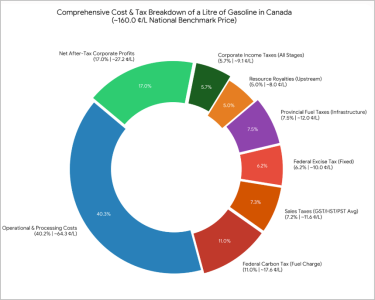
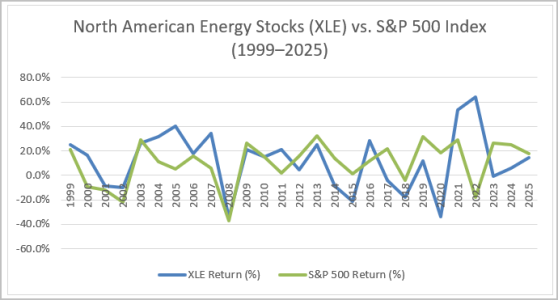
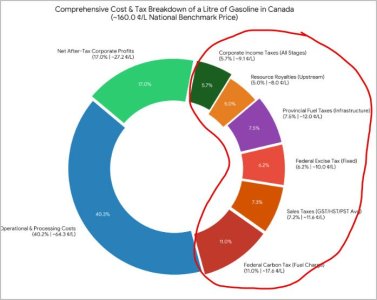
Well by that logic one should just convert his investment portfolio to oil company stock, become a shareholder, sit back & enjoy the 'extra profits'. But I would caution against that. Unfortunately timing is everything. The historical data doesnt quite support this simple view. There are lots of reasons for (apparent) lack of correlation to spot price & refined products. Here is a simplistic expense/profit pie chart for gasoline in Canada, kinda similar to refined oil. The 17% green wedge is NAT profits. Take note of the multiple 'tax' slices & what cumulative slice it represents. We are getting screwed all right, but maybe from some additional sources?

1786304972149.png1786303753239.png
 
Here is a simplistic expense/profit pie chart for gasoline in Canada, kinda similar to refined oil. The 17% green wedge is NAT profits. Take note of the multiple 'tax' slices & what cumulative slice it represents. We are getting screwed all right, but maybe from some additional sources?

Where is the cost to buy a barrel of unrefined oil?

The proportions in that chart seem to be independent of that cost. That can't be true. So I smell a rat.
 
Where is the cost to buy a barrel of unrefined oil?

The proportions in that chart seem to be independent of that cost. That can't be true. So I smell a rat.
Exactly, it's all the big oil companies. If the cost of a barrel drops they make less. Yeh sure. The refining cost goes up. Who owns the refinery, the poor bastards that are losing with the lower cost of oil.
Big war in the middle east (again), pump prices are almost as high as they were 2 months ago yet last week a barrel was trading for 80ish bucks. Someone is raping a s load out of our pockets.
 
Hi Guys,

Its the same over here ! The prices always go up at the slightest hint of an oil price rise, but they take a long time to come back down !!!

We were in France a few years ago, pre Brexit. Over there the prices went up and down almost daily.
 
Where is the cost to buy a barrel of unrefined oil?
The proportions in that chart seem to be independent of that cost. That can't be true. So I smell a rat.

The pie chart is actually a very good representation of all the components that constitute 'pump price'. 17% of the pie, represents net after tax profits. Thats what Big Bad Oil collectvely earns. Simple enough for a common person to understand, although I'd guess a small fraction of Canadians actually do. You can do the same profit margin math on other commodities: soda pop 85-90%, perfume & cosmetics 80-90%, prescription eyeglasses 80-90%, coffee 60-70%, software 25-35%, car 15-20%.... These are Google stats, probably more to those stories as well.

The chart conveniently combines two, typically distinct corporate elements Producers (exploration & production) and Refiners. There's also Transport but lets keep it high level. Yes, some producers have refining entities, many dont. In many respects all 3 compete with one another. So I had Gemini lump them together for name calling simplicity. Producers + Refiners = 17%.

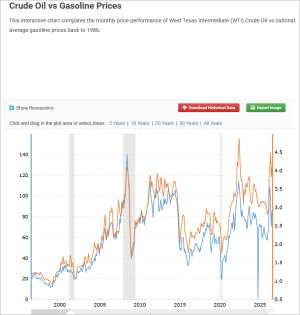
'Buying oil' depends on where & by whom. For an E&P company in western province, custody transfer occurs at any number of pipeline/sales locations along its way to refiners. That sale is the end of the trail. There are a multitude of N-Am reference prices WCB, WTI, Bakken, Mars... different locations, different crude specs, many variables. For example if WTI (West Texas Intermediate) spot trades at 78$U/bbl today, hopefully you can understand the Producer doesnt get that value. It would be more like 62USD WCS FOB Hardisty. Now keep backing up the pointer all the way to the field. Deduct transportation, royalties, taxes, capex, opex.... all the way to the wellhead. Oil might net back say 15$ there. Some days its negative. On the other side, the refiner 'buys' at a reference price like WTI. They dont find & produce crude, they are price takers. To turn crude into gasoline, jet fuel whatever I've heard processing opex like 7-12 USD/bbl, but it varies. Bottom line, feedstock price is for sure a big driver of refined product price, but not all expense categories. Big picture look at the historical crude oil vs gasoline chart, I think there is a bit of correlation there.

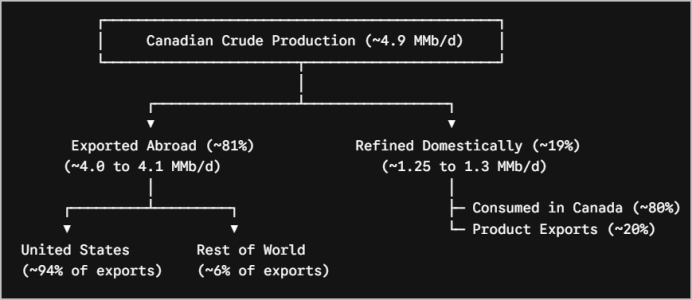
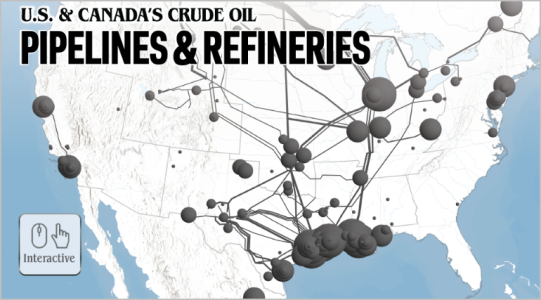
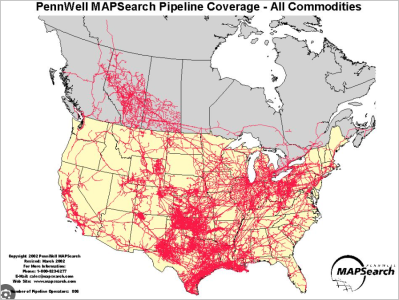
Canadian crude is predominatly refined in USA refineries. Canada supplies 60-70% of USA heavy oil imports. Refineries typically have specific crude requirements. Those built for light/sweet are operationally different than heavy/sour/synthetic. USA refiners source from multitude of countries including themselves, onshore, offshore. They want it cheap & reliable, in that order. So a skirmish in the middle east (light oil) has more impact to a light refiner, less impact to heavy & vise-versa. Refiners are located in different parts of the continent & serve different market sizes & needs. Eastern Canada imports 80% of its crude from USA, 20% international, so is input price is more affected by those supply markets.

So rat smelling aside, if you want to dive into price sensitivity analysis to any significant depth, be prepared to roll up your sleeves. There is a lot of industry specific drivers, not to mention political, regulatory, marketing influences constantly in flux to digest. If you like big picture economics & historical context I recommend start with some of Peter Tertzakian's books & articles https://www.arcenergyinstitute.com/


1786332419396.png
1786339110588.png
1786335210641.png
1786335245323.png
 
Last edited:
The chart conveniently combines two, typically distinct corporate elements Producers (exploration & production) and Refiners. There's also Transport but lets keep it high level. Yes, some producers have refining entities, many dont. In many respects all 3 compete with one another. So I had Gemini lump them together for name calling simplicity. Producers + Refiners = 17%.

I guess that was my point. Convenient is not the right word. At least not for me. If they are gunna break out all those taxes, I want to see crude, refining, transportation, all broken out too.

The problem I don't understand is actually reasonably well disguised. I want to know why a small bump in the cost of a barrel in the middle east causes such a big bump at the pump in Canada. It just doesn't make sense to me.

Taxes are a straight linear ratio, transportation and refining are constant. Therefore, the pump price should be just a tiny pimple instead of a huge abscess.

Since you seem to be interested and knowledgeable, perhaps you could also take a stab at explaining why the pump price reacts so fast to well costs. Shouldn't there be a 2 or 3 month delay?

In fact, why is pump cost in Canada affected at all? Because they can?

PS - I appreciate your knowledge. I'm not shooting the messenger.
 
Just a couple of months back I was looking at COSTCO brand 5W/30 full synthetic oil prices at around $45/case. Then it went up to about $53. Today $69. I undertsand why but wow!
Ha ha I too just had my wife pick up a case cuz I said they were only like $47 or something and that was a good price. She came home and said they were almost $70! WOW what a crazy price bump.
 
If they are gunna break out all those taxes, I want to see crude, refining, transportation, all broken out too.
Well, 'they' is me. If you want more granullarity, you will have to dig it up. I asked Gemini for a normalized breakdown to display Big Oil collectively because that is how Joe average typically labels the industry. Demonization is much easier if its a single target vs understanding a complex industry takes effort. I lumped together the two main elements Refining and E&P (Exploration & Production) so we cal call in Big Bad Oil. Transportation is an important third element that factors in the blue cost wedge but its a bit more variable. A producer may own gathering pipelines, or pay another a fee. Larger 'sales' lines are typically inependant midstreamers, producers/refines may have stake or equity, all depends. Rail, ship... some or none could be operated by Big Oil depending on where but largely not in N-Am me thinks. Maybe you dont have pump stickers like we do, they tend to come & go. They may be divided in different ways but the elements suggest similar metrics as what I've shown. I'm not saying 100% accurate today but I think its a fair big picture representation.


The problem I don't understand is actually reasonably well disguised. I want to know why a small bump in the cost of a barrel in the middle east causes such a big bump at the pump in Canada. It just doesn't make sense to me.
Taxes are a straight linear ratio, transportation and refining are constant. Therefore, the pump price should be just a tiny pimple instead of a huge abscess.
Since you seem to be interested and knowledgeable, perhaps you could also take a stab at explaining why the pump price reacts so fast to well costs. Shouldn't there be a 2 or 3 month delay?
In fact, why is pump cost in Canada affected at all? Because they can?

I'm not an expert in downstream but in the physical North American crude oil trade, roughly 80% to 90% of physical barrels move under term/contractual agreements; 10-20% are sold on the true spot market. So what a refiner is refining at any given time is a blend of rolling contracts, all with different volume/price/delivery/caveats. Refineries rarely buy all their crude from a single supplier or on a single timeline. Instead, supply teams manage a portfolio of rolling contracts with staggered expiration dates: 3 month, 6-month, 1-year, or multi-year agreements. So a middle east conflict in Tuesday's news probably wont reflect pump prices on Wednesday even though the spot price increased. And vise-versa. Marketers are perpetually filling contracts & positioning themselves given the news implications & other input factors. So Tuesdays news may be baked into contracts sold months from now. Think about something as simple as CAD/USD FX. If the Loonie advances or falls, that occurs in the financial markets, completely disconnected to energy related. But it makes the effective WTI benchmark more or less expensive to Canadian producers. WTI is USD/barrel. Oil storage by various bufferring mechanisms also factors in time delays.

Rolling Contract Staggering. Volume & Delivery: Contracts specify daily or monthly volume ranges (nominations) and strict delivery schedules tied to pipeline batches, unit trains, or barge arrivals. Price: Most term contracts do not use a fixed dollar amount; they use dynamic pricing formulas (e.g., Calendar Month Average of WTI ± a negotiated grade/location differential). Caveats & Quality Tolerances: Contracts include strict limits on sulfur content, API gravity, water content (BS&W), and heavy metals. If a delivered batch falls outside these bounds, price penalties or rejection clauses trigger. The Physical "Crude Slate" (Blending). Refineries are designed to process a specific recipe of crude oils to maximize yield profit—known in the industry as the crude slate. Modern refineries continuously run complex computer models (Linear Programming or LP models) to determine the most profitable mix of crudes given current product prices (gasoline, diesel, jet fuel) and raw crude costs. To achieve that optimal mix, the refinery physically blends different incoming streams—for example, pairing heavy Canadian crude (WCS) with light domestic shale oil (WTI)—in their tank farm before feeding it into the atmospheric distillation column.

O&G taxes from industry perspective are certainly not linear. O&G infrastructure is capital intensive. Different types of capital have different depreciation rates & terms & borrowing rates. A producer is perpetually drilling wells, building production facilities, reclaiming. Transportation is expanding, replacing, decommissioning. Royalties, another wedge identified, is paid by the producer to the Crown or Freehold or whatever. They have no investment or risk skin in the game, they get paid by delivery to market. The effective rate is yet another complex blend or province/jurisdiction, well type, product type, volume, sales price, reference benchmarks, pre/post payout... Its a subroutine unto itself within an economic model. In round numbers 5-40% of crude value gets paid to royalty owners by Producers. Alberta takes in ~20B$/year, Sask ~1B, BC ~1B. That money goes into whatever the government likes to do with income. Maybe a hospital or road, but probably p*ssing it away somewhere else.

So take all these N-Am factors & overlay them to crude arriving to N-Am refiner from a far away land with THEIR unique production costs & expenses. Often the State IS the producer, they make up their own rules in the absence of independant supply/demand competition. Their reservoirs, maturity, well types, environmental standards (or not) all factor into their price. Is the N-Am industry soiled with historical controversy, price gouging, monopoly? Of course, its well documented. I would never make excuses. But to be fair, have a look at other indusries with the same lens. Did car companies build sh*tty vehicles that killed people meanwhile declaring profit? Yup. Still happening in fact. Is FB destroying brains while making insane profit? Yup. Are iPhones made in USA with typical employment conditions? Nope. The O&G industry is in constant flux. 20 years go there was no CO2 tax because thermal production was not a thing. Now it is a very important thing. 30 years ago there was no such thing as producing light oil from shale rock until horizontal drilling, frac techniques. As I said, do a bit of reading. You might come away a bit surprised.
 
Last edited:
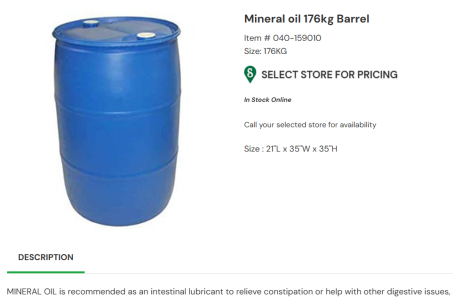
Where can I go to buy a barrel of oil?
In theory, with help, you an 999 friends can buy a minum 1000 bbl crude contract on the equity market. I'm not sure about taking physical possession or reselling it later if thats what you are getting at LOL. Safer to buy a stock or ETF or multitude of 'bets' in the stock market. There used to be a standing joke that played out many times, the physical barrel may be worth more than the oil itself.
 
As I said, do a bit of reading. You might come away a bit surprised.

I will.

I think maybe Calgary pump pricing is not like Ontario. Otherwise you might share my view.

In the meantime I did a bit of research. In general, what I found can be summarized by this summary from AI:

"So the short version: physical origin of the molecules in your tank is almost irrelevant. Price is set by the global marginal barrel, and Canadian producers/refiners aren't going to sell below what the world market will pay."

In other words, my observation is correct. Even though my fuel comes from Canada, I gotta pay the same price on the same day as the middle east gets for their fuel going to Hawaii. Call it what you will. To me, it's Canadian companies gouging Canadian citizens for Canadian resources.

But to be fair, have a look at other indusries with the same lens. Did car companies build sh*tty vehicles that killed people meanwhile declaring profit? Yup. Still happening in fact.

That's just plain popular bull shit Peter. I'd tell you to read about it (LOL), but I'd guess most of what is available to read is sensationalized or creative writing - not the plain boring truth.

I spent my whole career working at one of the major auto companies. That included a major stint in vehicle safety including defect investigation, recalls, and occupant protection. In that entire time, I never met even one engineer or one executive who didn't put safety ahead of profits. Even if you don't believe that engineers have ethics, you must know that these same engineers also drove the products they designed and trusted them to safely carry their families.
 
In other words, my observation is correct. Even though my fuel comes from Canada, I gotta pay the same price on the same day as the middle east gets for their fuel going to Hawaii. Call it what you will. To me, it's Canadian companies gouging Canadian citizens for Canadian resources.
Probably not much different than corn or wheat or any other global commodity.
 
Back
Top