• Scam Alert. Members are reminded to NOT send money to buy anything. Don't buy things remote and have it shipped - go get it yourself, pay in person, and take your equipment with you. Scammers have burned people on this forum. Urgency, secrecy, excuses, selling for friend, newish members, FUD, are RED FLAGS. A video conference call is not adequate assurance. Face to face interactions are required. Please report suspicions to the forum admins. Stay Safe - anyone can get scammed.
  • The 2026 Calgary Area Meetup is set for Saturday May 30th at 10am. The signup thread is here! Robinhood has graciously offered to host the meetup again this year. Please note that you MUST RSVP to the notice linked above if you wish to come.

Really ?

Saw a video recently, that compared the cost at the Ontario Beer Store for a six pack of his favorite IPA, at $3.50/can, vs. buying a can of hopped Malt concentrate off Amazon for $20, adding a kilo of sugar (from personal experience, add another kilo of malt extract!) and some time, to produce the same qty of beer for ~35 cents a can worth. Admittedly a small amount of the price at the store covers packaging, advertising, and transportation, but almost all the price is taxes buried out of sight and not easily seen.

If you were to want a neutral spirit, it is a pretty basic system to learn, agings, flavourings, various factors regarding mouth feel, etc., are pretty easily got from various available flavouring concentrates that can be got through almost any brew shop, if all you want to match, is "cheap scotch". But you will get gallons, for what you paid for a bottle...
Used to make my own beer and wine. SWMBO as she became more 'fussy' liking more expensive wines considered mine too yeasty. I've since bought a filter unit but as yet have not tried it. In fact now about 17 years since I brewed anything. But the filters and some of the other gear do start to jack up the cost.

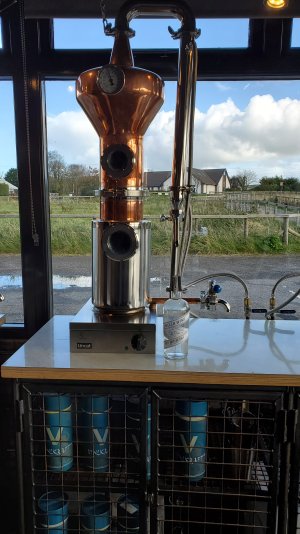
Same with a still (although I would never do something illegal...). Say investment was around $1200. At $34 per bottle it takes about 35 hooch bottles to break even. We're really not supposed to drink more than 5 times per week and no more than 2 per day. That's 40 shots of 45ml or about 900ml so we're talking more than 2 years without ingredients to recover investment.

We did distill some Gin almost two years ago but that was at a distillery in Wales. They even put a custom label on our bottle so we could take it home through customs.
20241019_135835.jpg
 
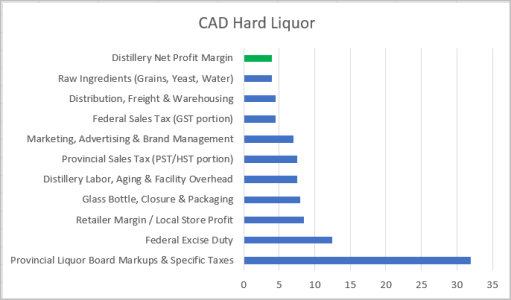
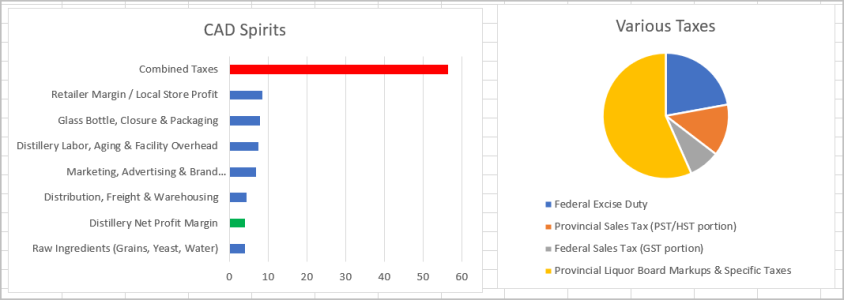
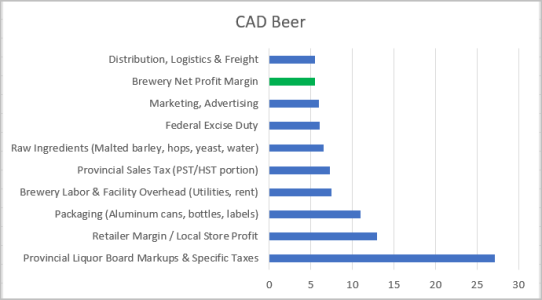
I just had to ask Gemini. Anyone else picking up a common theme with consumer items? Maybe... the entity that doesnt make anything, doesnt produce anything, doesnt risk capex...

1786544992358.png

Because hard liquor (spirits) has a much higher alcohol-by-volume (ABV)—typically 40% compared to beer's 5%—it attracts significantly higher federal excise duties and provincial markups.
For a standard $30–$35 bottle (750 mL) of spirits in Canada, government taxes and liquor board markups routinely account for 55% to 65% of the total shelf price.
1786545036026.png
 
Having to turn on the cruise control every time you turn the vehicle off. In the Avalanche, I turned on the cruise control when we inherited it & haven't had the need since. Just set & go. In the Vibe & the minivan, every time the key gets turned off, ya gotta turn the CC back on before you set it.

Bugs the hell outta me...
I drive a GMC, Toyota, Nissan and a VW and NONE of the them are the same controls for the CC or the wipers and I am either mistakenly turning one off or the other one on whenever I switch vehicles. And the VW is the quirkiest of them all, I have to turn on "econo" mode on AC to turn it off.
 
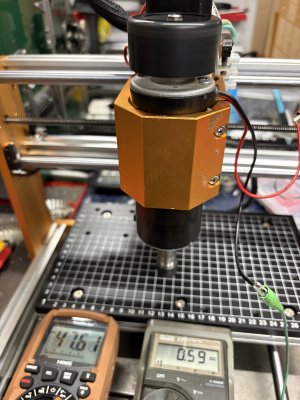
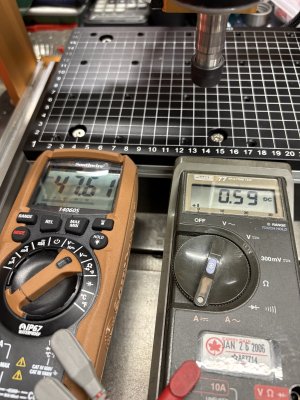
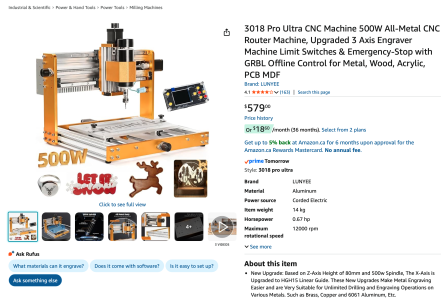
And off on a slight tangent, why does Amazon not need to comply with consumer protection laws? Bought a new-ish CNC router, advertised as having a 48 VDC 500W spindle motor. Spindle motor is 2" diameter x 4-1/2" long. No frickin' way this motor could survive 500W input. So I set it up with a couple of meters and measured current and voltage at no load. Power supply is 48 VDC, rated 11 Amp. No load draw is 0.6 A @ 47.6 VDC. If I heavily load the motor, current rises to about 1 A.

If this motor is capable of 500W output, I'm about to be chosen as the next Pope.

Although, to be fair, the mechanical aspects of this CNC router are actually quite robust. And I got it at a deal, $200 because the controller card is toast. Replaced it with a GRBL card from stock.


IMG_5614.jpegIMG_5615.jpeg
Screenshot 2026-08-12 at 1.43.00 PM.png
 
Amazon and others get away with it because we let them. It takes effort to fight back, and they count on complacency of the genereal buying public to continue with the status quo. Even one or 2 complainers isn't enough to change their ways, the math is on their side when selling large quantities of junk.

So you have 2 ways of dealing with it in our current climate - be selective and don't buy from them, or fight back and try to get some authority involved (likely very hard to do unless you move to europe).
 
No load draw is 0.6 A @ 47.6 VDC. If I heavily load the motor, current rises to about 1 A. If this motor is capable of 500W output, I'm about to be chosen as the next Pope.

(Not a motor guy but willing to learn LOL).
I'm not clear what you mean. 28 watts just to spin the motor = 5% of sticker output, that value by itself means it could never reach 500W somewhere on the torque/rpm curve?
 
(Not a motor guy but willing to learn LOL).
I'm not clear what you mean. 28 watts just to spin the motor = 5% of sticker output, that value by itself means it could never reach 500W somewhere on the torque/rpm curve?
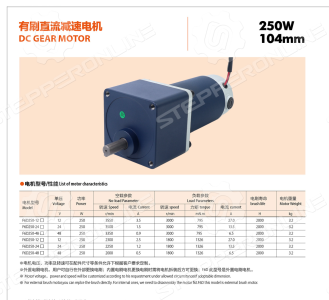
More likely the Amazon values are just utter fabrication. Comparing the Amazon motor to a reputable distributor, Stepper Online sells a 250w 48VDC brushed motor. The S/O 250W motor is twice the diameter, 1.5x the length, and shows 0.9A no load at 48VDC, to a maximum of 6.5A at 90% of no-load RPM. So <maybe> the Amazon motor could get to 500W, but I suspect it would go up in smoke long before it got anywhere near the published value. I did load the motor far beyond what I would expect to see in operation, and it got to a peak of 1A current draw at 48VDC, so about 50 W.

Screenshot 2026-08-12 at 4.45.47 PM.png
 
OK but (my understanding) a no load test is telling you watts consumed just to turn over = cumulative energy lost to internal friction, winding/magnet efficiency etc. right? The shaft cannot turn anything at this zero torque vs rpm coordinate? So if those watts (you measure volts & amps) equates to 5% of rated power and (big if) remains relatively constant, wouldnt that just de-rate the sticker max watts by that amount? So just assuming it was 550W nominal on the sticker, 100-5 = 95% * 550 = 522 watts at some torque/rpm combination? Maybe I'm off base.

The spec chart you shows no load rpm vs load rpm at various voltage & torque combinations. To me these are 'along the curve' data points. But look at calculation below, now I'm more confused
no load 12v * 3.5a = 42 watts 42W/250W = 17% gives 3550 rpm
at load 12v * 27a = 324 watts ... but the motor is rated 250 watts? what gives?
 
Generally motor size is correlated closer with torque output than power output, because you can get more power simply by spinning faster. Comparing the power of a much slower motor is kind of an apples to oranges comparison. Kinda like a 200hp literbike engine vs a 200hp industrial diesel.

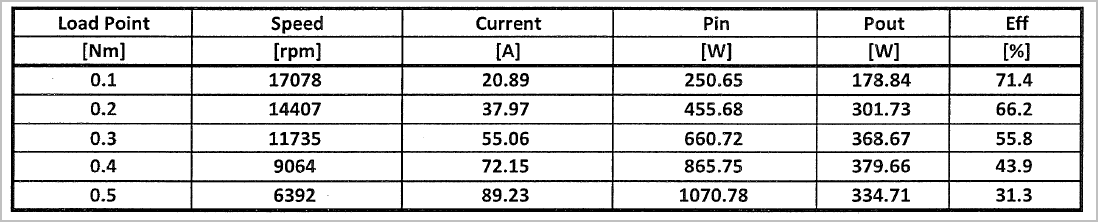
This smaller motor has a peak mechanical output of ~380w but draws ~800w of electricity to achieve it (the 420w in between those numbers becomes heat), at 10,000RPM. See datasheet here. I'm familiar with this motor and trust these numbers.

If you were to dyno that spindle, I suspect there's somewhere where it's at least drawing 500w.
 
Having to turn on the cruise control every time you turn the vehicle off. In the Avalanche, I turned on the cruise control when we inherited it & haven't had the need since. Just set & go. In the Vibe & the minivan, every time the key gets turned off, ya gotta turn the CC back on before you set it.

Bugs the hell outta me...

I hear you guys. Automotive Engineers have tried to develop a standard for such things but there was too much resistance between companies. Everyone agrees it's a good idea but everyone wants their own system or configuretion to be adopted. Some companies also felt they had a competitive advantage with their speed control design and didn't want to share or change. The closest we all got to common standards are the individual ISO symbols used to identify individual functionality. Headlight symbols, wiper symbols, etc, are the same on every vehicle on the road.

Cars and trucks, their styling, their interiors, their power trains, their seating, their instrumentation and controls, etc are all unique in some or multiple ways. Personally, I like the variety and the choice. Some people don't.

Vive La Differance!
 
I hear you guys. Automotive Engineers have tried to develop a standard for such things but there was too much resistance between companies. Everyone agrees it's a good idea but everyone wants their own system or configuretion to be adopted. Some companies also felt they had a competitive advantage with their speed control design and didn't want to share or change. The closest we all got to common standards are the individual ISO symbols used to identify individual functionality. Headlight symbols, wiper symbols, etc, are the same on every vehicle on the road.

Cars and trucks, their styling, their interiors, their power trains, their seating, their instrumentation and controls, etc are all unique in some or multiple ways. Personally, I like the variety and the choice. Some people don't.

Vive La Differance!
I don't like symbols for buttons or switches. Label it in English and leave it alone

Small trucks reached their pinnacle in 1979. Large trucks peaked around 2008.

Engineers have sucked since about 1776
 
This smaller motor has a peak mechanical output of ~380w but draws ~800w of electricity to achieve it (the 420w in between those numbers becomes heat), at 10,000RPM. See datasheet here. I'm familiar with this motor and trust these numbers.

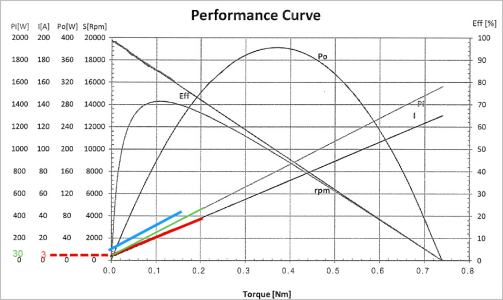
Now this datasheet makes sense to me. I assume Pin (power in) is volts * amps = watts. Pout (Power out) also converted to watts, is actual at the shaft or 'brake'? Each load point combination of parameters is an X,Y point coordinate on the chart, X=Torque, Y=whatever. This makes the curves or lines depending on the parameter. Pin is always greater than Pout. The ratio between is efficiciency. Am I getting it so far?
So maybe this explains potential confusion of random motor with no chart but a single power value 550W. Is it maximum torque at 20% efficiency an a few degrees from melting? Is it at maximum efficiency? Is it Pin or Pout? Technically they may not even be lying, but without more information or actual brake test we dont have a clue.
1786631416970.png

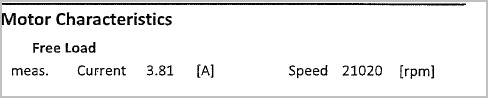
and they referernce free load as a line item, expressed as amps & rpm
1786632396563.png

Carrying on, maybe I'm on a roll. The no-load value are the Y coordinates at X = Torque = 0. So 3A (green) looks right. Or about 30 watts Pin. Its consuming power without the shaft doing any work.
Not exactly sure if that is measured directly or extrapolated but what I was trying to say a few posts up is knowing this value alone, we dont really know what the motor is capable of; the curves extending to the right. Say I had a cheaper motor (blue line). My gap is higher, its for sure less efficient but where does it extend from there?
Am I on the right track?
1786633093819.png
 
Am I on the right track?

Yep. Everything is good so far (at least for a brushed DC motor like the ones we're discussing). You'll also notice on the right side mechanical power (and efficiency) drops to zero because RPM drops to zero. It's not doing any work because it isn't moving, but the motor is drawing it's maximum electrical power and delivering it's max torque. Peak mechanical power is in the middle - at half free speed and half stall torque.

You can make a reasonably accurate graph if you have the free speed (RPM), free current (A), Torque at a given RPM (N-m), and current at that same RPM (A). You can choose 0 RPM for these values too (stall torque/current), but be careful because stalling motors like the one I posted turns them into single use smoke machines.

An easy way to estimate stall current pretty accurately is to disconnect the motor and measure the resistance across the motor leads. I=V/R so you just divide the supply voltage by your measured resistance to get your current estimate.

You can estimate stall torque using a calculated torque constant, but real life torque tends to vary. Unsurprisingly, a real dyno is the best way to evaluate a motor.
 
Last edited:
Not gunna happen Dave. In Canada it would have to be bilingual and in the US also in Spanish!
I learned about Mexican whistling the other day. Apparently the most common whistle in the 'hood means I need help, or come here. Buddy said if I spend more time on jobsites working with them, I would likely start learning what the different ones are. I guess like any language you just need to be around it and using it
 
I don't like symbols for buttons or switches. Label it in English and leave it alone

Small trucks reached their pinnacle in 1979. Large trucks peaked around 2008.

Engineers have sucked since about 1776
Mine is a 19. Left front turn signal stopped working, should be an 1157, a buck or two. Nope the whole unit has to be replaced, 100 bucks wholesale for the part.
Really ?
 
Back
Top