• Scam Alert. Members are reminded to NOT send money to buy anything. Don't buy things remote and have it shipped - go get it yourself, pay in person, and take your equipment with you. Scammers have burned people on this forum. Urgency, secrecy, excuses, selling for friend, newish members, FUD, are RED FLAGS. A video conference call is not adequate assurance. Face to face interactions are required. Please report suspicions to the forum admins. Stay Safe - anyone can get scammed.

Laser Engraving

I am not sure I understand the path of the laser beam, does it travel back and forth, running parallel to each previous path? If so, an area that it travels over, that has already been etched to finished height or depth, the laser beam is shut down or stopped until it comes to the next area to be etched deeper and restarts/continues. If this is the case, the more that is removed/etched away, the less the laser runs, but this does mean that there is travel time but no laser power time. If the unit does do this it should not heat up as much as the etching progressed deeper.
The travel time when not extruding, appears to be faster then when extruding on my filament 3d printer.
 
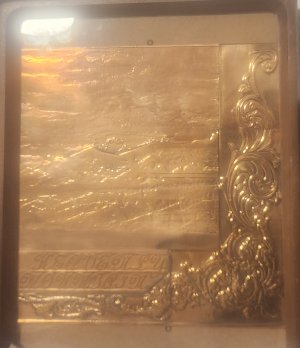
The 3d sliced mode follows a grayscale image on a repetitive parallel path as you described, but the difference in depth according to the grayscale is achieved by changing the level of power the laser uses rather than the number of passes, in accordance to the darkness on the image. The settings of the 3d slice require both the maximum and minimum power, and the frequency and speed for every pass.
 
The fact that there are many areas on the image that stand out points out that a high percentage of every pass was not at full power or any power at all. I'm thinking this is why it did not overheat over such a long run.
 
After googling the Gwieke 50W laser, it's apparent why it struggled with that substrate, being only a Q-switched laser source doesn't give any opportunity to control pulse width which would make it easier for the laser to ablate. Copper is of course the worst substrate for even a MOPA but would have completed the task much quicker.
 
1000006167.jpg
After finishing this bronze plaque, and a smaller brass plaque I got more ideas and finished designing the next plaque, but found that my fiber laser had crashed and wouldn't even turn on.
I've contacted Gweike over the warranty, and they told me to test the electric power supply. The power supply doesn't work, so they confirmed they would send me a new power supply for repair.

Though they are sending me the electric power supply, I'm thinking that is not the only thing that is blown. When I opened the case to test the supply the machine was filled with vaporized metal dust which must have damaged other parts.

My plaques are some of my most popular items, so Im depating on investing in an upgraded machine like the Xtool F2 ultra 60w mopa/40w diode laser or the Acmer 100w mopa laser. I still have the d2pro and I don’t engrave much non metalic material; so I'm not sure how much benefit there would be in the additional 40w diode in the F2 ultra.
 
What have you engraved so far? The 8" work area, full enclosure and cameras of the F2 Ultra are what catch my attention, but most of the engraving I do is very demanding.
I'm not sure how much difference a power enhancement of only 60w would be from 50w of the gweike g2 max.
The Acmer SM is a 100W mopa laser, but it is a open frame.
 
Back
Top