• Scam Alert. Members are reminded to NOT send money to buy anything. Don't buy things remote and have it shipped - go get it yourself, pay in person, and take your equipment with you. Scammers have burned people on this forum. Urgency, secrecy, excuses, selling for friend, newish members, FUD, are RED FLAGS. A video conference call is not adequate assurance. Face to face interactions are required. Please report suspicions to the forum admins. Stay Safe - anyone can get scammed.

JCDammeyer's 42 projects

Somehow I think there was still too much wobble along with the backlash issues. I even tried doing a profile with a 4 flute 3/4" mill (0.75") which didn't even touch the existing cut. I changed the cutter diameter in the CAM software to be 0.74" and then it cleaned up a bit of the surface but still not all. I guess I could have gone smaller by another 0.01" but I didn't want to make the base smaller than the 3D print.

I'm also going to guess that for a 1/2" piece of metal perhaps a 6mm 2 flute is perhaps too fragile and deflects easily.

In either case... I'm done with this piece. So much more to build and wire.
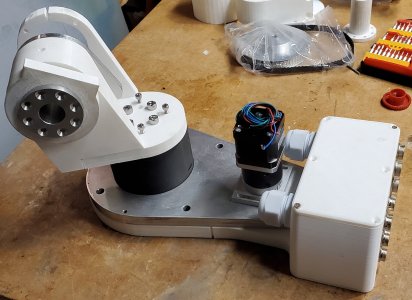
BasePlateComplete.jpg
 
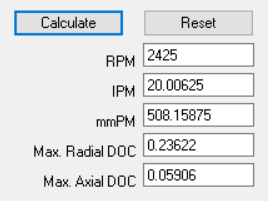
Here's a close-up of the milled edge. When I used Machinist toolbox to figure out parameters I didn't select slotting and that is in fact what I was doing so the depth of cut should have been 1.5mm (0.059") not 2 mm but otherwise I was way slower than what would be used by a HAAS.

1765480562793.png

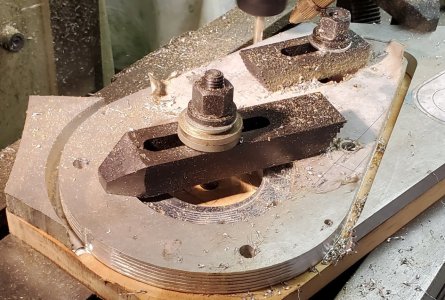
Pretty rough unless motion is inline with one of the axis. I'm going to guess backlash is still a significant problem even with LinuxCNC backlash compensation.

BaseMilledOut.jpg

Suggestions? I still have a few more pieces to cut out.
 
Hi John,

I've not done any CNC but have you tried full depth and a slow feed ? In alloy that works for me. Also lots of WD40 or ATF and paraffin mixture, about three paraffin to one ATF.
 
When I slot profiles like that I always leave 0.003-0.005" on the xy at every z pass, then come back at a zero offset for a full depth pass. Sometimes I'll do another spring pass too if I really want a good surface finish. Depends on the cutter I might reduce the feed to 80% or so too.
 
Hi John,

I've not done any CNC but have you tried full depth and a slow feed ? In alloy that works for me. Also lots of WD40 or ATF and paraffin mixture, about three paraffin to one ATF.
That's too big a load for the small cutter. What's fascinating is that the other side of the cut was smooth. I may try climb milling instead of conventional.
 
When I slot profiles like that I always leave 0.003-0.005" on the xy at every z pass, then come back at a zero offset for a full depth pass. Sometimes I'll do another spring pass too if I really want a good surface finish. Depends on the cutter I might reduce the feed to 80% or so too.
Yeah, I had that setting set at 0.01mm tolerance and should have had it bigger so I could do a nice full depth pass around the circumference. I'll do that on the next. But even with that bigger 0.75" 4 flute set has having a diameter of 0.74 it didn't take off the crap.

I finally gave up and pulled it off the mill. Maybe next piece will be better.
 
FYI - I think CNC stands for Crunch 'N Crash... at least it does in my shop until I've blown off the summer cobwebs.
Definitely try climb milling for CNC work, thats the default when picking a CAM operation in Fusion anyways and the theory/practice is that the cutting edge enters with a "full bite" and the chip gets progressively thinner until its parted from the surface. The down side is the self feeding tendency that can break endmills on loose machines with backlash.

I've switched to carbide from China for all my learning CNC activities. Its really cheap, and the improved rigidity of a carbide tool over HSS is well worth the small difference in price as long as you stay away from the large stuff. I tend to favor 6mm as a go to tool for a lot of work, as I'm not a job shop and material removal rate is nearly meaningless to me and that size will do a lot for little $.
A 6mm endmill can usually be had for about $7 for 1 or $5 for 5. Its also happy running at the max rpm (~5100) of my mill , which is well below the cutters ideal rpm but it doesn't seem to cause any issues.
 
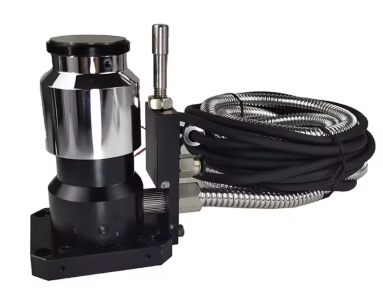
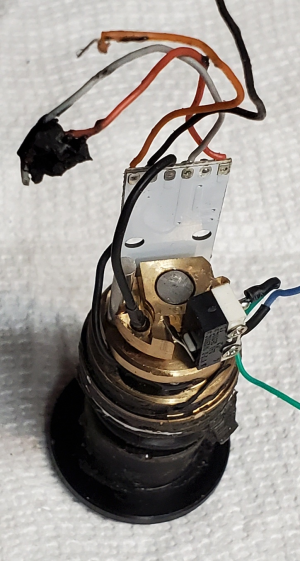
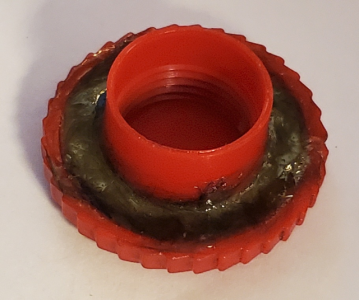
This is what had an 8mm drill bit embedded into it.
1765497808506.png

I paid $110 for it. No longer available with a listed price of $146. I ordered a different one from Amazon for $55 which is about the same as AliExpress once shipping is included.

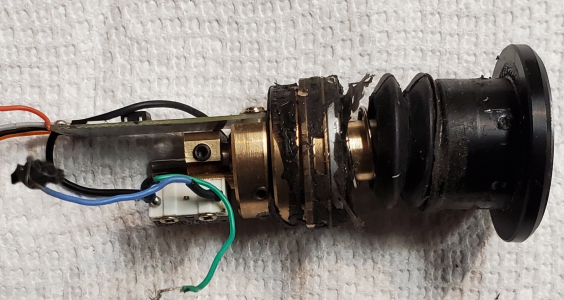
So what do they look like inside?

1765498582661.png

The little brass part slides towards the chip on the other side. Some sort of capacitive coupling.

1765498640593.png
 
FYI - I think CNC stands for Crunch 'N Crash... at least it does in my shop until I've blown off the summer cobwebs.
Definitely try climb milling for CNC work, thats the default when picking a CAM operation in Fusion anyways and the theory/practice is that the cutting edge enters with a "full bite" and the chip gets progressively thinner until its parted from the surface. The down side is the self feeding tendency that can break endmills on loose machines with backlash.

I've switched to carbide from China for all my learning CNC activities. Its really cheap, and the improved rigidity of a carbide tool over HSS is well worth the small difference in price as long as you stay away from the large stuff. I tend to favor 6mm as a go to tool for a lot of work, as I'm not a job shop and material removal rate is nearly meaningless to me and that size will do a lot for little $.
A 6mm endmill can usually be had for about $7 for 1 or $5 for 5. Its also happy running at the max rpm (~5100) of my mill , which is well below the cutters ideal rpm but it doesn't seem to cause any issues.
Best I can do is 3000 RPM unless I design a new set of pulleys and odds are the bearings wouldn't like it. Those would have to be replaced.

I found using larger end mills and climb milling that it did sometimes dig into steel and pull the table. But that was slow speeds and a 1/2" end mill and steel.

I may just set up an experiment with the HSS 6mm mill and try climb with the 2500 RPM, 5 IPM and only 1mm depth of cut. Will take longer but maybe no deflect and cleaner surface.

Definitely a learning thing.
 
However when it all works right it's really magic. I've made over 100 of the little front panels on my CNC router. Just a bunch of holes and a special jig but press go and walk away and do something else. Come back and remove, insert new piece and repeat.

I used my ELS way back to wind coils. Inserted the hub, pressed start to thread and after 77 turns it stopped. Cut wire. Do another one.

There are nice things about automation for multiples because then we can practice till we get it right an after that churn out the parts.

It's the one off that is killing me...
 
Back
Top