140mower
Don
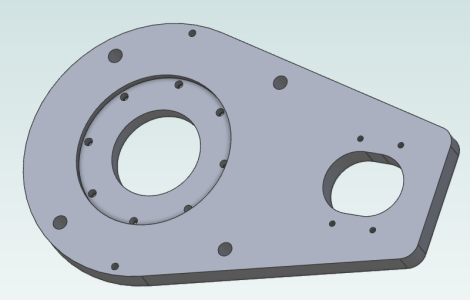
So are we, but fortunately, they are your endmills. 🙄 😛Well time to try and cut out a 1/2" piece of aluminum. G-Code all ready to go.
View attachment 74441
I'm afraid...

So are we, but fortunately, they are your endmills. 🙄 😛Well time to try and cut out a 1/2" piece of aluminum. G-Code all ready to go.
View attachment 74441
I'm afraid...

I'm about to do the first step which will verify things. Centre drilling all the locations for holes.Did you air cut first just a little bit? For scary programs I usually have it run the code so that the lowest move will still be above the material, and I can get a feel for how its going to go. Can't always do that if its a really long program, but helps build confidence that Z moves are ok.
It's this hole right here. Quite possible the broken part doesn't even go down that far or if it does just barely. The target surface is 4mm down. The centre drill part is less than 4mm diameter but the tapered part of the drill may also be stuck in there above the expected surface.Can you do a little circular interpolation on that hole? 4mm end mill would do it but better to use it like an end mill and cut from the side and not plunge in. Don't want a layer cake of HSS and carbide on aluminum.
Carbide drill can do it too, but I find it sketchy the few times I've tried. If it doesn't cut, it will deflect and break if its a small drill. You'd need to use the biggest the hole will allow.
Good luck, sucks to start a part like that. Hopefully it gets better.
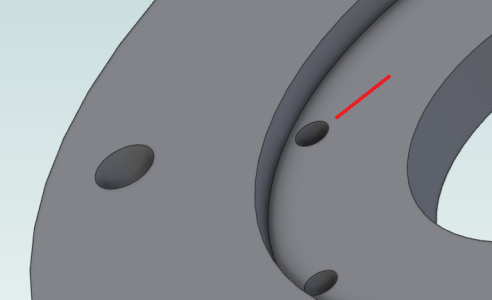

What are the stock dimensions?It's this hole right here. Quite possible the broken part doesn't even go down that far or if it does just barely. The target surface is 4mm down. The centre drill part is less than 4mm diameter but the tapered part of the drill may also be stuck in there above the expected surface.
And truthfully it's not likely a real issue if I never even used that hole. The amount of stress won't be that high. But I'm upset. I don't have any other stock that that this piece could fit on. First step is to acquire a carbide end mill to remove the garbage now in the hole.
View attachment 74452

But I'm upset. I don't have any other stock that that this piece could fit on. First step is to acquire a carbide end mill to remove the garbage now in the hole.
the part would just fit inside 6"x10"x1/2". This is the reason I like casting. Make a mistake. Melt it down and recast it.What are the stock dimensions?
Not wide enough to turn. I have a 1/4" carbide router bit that I could plunge down 4mm and then take a look to see if there's any more of the drill bit below that.Hey John, if you don't have enough stock to make another one, why don't you just plug all the holes and then clock it 15 degrees or so or whatever makes sense.
I know that isn't ideal, but it would get you going again.
I have a big chunk if you need some 1/2" plate.the part would just fit inside 6"x10"x1/2". This is the reason I like casting. Make a mistake. Melt it down and recast it.
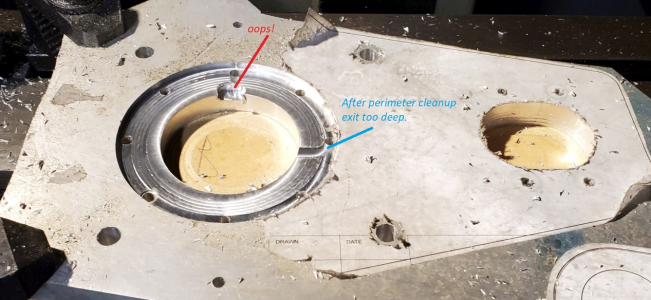

You are right. Not even close to being faster other than cutting out the profile shape perhaps.Maybe I'm just too stuck in the past, but how is all this CNC-ing faster than using a boring head? Align mill, cut the centre hole as big as possible with a hole saw, bore to finished size, bore outer recess, lay out bolt holes, drill & tap. It's aluminum, a carbide boring bar goes through that stuff like butter. That's how I occasionally make pipe flanges and modify valve bodies using my mill, and I'm a hack at best.
No matter which way we look at it I think education is expensive.

rotary table, and milling it?I didn't have a tool on hand to use with the boring tool to cut the larger recess which centres the turret holding bearings. In the past I've mounted that sort of thing on the lathe face plate but it's too large so that wasn't an option either since it would require a 12" lathe. Maybe the recess isn't needed but I'm trying to follow the plans.
Actually you and @Susquatch are correct. Since I spray glued the drawing onto the plate to be able to orient it to fit on the mill (just barely) drilling the first hole with a hole saw and then using the boring tool to clean it up to dimension would have been the best way.rotary table, and milling it?
I see every experience as a learning opportunity. This project, along with these messy issues, hopefully won't discourage you too much. I am vicariously learning about CNC stuff from your travails!