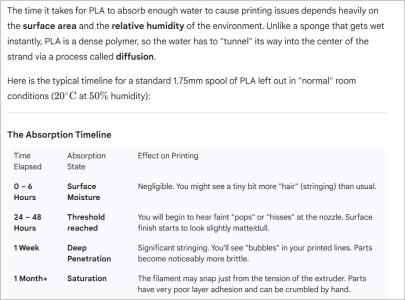
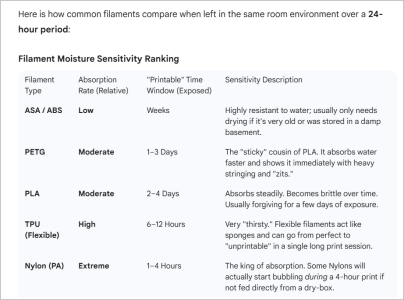
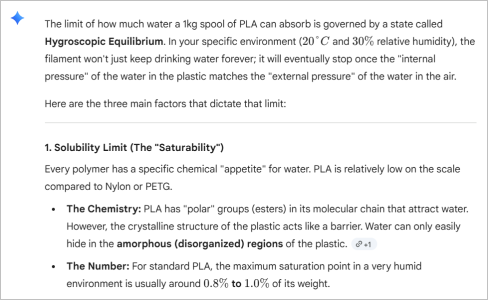
My crazy curiosity got the best of me Peter. I did some more research.....
It turns out that my foolish assumption that PLA would act a lot like air does actually has some merit. That doesn't excuse me for making assumptions though. It was definitely not the wisest thing I've ever done.
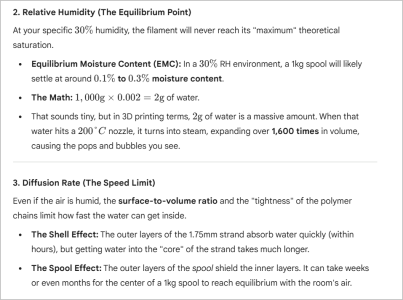
What I found is that the ability of PLA to hold water actually is somewhat similar to air. Your data was for room temperature PLA. So I went looking for low temperature data. There isn't much, but there is some.
One particular study showed that PLA holds 10x the amount of water at room temperature as it does at freezing! That's very significant!
Although it's only one study, I think we can trust it because it makes intuitive sense. That's what got me into trouble in the first place so why not also let it be the way to get me out of trouble!
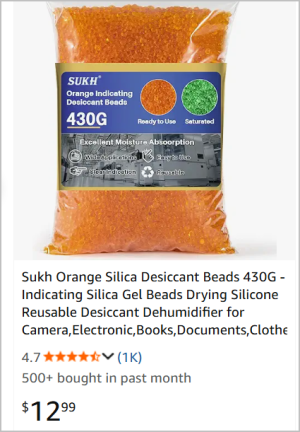
If you think about how a filament dryer works, there are two scenarios. Both involve water leaving the PLA to be distributed in the air where it can be absorbed by a dessicant or by a physical dryer. Basically, the dryer and the dessicant dry the air causing moisture in the PLA to be out of equilibrium so the water from the PLA migrates to the air to reach equilibrium, where it is removed, and so the cycle continues until the PLA is dry.
That same relationship must coexist at lower temperatures.
This leads to the somewhat abstract idea that one way to dry PLA might be to store it in a fridge equipped with frost removal (frost free fridges and freezers).
That's actually an easier solution than opening and closing containers in the freezer. Just stick the container and fillament in the fridge for a few days with the lid off. Then add the lid to seal the container and put it with the printer. No need for dessicants.
It seems that I have a lot of time before my printer arrives. So I think I will order some PLA and conduct a few tests to evaluate my idea.
I'd appreciate your thoughts about this
@Arbutus &
@PeterT.
Actually, I'd appreciate everyone's thoughts!