• Scam Alert. Members are reminded to NOT send money to buy anything. Don't buy things remote and have it shipped - go get it yourself, pay in person, and take your equipment with you. Scammers have burned people on this forum. Urgency, secrecy, excuses, selling for friend, newish members, FUD, are RED FLAGS. A video conference call is not adequate assurance. Face to face interactions are required. Please report suspicions to the forum admins. Stay Safe - anyone can get scammed.
  • The 2026 Calgary Area Meetup is set for Saturday May 30th at 10am. The signup thread is here! Robinhood has graciously offered to host the meetup again this year. Please note that you MUST RSVP to the notice linked above if you wish to come.

Tips/Techniques Filament Recommendations

Tips/Techniques
This is directionally a great idea. But may I suggest putting it in the bag while the bag is inside a chest freezer.

Squeezing warm air out of the bag still leaves wet air inside the bag which the dessicant must remove.

Cold air inside the freezer can't hold much water so when you close the bag, and then remove it from the freezer the air inside will be dry.

Winter air is just as good.

This applies even more so to containers like @Doggggboy uses because they hold more air.
10% in my containers in the shop right now, goes up to maybe 20-25% in the summer while the shop itself will 50-60%
 
I would really recommend you start off with the Bambu filament. As was mentioned earlier the printer will automatically optimize the settings so there is no tuning effort on your part. It will just work. Once you have been printing a bit you can try others. Generally Bambu filament price is very reasonable. Yes you can save a bit with generics but it is not a big difference.

PLA is the most common filament. It is the easiest filament to have good results with. For most generic things this works fine. If you need higher mechanical strength, or UV stable then you will look elsewhere.

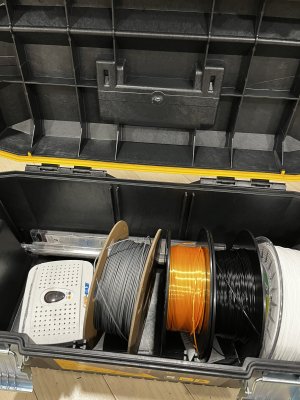
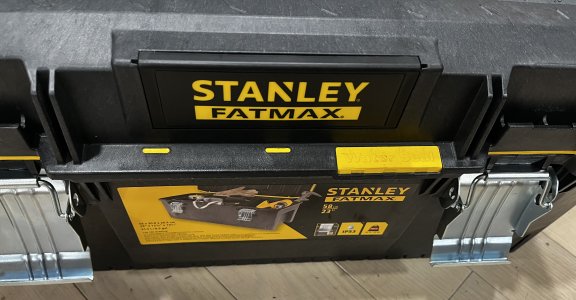
For storage I use a Stanley toolbox I found with a gasket seal. Just bought it at Canadian tire if I remember correctly. Holds several rolls of open filament and I just place a rechargeable gun safe dessicant pack in there to help.

IMG_7542.jpegIMG_7543.jpeg
 
Did I do my GoogleFu & math correctly? Today, inside my 20C house on this -30C MF! Calgary day, the humidity is 20%. I can spot weld through my finger tips walking across the carpet.

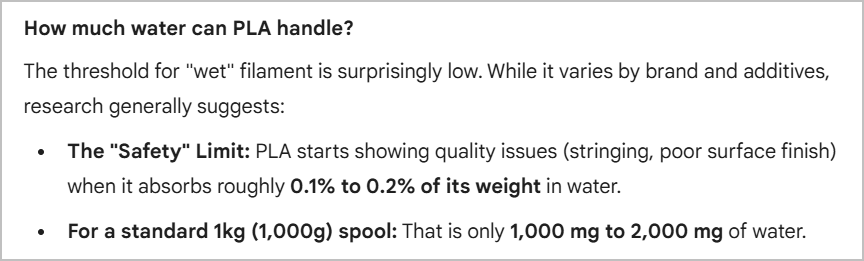
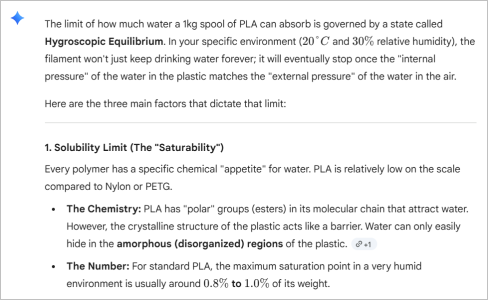
This is supposedly the water threshold of PLA per kg
1771466347852.png

If my ziplock storage bag holds 1 liter of air (which is pretty lazy packing) that air holds 3.46 mg water at 20C. 17.3mg at 100%. Yes the cold air thing reduces it, but to put that in perspective apparently 1 human breath is 20-30mg water at 37C body temp, so no huffing in the bag!
1771466449242.png

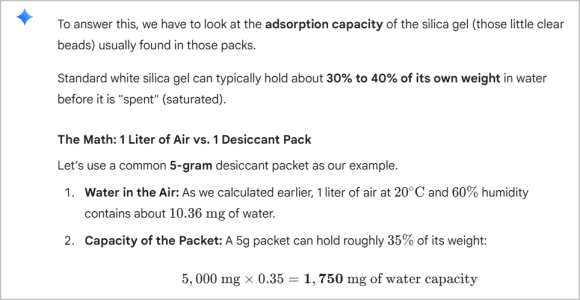
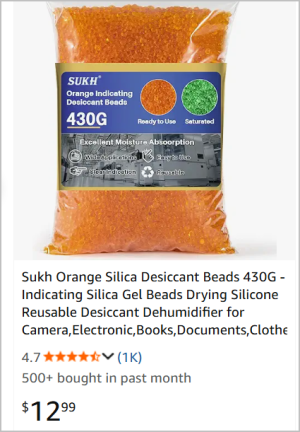
Throw in a silica gel pack & zip it up. It has the capacity to remove 1750 mg water. (Yes plastic bag is slightly permeable, ignore that for now)
Conclusion, the silica adsorption capacity is orders of magnitude higher than trapped air. Its going to pull water out of the filament. A good thing.
1771466689432.png

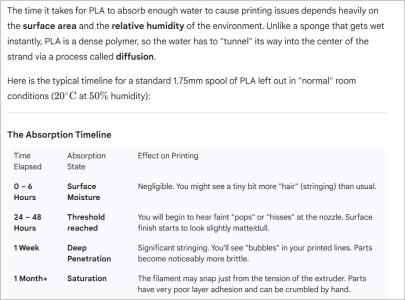
I think this is the core issue. It actually doesn't take long for exposed PLA filament to absorb ambient water before its problematic in high humidity conditions. This is crazy, what about those 8-12 hour print jobs you hear about? So 'storage' as in 'seal' isn't the concern at all. It really needs to be 'dehydration'. Probably why the new fangled printers don't mess around & have those features integrated.
1771467657213.png

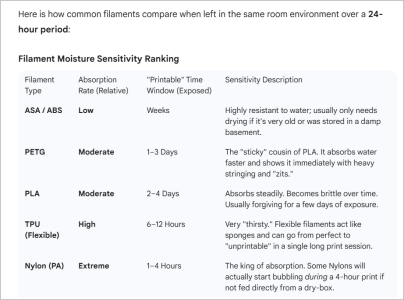
other filaments
1771467657219.png
 
Did I do my GoogleFu & math correctly?

I think you did a great job.

When I wrote that, there was this little guy in the back of my head screaming at me that I don't know the relative humidity of the Filaments. You have just shown that it can hold a lot more water than the air can. So using dry air doesn't really help much. My bad for not checking first.

That said, you wouldn't happen to know how the relative humidity for filament changes with temperature do you? I bet you can guess where that is going......

But now I'm confused. @Arbutus suggested that PLA isn't hygroscopic. So how does it hold so much water?
 
Most of us printed for many years with PLA before the dryers came out. I don't recall any PLA issues, but back in the day, PC and Nylon were nearly impossible to print without ambient heat and dried filament. I don't print much PLA any more, but I have many old spools that are unsealed and have been for a long time. My last PLA print was one of these old spools and there were no print issues at all.

So who knows?
 
Could it be that moisture issues with PLA is a geography issue and folks in the dry parts of Canada don't have the same problems as folks in the humid parts of Canada?
 
Most filaments print well if stored long term in an environment with 20% or less humidity. PLA and ABS will print well if stored long term in an environment below 40% Rh so there will definitely be some regional differences.
 
Guy who got me into FDM stuff has a whole room of his house dedicated to his nerd interests that's climate controlled, humidity and temperature.

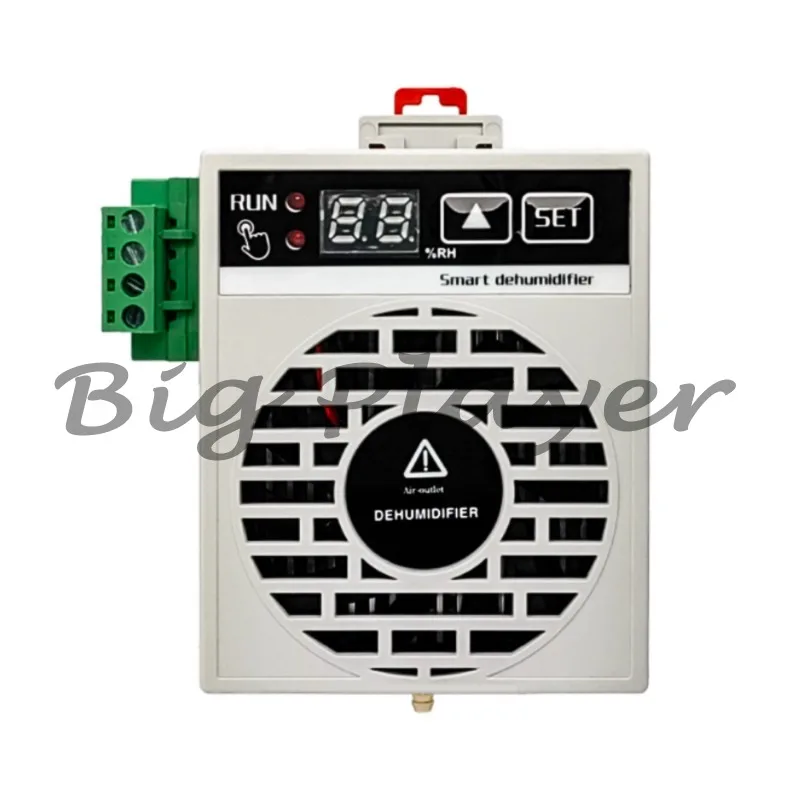
If you have the option, even a little dehumidifier can keep your shop space a tad less rusty, and your filaments and powders safer. . .

I don't have a lot of trouble with water infiltration into FDM filaments, but I print a lot more PETG than anything else thesedays, just hits the sweet spot for most things. . . on occasion I buy a nice PLA for its aesthetic characteristics, usually for a Numismatic job or making statuary.

CUBES!.JPG
 
Guy who got me into FDM stuff has a whole room of his house dedicated to his nerd interests that's climate controlled, humidity and temperature.

If you have the option, even a little dehumidifier can keep your shop space a tad less rusty, and your filaments and powders safer. . .

He sounds a lot like me. One can only describe my interest in corrosion vs humidity and temperature as nerdish. I am an engineer and I studied humidity and corrosion during my career. I even established a corrosion research center at my automotive employer. I've written about shop corrosion on the forum many times. Here is one of those threads

 
Did I do my GoogleFu & math correctly? Today, inside my 20C house on this -30C MF! Calgary day, the humidity is 20%. I can spot weld through my finger tips walking across the carpet.

That said, you wouldn't happen to know how the relative humidity for filament changes with temperature do you? I bet you can guess where that is going......

My crazy curiosity got the best of me Peter. I did some more research.....

It turns out that my foolish assumption that PLA would act a lot like air does actually has some merit. That doesn't excuse me for making assumptions though. It was definitely not the wisest thing I've ever done.

What I found is that the ability of PLA to hold water actually is somewhat similar to air. Your data was for room temperature PLA. So I went looking for low temperature data. There isn't much, but there is some.

One particular study showed that PLA holds 10x the amount of water at room temperature as it does at freezing! That's very significant!


Although it's only one study, I think we can trust it because it makes intuitive sense. That's what got me into trouble in the first place so why not also let it be the way to get me out of trouble!

If you think about how a filament dryer works, there are two scenarios. Both involve water leaving the PLA to be distributed in the air where it can be absorbed by a dessicant or by a physical dryer. Basically, the dryer and the dessicant dry the air causing moisture in the PLA to be out of equilibrium so the water from the PLA migrates to the air to reach equilibrium, where it is removed, and so the cycle continues until the PLA is dry.

That same relationship must coexist at lower temperatures.

This leads to the somewhat abstract idea that one way to dry PLA might be to store it in a fridge equipped with frost removal (frost free fridges and freezers).

That's actually an easier solution than opening and closing containers in the freezer. Just stick the container and fillament in the fridge for a few days with the lid off. Then add the lid to seal the container and put it with the printer. No need for dessicants.

It seems that I have a lot of time before my printer arrives. So I think I will order some PLA and conduct a few tests to evaluate my idea.

I'd appreciate your thoughts about this @Arbutus & @PeterT.

Actually, I'd appreciate everyone's thoughts!

 
I use the same type of large container as Doggggboy to store my rolls along with relatively large desiccant container with the microwavable (to redry) reusable desiccant. I use these in my RV and old dodge for winter storage as well. I've also used that type of desiccant for air tool inline dryers that change from blue to red/pink when they become 'wet'.

I haven't been printing for long so I'm still learning but for been exclusively using PLA in my Bambu A1... love that thing man, its addictively mesmerizing to sit and watch lololol
 
That's actually an easier solution than opening and closing containers in the freezer. Just stick the container and fillament in the fridge for a few days with the lid off. Then add the lid to seal the container and put it with the printer. No need for dessicants.
I get the intent of temperature & dryness but it seems complicated. A freezer brings up new unknowns. Water expands below freezing. Doubtful even humidity saturated filament has enough water content to mechanically damage the material. But when you remove the (now frozen ) material I can see new issues just related to temp. Plastic becomes brittle so any jostling might induce cracking the printer wont appreciate. Also you have to keep it sealed for X time until fully room temp stabilized or its going to attract condensation on its surface which is what were trying to avoid.

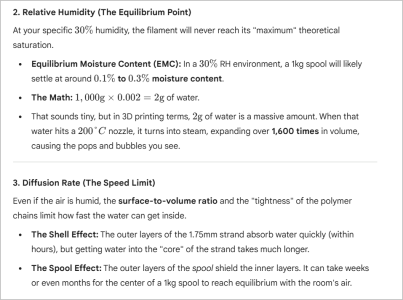
Not sure if this is accurate but its suggesting fully a fully saturated 1kg PLA spool could absorb max at 2g = 2000 mg water in dry Calgary. A single (5g) silica bag almost covers it at 1750 mg, 2 bags would pull 3500g. It was shipped new in a vacuum sealed bag with 1 packet. Now soggy weather geography at say 60% could be 7g = 7000mg at 20C. Yes I can envision why the same print job could be problematic. Still, 4 silica packs would cover it.

1771516056087.png1771516081151.png
1771515462662.png
1771515487106.png
 
My crazy curiosity got the best of me Peter. I did some more research.....

It turns out that my foolish assumption that PLA would act a lot like air does actually has some merit. That doesn't excuse me for making assumptions though. It was definitely not the wisest thing I've ever done.

What I found is that the ability of PLA to hold water actually is somewhat similar to air. Your data was for room temperature PLA. So I went looking for low temperature data. There isn't much, but there is some.

One particular study showed that PLA holds 10x the amount of water at room temperature as it does at freezing! That's very significant!


Although it's only one study, I think we can trust it because it makes intuitive sense. That's what got me into trouble in the first place so why not also let it be the way to get me out of trouble!

If you think about how a filament dryer works, there are two scenarios. Both involve water leaving the PLA to be distributed in the air where it can be absorbed by a dessicant or by a physical dryer. Basically, the dryer and the dessicant dry the air causing moisture in the PLA to be out of equilibrium so the water from the PLA migrates to the air to reach equilibrium, where it is removed, and so the cycle continues until the PLA is dry.

That same relationship must coexist at lower temperatures.

This leads to the somewhat abstract idea that one way to dry PLA might be to store it in a fridge equipped with frost removal (frost free fridges and freezers).

That's actually an easier solution than opening and closing containers in the freezer. Just stick the container and fillament in the fridge for a few days with the lid off. Then add the lid to seal the container and put it with the printer. No need for dessicants.

It seems that I have a lot of time before my printer arrives. So I think I will order some PLA and conduct a few tests to evaluate my idea.

I'd appreciate your thoughts about this @Arbutus & @PeterT.

Actually, I'd appreciate everyone's thoughts!
Don't forget that as the air cools the relative humidity rises. So by cooling the equilibrium you mentioned might shift towards moisture migrating back into the filament. This is why filament dryers are typically heaters not coolers.
 
Peoples' experiences with filament drying vary so much it's interesting. Everybody has a different strategy and outcome, some bordering on superstition (also practicality depends on how much filament you store). My strategy is to use up hydroscopic material quickly, and not care about PLA. I'll do something more rigorous later.

Some neat edu-tainment on the topic:

I haven't tried it but I think this is one of the few cases where a peltier "cooler" makes perfect sense. You bring air in, cool it with the cold side to condensate water, then push that dry air over the hot side to heat it up. The low efficiency of the Peltier is fine, especially when compared to the typical resistive electric heaters in normal filament driers. I'm 90% sure that's what this does:

 
Last edited:
Back
Top