• Scam Alert. Members are reminded to NOT send money to buy anything. Don't buy things remote and have it shipped - go get it yourself, pay in person, and take your equipment with you. Scammers have burned people on this forum. Urgency, secrecy, excuses, selling for friend, newish members, FUD, are RED FLAGS. A video conference call is not adequate assurance. Face to face interactions are required. Please report suspicions to the forum admins. Stay Safe - anyone can get scammed.
  • The 2026 Calgary Area Meetup is set for Saturday May 30th at 10am. The signup thread is here! Robinhood has graciously offered to host the meetup again this year. Please note that you MUST RSVP to the notice linked above if you wish to come.

Other Basic Electronics, Multimeters, & Oscilloscopes

This thread is about basic electrical, electronics, Multimeters, and Oscilloscopes. It is an outcome of interest that various members have expressed about these subjects.

@Janger , @Johnwa , and @kevin.decelles have all recently obtained a starter Oscilloscope so I think the timing is good for a thread like this.

The primary resource will be a book (available on Amazon in paper or kindle) called Electronics for Dummies by Kathleen Shamieh. The book isn't a requirement, but it always helps to have a reference of some kind to facilitate discussion. Other references might get added as the thread progresses.

I'm not picturing this thread as a course, just a good place to ask questions, find answers, and share knowledge and experience about basic electrical knowledge and testing.

As always, a good time and lots of great jokes are expected!
 
My 1" scope was built from a circuit in the Aug. '60 issue of Popular Electronics mag. It uses 2 6AU6s, one as the vert amp and the other as the horiz sweep osc. I ordered the CRT from the UK, can't remember the exact price but I think it was around $10, a lot of money for a 16 year old back then! When I first built it, it wouldn't work, took it to a friend's dad who fixed TVs and he couldn't find anything wrong with my wiring. Eventually after a lot of head scratching we found that the tube pins were numbered wrong on the schematic in the mag. After re-wiring the tube sockets everything worked as advertised.
John
 
Hi John, Guys,

That happened a lot in those days, lots of corrections in following issues. It still happened with the advent of IC's. Numbered from the wrong side or worse from the wrong end. Somewhere I still have a digital clock that I built from a magazine, the circuit was numbered backwards, fortunately I purchased a PCB for it which was correct.
 
@JohnP
@BaronJ

There have been a few times where I have believed to have built a circuit exactly as the diagram shows and it fails to work. Naturally, my first instinct is to assume "OK, what did I get wrong this time". It's both rewarding and frustrating, usually after hours or days of troubleshooting, to find out that I did nothing wrong according to the diagram except that the diagram is wrong.😀 The availability of reading online comments following someone's posted design is a wonderful feature for amateurs like myself. I have learned the hard way that I need to read all the following comments where the publisher or commenters will sometimes reveal corrections.

Just the other day I was looking online at an AD8307 based RF power meter circuit published 2001 in QST Magazine. I kept searching and found more variations where one author mentions his version is based on the 2001 QST Magazine version and that one of the devices in the diagram is "not shown correctly".
 
Hi Guys,

Yes I've seen that article and obtained the AD8307 in order to build it, which I never got around to doing. I do believe that there was a sample PCB available for that project. I doubt that it is no longer available.
All my copies of QST have been consigned to the paper salvage, so I no longer have reference to them.
 
There have been a few times where I have believed to have built a circuit exactly as the diagram shows and it fails to work. Naturally, my first instinct is to assume "OK, what did I get wrong this time". It's both rewarding and frustrating, usually after hours or days of troubleshooting, to find out that I did nothing wrong according to the diagram except that the diagram is wrong.😀

Seems too common. There is a contemporary example of that playing out as we speak advertised as a DIY kit. When the DIYer can’t get it to work the response from the source is you must have built it wrong because the already assembled kits we sell always work;-)

One of the problems is that the DIY hardware and firmware keeps changing and the posted instructions are both incorrect and not up to date. Unless you have some experience the odds are heavily stacked against you.
 
Hi Guys,

Yes I've seen that article and obtained the AD8307 in order to build it, which I never got around to doing. I do believe that there was a sample PCB available for that project. I doubt that it is no longer available.
All my copies of QST have been consigned to the paper salvage, so I no longer have reference to them.
Well, I am going to take a run at building it. Ordered an AD8307 today from DigiKey.ca. Seen several "packs of 10" on eBay for a fraction of the cost. Based on the source I was very skeptical of the authenticity. Maybe a little too paranoid for my own good...good of my wallet.
 
Hi Guys,

I believe that chip is/was used in some mobile phones. Often hidden under a tinplate shield. So I'm not at all surprised that they are common in China and places that make phones.
I would approach AD and ask if the PCB is still available.
 
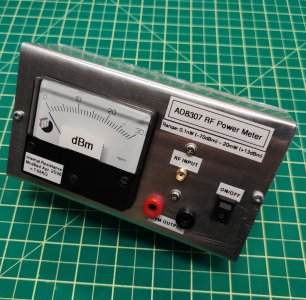
As with most first attempts, if I were to build it again, I would make several changes. But it is working as expected.

View attachment 82768
Pretty cool. What do you intend to use it for? Way back when I was building CAN_RF product line and before I developed the Wireless Replica Operated Mine (WORM) for DRES in Suffield I did consider going for my HAM license so buying these seemed like a no brainer.

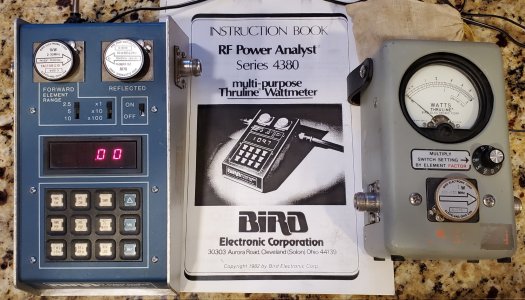
SWR.jpg

I see the 4381 now sells on EBAY for upwards of $250 and the BIRD 4304 for $400 and up so I can see why you'd build one.
I'm trying to charge the battery on the 4381. If not I guess I should take it apart and replace them. Project #42.
 
Pretty cool. What do you intend to use it for? Way back when I was building CAN_RF product line and before I developed the Wireless Replica Operated Mine (WORM) for DRES in Suffield I did consider going for my HAM license so buying these seemed like a no brainer.

View attachment 82771

I see the 4381 now sells on EBAY for upwards of $250 and the BIRD 4304 for $400 and up so I can see why you'd build one.
I'm trying to charge the battery on the 4381. If not I guess I should take it apart and replace them. Project #42.

I once had a BIRD (not sure of the model) and sold it long before I really got into the hobby - doh!

I have built and would like to continue building low power transmitters for experimentation. The RF Power Meter will be useful for that purpose.

Went through an online study course for a Ham License just to see what I would be getting into. A lot of information, a lot to learn. Maybe.

My problem is too many interests. Recently, I have been once again experimenting with SDRs and building directional Yagi antennas for scanning certain frequencies. Endless projects.
 
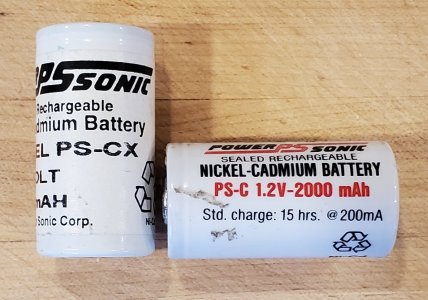
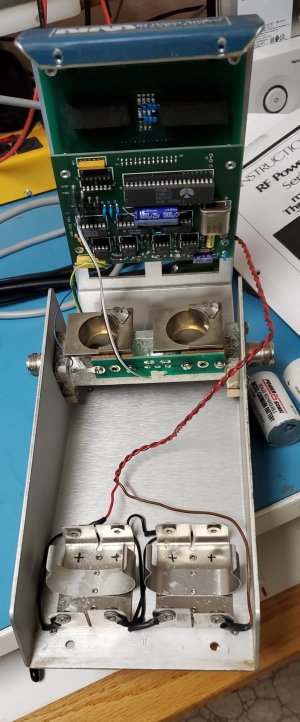
The issue with the 4381 is it uses 4 C size Ni-cad batteries. The AC Adapter I dug up is also a little under powered. It needs 350mA at 9V so that's another cost to get this thing working again. I've requested a quote on the batteries from a local battery shop. There were only two inside the unit.
NiCAD_C-Cells.jpg

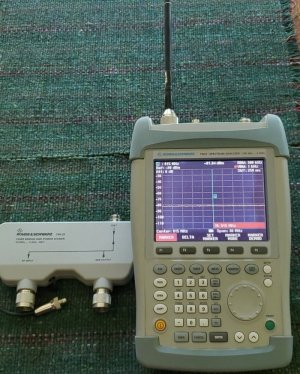
Thing is, I don't really need either of those instruments anymore because when I did the WORM project I earned enough to buy a R&S RSH-3 back when it was only $13K. Now the RSH-4 which has superseded mine is only $19K and that's without the soft carry case. Not sure about the bridge.

RSH-3.jpg

Really sad thing is if I want to use this one under battery power I'll have to replace the battery again. Last time I think it cost $400. They only last a few years although the unit is about 20 years old.

And then there's my Android phone which also needs a new battery. Seems that's the story of everything nowadays.
 
The issue with the 4381 is it uses 4 C size Ni-cad batteries. The AC Adapter I dug up is also a little under powered. It needs 350mA at 9V so that's another cost to get this thing working again.
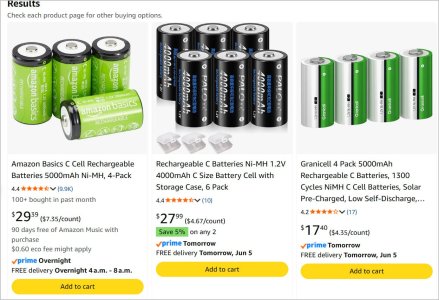
NIMH will give you same nominal voltage as NICD, way more maH capacity & a spit cheap universal charger. Even if the cells are more hard wired in the unit, you could rig up a suitable charging system using the supplied jack if its an oddball size.
 

Attachments

  • SNAG-04-06-2026 1.13.46 PM.jpg
    SNAG-04-06-2026 1.13.46 PM.jpg
    191.3 KB · Views: 1
NIMH will give you same nominal voltage as NICD, way more maH capacity & a spit cheap universal charger. Even if the cells are more hard wired in the unit, you could rig up a suitable charging system using the supplied jack if its an oddball size.
You are correct and if I wanted to add to my 42 projects list it might well be possible. In the past I've been able to get Klipsch to send me the schematic of their sub-woofer. A design flaw caused overheating in a power resistor so I modified the unit to add a heat sink once I replaced the burnt resistor with one that has the heat sink as part of it.

So likely if BIRD is still around it's possible a schematic is available. Totally within my capabilities to change the charging but... what if the charging circuit adds RFI? Is it worth it compared to just swapping in NiCads assuming they can be found.

Same with the AC Adapter. It's likely a 1982 product might not have the same level of filtering for a cheap 9V switching AC Adapter. That means it can't be a 100-240VAC input. Or maybe it's not an issue?
 

Attachments

  • Inside_BIRD_8041.jpg
    Inside_BIRD_8041.jpg
    436.2 KB · Views: 4
So likely if BIRD is still around it's possible a schematic is available. Totally within my capabilities to change the charging but... what if the charging circuit adds RFI? Is it worth it compared to just swapping in NiCads assuming they can be found.
Not familar with the hardware instrument itself, but charging is charging whether NIMH or NICD. Its relatively low DC voltage & current levels going down the wires until the cells are topped up. If the unit is not operating simultaneously to charging, would RF be adversly affecting anything even if the wires were in close proximity to components anyway? Another option is modify the instrument to swap in a fully charged pack with a suitable plug & that would mitigate inboard charging altogether.

Anyway, I'm just pointing out that NIMH chemistry has essentially replaced NICD for many year now, mostly due to disposal concerns (Cadmium). And if it wasnt for specific voltage requirement in legacy devices NIMH would be slim pickens in lieu of Lithium these days but thats a different story. NICD is still available, but for the 99% of normal applications there is basically no downside to NIMH. Same form factor, same nominal voltage, no NICD memory/conditioning issues, longer maH duration so longer/flatter discharge curve, higher amp duty because capacityi has been increasing vs. somewhat stale development in NICD. NICD behaves better in cold & wakes up better from depleted state or self discharge. Probably some other pros & cons Ive forgotten but more application specific.
 
All Battery in Langford just replied to my email:
"We sell NiCD C size batteries 3000mAh for $7.99 each. Yes I have 4 pieces"
So I guess I can pop over there tomorrow. Have to dig through stuff to see if I have a better 9V adapter. Then I'll put it up for sale.
 
Not familar with the hardware instrument itself, but charging is charging whether NIMH or NICD. Its relatively low DC voltage & current levels going down the wires until the cells are topped up. If the unit is not operating simultaneously to charging, would RF be adversly affecting anything even if the wires were in close proximity to components anyway? Another option is modify the instrument to swap in a fully charged pack with a suitable plug & that would mitigate inboard charging altogether.

Anyway, I'm just pointing out that NIMH chemistry has essentially replaced NICD for many year now, mostly due to disposal concerns (Cadmium). And if it wasnt for specific voltage requirement in legacy devices NIMH would be slim pickens in lieu of Lithium these days but thats a different story. NICD is still available, but for the 99% of normal applications there is basically no downside to NIMH. Same form factor, same nominal voltage, no NICD memory/conditioning issues, longer maH duration so longer/flatter discharge curve, higher amp duty because capacityi has been increasing vs. somewhat stale development in NICD. NICD behaves better in cold & wakes up better from depleted state or self discharge. Probably some other pros & cons Ive forgotten but more application specific.
I totally agree. However the unit runs off the 9V adapter and there's likely a circuit that maintains a constant current at C/10 or else just a 1.41*4 volts constant voltage to ensure current remains at C/10. The unit has a 2500mAH and 2000mAH battery and two empty spots all wired for series. I'd guess the charger is probably limited to 200mA. Since there's a micro-processor it might even be clever enough to detect a fully charged pack.

The fast and easy solution is to buy 4 batteries.

 
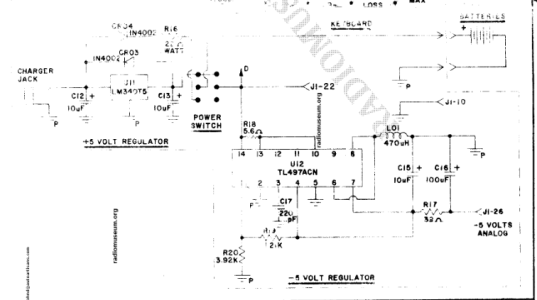
Hmm. Very low level if this schematic is accurate. At least now I do have a schematic. And a diode and 22 Ohm series resistor from 9V is pretty simple charging. It looks like if the batteries are removed the 9V is shunted back into the regulator. Cheesy.
1780616227639.png
 
I totally agree. However the unit runs off the 9V adapter and there's likely a circuit that maintains a constant current at C/10 or else
Ah gotcha. If utilizing the original (typically wall wart) charger adapter is part of the plan, you are much more constrained because NIMH don't do well on them. Enter the smart chargers with selectable chemistry /algorithms specifically for NIMH. We used to charge our old school NICD RX & TX batterys on wall warts, but many non-believers pooched their NIMH packs on the same adapters.
 
Back
Top