• Scam Alert. Members are reminded to NOT send money to buy anything. Don't buy things remote and have it shipped - go get it yourself, pay in person, and take your equipment with you. Scammers have burned people on this forum. Urgency, secrecy, excuses, selling for friend, newish members, FUD, are RED FLAGS. A video conference call is not adequate assurance. Face to face interactions are required. Please report suspicions to the forum admins. Stay Safe - anyone can get scammed.
  • The 2026 Calgary Area Meetup is set for Saturday May 30th at 10am. The signup thread is here! Robinhood has graciously offered to host the meetup again this year. Please note that you MUST RSVP to the notice linked above if you wish to come.

Other Basic Electronics, Multimeters, & Oscilloscopes

This thread is about basic electrical, electronics, Multimeters, and Oscilloscopes. It is an outcome of interest that various members have expressed about these subjects.

@Janger , @Johnwa , and @kevin.decelles have all recently obtained a starter Oscilloscope so I think the timing is good for a thread like this.

The primary resource will be a book (available on Amazon in paper or kindle) called Electronics for Dummies by Kathleen Shamieh. The book isn't a requirement, but it always helps to have a reference of some kind to facilitate discussion. Other references might get added as the thread progresses.

I'm not picturing this thread as a course, just a good place to ask questions, find answers, and share knowledge and experience about basic electrical knowledge and testing.

As always, a good time and lots of great jokes are expected!
 
Then no, I don't understand. I understand relays how you can input low voltage on one side to switch for a higher voltage on the other legs

Vacuum tubes were largely 1980-ish and older?

OK, so you understand relays. Now imagine a relay where you could change the current flowing in the relay coils to change the amount of current flowing across the relay contacts. That's the big difference. Relays are on or off, they don't control how much.
 
OK, so you understand relays. Now imagine a relay where you could change the current flowing in the relay coils to change the amount of current flowing across the relay contacts. That's the big difference. Relays are on or off, they don't control how much.
I read the other post, too

Voltage, is either on or off, controlled by a switch or a relay or fuse and ground. Agreed

How much voltage is limited to what the circuit is designed for

What is this voodoo about a vacuum tube changing voltage?
 
Then no, I don't understand. I understand relays how you can input low voltage on one side to switch for a higher voltage on the other legs

Vacuum tubes were largely 1980-ish and older?

Here is perhaps a better example.

Imagine a million relays all connected in parallel. Each relay's coil triggers at a slightly higher voltage than the one next to it and each has a slightly higher voltage on the input contacts. So as the input coil voltage increases, more and more total current flows through all the contacts.

In terms of popularity, that's probably a reasonable date range. Perhaps 70s would be better. But the invention itself and first applications are much older. It's a pretty long term revolution. By the 80s we already had integrated circuits and microprocessors. But they were not really in widespread usage in consumer devices right away. Someplace I remember reading that major technology shifts take 30 to 50 years to become common. So you can't really pick a good before and after date for tubes and transistors.
 
Here is perhaps a better example.

Imagine a million relays all connected in parallel. Each relay's coil triggers at a slightly higher voltage than the one next to it and each has a slightly higher voltage on the input contacts. So as the input coil voltage increases, more and more total current flows through all the contacts.

In terms of popularity, that's probably a reasonable date range. Perhaps 70s would be better. But the invention itself and first applications are much older. It's a pretty long term revolution. By the 80s we already had integrated circuits and microprocessors. But they were not really in widespread usage in consumer devices right away. Someplace I remember reading that major technology shifts take 30 to 50 years to become common. So you can't really pick a good before and after date for tubes and transistors.
I don't think that's inaccurate. Corvettes had an early fuel injection system in the 50's. Wasn't until the late 80's where TBI started being common. Then late 90's carbs were phased out slowly
 
I read the other post, too

Voltage, is either on or off, controlled by a switch or a relay or fuse and ground. Agreed

How much voltage is limited to what the circuit is designed for

What is this voodoo about a vacuum tube changing voltage?

I think we need to careful when talking about voltage alone. Most of these things are really current devices, not voltage. But current and voltage are closely related. I like to teach basic electrical and electronics by comparing it to a water hose. Voltage is the water pressure and the volume of water flowing is the current or amperage. The diameter of the hose and all the bends and orifices are resistors. Water hammer is coils or inductance, big water tanks are like batteries, and small tanks are like capacitors. Valves are like transistors. Etc etc.

I'd also add that it normally takes a year or so to gain a basic understanding. So we are not going to teach you everything there is to know in just a few posts on the forum.

Coming back to your question, vacuum tubes are big things that require heaters and a vacuum chamber. Transistors are tiny and don't require a vacuum or a heater. That's really the biggest difference.

What is this voodoo about a vacuum tube changing voltage?

That's not a good way to look at it. Instead, a vacuum tube has a voltage controlled gate inside it that physically sits between the input and output terminals. The voltage on the gate controls how much current flows between the terminals. Voltage is only a consequence of the current since voltage and current are related to each other.

Back to the water, the control gate in the vacuum tube controls how much water can flow in the pipe. It isn't an on/off control like a relay. It's a variable control. Not only that, it's an amplified variable control.
 
Wow! Has this ever gone sideways. Love it!
Back in the day electric current flow was thought of as electrons moving from a negative terminal to a positive terminal.

When you heat up a part in the tube called a cathode, in a vacuum, electrons are emitted. It's that 6.3V filament that heats up the cathode. Across from the cathode is a larger flat part called a plate.

A high voltage battery (say 300V) is placed cross these two parts with the plate positive and the cathode negative. Normally it's open circuit but add the heat and electrons emitted into the vacuum are pulled across by that high voltage potential on the plate and now you have current flowing. Pretty neat concept actually.

Most of us in Canada have experienced mosquitoes so we have window screens to keep them out when we open the window. Air and the bugs flow through the window without the screen quite easily. Close the window (like a solid screen) and nothing comes through. Use coarse screen and some bugs come through. Fine screen and less air and bugs get through.

So think of putting a wire screen between that heated cathode and the flat plate and call it a control grid. Apply a small negative voltage to that grid and the electrons can't get past. Like the size of the screen changes to keep out insects from gnats up to dragonflies changes with a very small change in voltage.

So there you have your Triode vacuum tube. Small voltage change on the grid creates a larger voltage change on the plate because of those electrons flowing from the heated cathode. To use that changing higher voltage (low current 1mA) a transformer is used to step down the 300V (+/- 30V now) to say 5V (+/- 0.5V now). And the current has been multiplied by that same 60:1 ratio up to 60mA.

Hopefully that's not too technical. Won't talk about semiconductors and the concept of holes moving through the material instead of electrons. That's a different story.
 
After I retired I repaired music amps, electronic pianos and other electronic musical gear for 15 years. Much preferred working on tube gear, easier to trouble shoot and didn't fail catastrophically (usually) like transistor gear did. Just had to keep one hand in your pocket! Mind you I might be prejudiced, all my first introduction to electronics was on tubes as a early teenager. I can remember taking my first radio apart on the basement floor in Toronto after my parents had found it in someone's garbage down the street and brought it home, I was probably 9 or 10. It was a Philco, anyone remember body end dot resistors, I still have some, 1/2W about 1 1/4" long and 1/4" dia. Found out about transistors when I was about 13, still have some of the first transistors commercially available. GE 2N107 2N170 Raytheon CK722 and a Sylvania 2N35.
John
 
Hi John, Guys,
Like you I have a collection of what I would call rare transistors and diodes. A lot of the early diodes, un-numbered, were basically cats whiskers in a tube, you might remember the Mullard OA80 and the OC40/44/45 series. Well you mentioned the Raytheon CK722, I have a couple of the Russian versions of them.
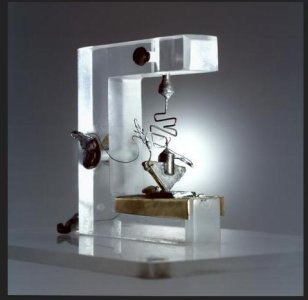
If you ever watch the BBC leader ads they show a picture of the very first Transistor created by John Bardeen and Walter Brattain in 1947. William Shockley later developed the improved bipolar junction transistor in 1948.

The first Transistor 1948.jpg

The one shown on the BBC is an encapsulated version from about 1950.
 
Found out about transistors when I was about 13, still have some of the first transistors commercially available. GE 2N107 2N170 Raytheon CK722 and a Sylvania 2N35.

I don't have any vacuum tubes left anymore. But I do have several little draws full of old transistors, resistors, capacitors, etc.

My favorite transistors were the NPN 2N2222 and its 2N2907 PNP Compliment. I still have hundreds of them. Lots of LM317 power regulators and 555 timers too.
 
Hopefully that's not too technical. Won't talk about semiconductors and the concept of holes moving through the material instead of electrons. That's a different story.

Did you really think about them working that way? If so, your pain threshold was/is higher than mine.

Although I knew that reality, to me it was just easier to think of them as little current amplifiers with a given gain, rated frequency response, and a power rating.
 
Did you really think about them working that way? If so, your pain threshold was/is higher than mine.

Although I knew that reality, to me it was just easier to think of them as little current amplifiers with a given gain, rated frequency response, and a power rating.
That is just how I think of them, Thyristors and Triac's are closer to relays !
 
Did you really think about them working that way? If so, your pain threshold was/is higher than mine.

Although I knew that reality, to me it was just easier to think of them as little current amplifiers with a given gain, rated frequency response, and a power rating.
No. I still use conventional current so the current flow goes with the arrow even though technically that's incorrect.
 
I have a few boxes of vacuum tubes, the oldest are 3 UV201s from the '20, also quite a few from the 30s, and 40s.
John
 
Hi Guys,
I sold all mine a couple of years ago, around 2000 of them. Some 807, 813, 6L6, EL34, a couple of "R" valves some other rare ones. Most of them WW2 ones. All boxed. The chap I sold them to E-Bayed them. I was happy to get the space back, I had them all stored in trays.
Actually I might still have some.
 
At one time I had a surplus tube from a Big-A transmitter that I picked up because it looked cool (the top terminal was a sort Ø1/2" Brass cylinder.

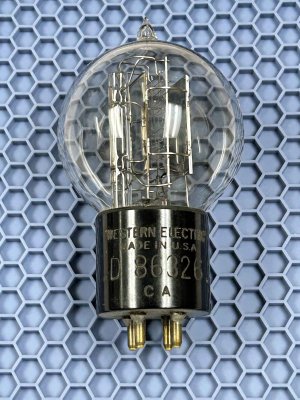
While I don't have that to display, this is in my box of "Make a Display Base for These:"

20260815 Western Electric Vacuum Tube rfs.jpeg
Easy to see example of the components (sorry for the glare).

Many music purists still use vacuum tube audio amplifiers to listen to their LP's: in combination with really large capacitors and output transfomers it's said that vacuum tubes produce cleaner sound.
 
Many music purists still use vacuum tube audio amplifiers to listen to their LP's:

My theory is that most of those purists who can afford such stuff are too old to hear the difference.

In my case, the tinnitus, the high freq loss, and the sub sonic vibrations in my skull suggest transistor amps are way more than I'll ever need.

But who knows, maybe there are a few old guys around who actually can.
 
Many music purists still use vacuum tube audio amplifiers to listen to their LP's: in combination with really large capacitors and output transfomers it's said that vacuum tubes produce cleaner sound.
I have two stereo amplifiers; an old Marantz as well as a tube amplifier. Lately I listen to the tube amplifier. Tube amplifiers don’t actually produce “cleaner” sound, but they clip in a way that is pleasing to the ear (even harmonics), while solid state amplifiers clip in a nasty to the ear way (odd harmonics).

Good tube amplifiers (for example McIntosh, Audio Research), are brutally expensive.
 
Last edited:
Several years i was building small tube amplifier based on just one tube - triode and pentode in one glass (two tubes for stereo) . It worked surprisingly well. Surprisingly, it works until now 🙂 . Yes, as @Susquatch said - tubes are rarely failing catastrophically, they much less afraid of short circuit situation or wrong currents/voltages applied.
I wanted to build bigger amplifier based on Russian GU50, but never had time for that... one bright day.
 
Back
Top