• Scam Alert. Members are reminded to NOT send money to buy anything. Don't buy things remote and have it shipped - go get it yourself, pay in person, and take your equipment with you. Scammers have burned people on this forum. Urgency, secrecy, excuses, selling for friend, newish members, FUD, are RED FLAGS. A video conference call is not adequate assurance. Face to face interactions are required. Please report suspicions to the forum admins. Stay Safe - anyone can get scammed.
  • The 2026 Calgary Area Meetup is set for Saturday May 30th at 10am. The signup thread is here! Robinhood has graciously offered to host the meetup again this year. Please note that you MUST RSVP to the notice linked above if you wish to come.

Other Basic Electronics, Multimeters, & Oscilloscopes

This thread is about basic electrical, electronics, Multimeters, and Oscilloscopes. It is an outcome of interest that various members have expressed about these subjects.

@Janger , @Johnwa , and @kevin.decelles have all recently obtained a starter Oscilloscope so I think the timing is good for a thread like this.

The primary resource will be a book (available on Amazon in paper or kindle) called Electronics for Dummies by Kathleen Shamieh. The book isn't a requirement, but it always helps to have a reference of some kind to facilitate discussion. Other references might get added as the thread progresses.

I'm not picturing this thread as a course, just a good place to ask questions, find answers, and share knowledge and experience about basic electrical knowledge and testing.

As always, a good time and lots of great jokes are expected!
 
Settings suggestions? Let's assume I'm trying to catch a 7 Volt, 3 Hz square wave for about 180 RPM. About 2V/cm & 200 mS/cm?

I'd use the external trigger input, connect that to the same point as your regular input with an alligator clip, and try setting the sensitivity to auto. You shouldn't need a high frequency input nor trigger filtering for this job. I've been known to just push buttons too.... LOL!

When you speak of a small RC circuit are you speaking of a series resistor (value?) with a small (a few pf) cap between the signal side of the resistor and ground?

Given how low the frequency is, I was thinking two 50k resistors in series with the signal input to the device or the scope and a few microfarads in between them to ground. You will know when you see the signal whether that is too much or too little. I just want to get rid of the high frequency noise - if any. The resistor on the scope side isn't required, but it usually helps maintain a better signal too. You are just making what is frequently called a "low pass filter". You can find formulas on the web, but I usually just play with it till I see what I want.

I understand the reed is a mechanical switch subject to wear but I’m scratching my head on this one because that’s what most of the treadmills use for their Tach input. Designed to price point? Maybe they aren’t designed to get that much use over their lifetime or maybe it’s a planned service revenue stream.😉

I'm just not a fan of reed switches. Their quality can vary all over the map.

Base on my limited experience you do indeed want to mock up your installation before spending any time designing and making in-machine mounts. From what I hear, it also pays to mount the display right side up for the test.😉

I guess I'm just used to that kind of stuff working first crack. My confidence is probably misplaced.

I can’t guarantee that a genuine Noga mount will work, I used an imitation Nauga from PA, I’m not sure that stood out in my description. 😛

It didn't. I honestly thought it was a typo! LOL!

I prolly won't use a Noga either. Anyone of my mounts should work and all are easier than fabbing a custom bracket.
 
I have some high end oscilloscopes, high end enough that I'm reluctant to connect them to hazardous circuits without using fully isolated high voltage probes and that makes for a cumbersome setup.

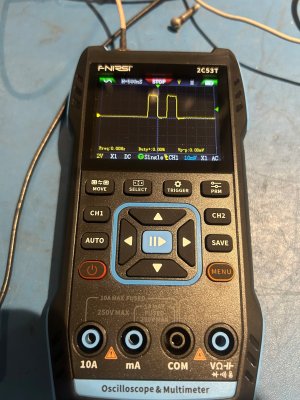
So I recently received one of these bargain basket $101 shipped Fnirsi 2C53T oscilloscope/meters.
+The GUI could be better, however it is usable.
+ Battery powered, so really convenient for field type measurements
+ Advertised 250MS/s sample rate
- I wouldn't trust the CAT ratings
- bandwidth is limited as expected, even at 1/10 of sample rate the displayed signal is highly attenuated, so don't expect to catch anything fast

I have not evaluated in detail, however I did try it with a couple of 200ns bursts just to see if it would capture a half quick pulse and it did, see below.
At the advertised 50MHz limit the displayed signal is okay, you just can't believe the amplitude (at all)
Faster than that is a crap shoot. I tried 1GHz just for giggles and nada as expected.

Overall I'm happy with it. For a $100, it's a bargain and a great tool for poking around lower voltage circuits when you need more than a meter reading.

2C53T.jpeg
 
I mentioned the GUI is useable (not great).

Keep the following in mind if you pick one of these up, as the manual is next to useless.

Near the top of the screen there are four pairs of symbols, these symbols change colour to represent what channel, and change symbols to indicate what the four cursor keys will change. Until you understand what those symbols indicate, it’s frustrating trying to setup the scope, once you know what they represent it’s easy. I found a YouTube video (some British guy), that explains the symbols meaning.

In the image above the symbols are V and H, they change to various triangular icons as you cycle through the modes.

In this mode V represents the vertical or Volts/div, (up/down cursor buttons), and the H represents the Horizontal axis or time with the left/right cursor buttons. The other modes are similar, trigger level, position etc.
 
Last edited:
I just found this wonderful thread and have the odd surplus analog scopes if anyone wants or needs one , good beginner units 30mhz but working last I looked , my work is on the brink of scrapping the rest of theirs so I'm keeping an eye out ...
 
Recently I was looking at a Tektronix 475 Oscilloscope. Original owner claims that it is in mint condition. It comes with a DM 44 and factory cart. Seller is in Calgary and it just happened that one of my kids was heading there a few weeks back. I made inquiries and did my research. In the end, after weighing out the pros and cons, I decided to let it go.

One of the biggest concerns was that the owner said the scope has never had any replacement parts, all original. I read that the 475 is a huge PITA to deal with failed components even for technicians who are trained to work on them. Therefore, because of it's age, any day could be that scope's last good day before it becomes a repair project. As well, people often recommend owning a donor 475 or even a second working model for comparison when troubleshooting. All in all, that sounds like a potential money pit waiting to happen.

I currently have 3 decent oscilloscopes but none of them are analog. I will wait until the right comes along.
 
Recently I was looking at a Tektronix 475 Oscilloscope. Original owner claims that it is in mint condition. It comes with a DM 44 and factory cart. Seller is in Calgary and it just happened that one of my kids was heading there a few weeks back. I made inquiries and did my research. In the end, after weighing out the pros and cons, I decided to let it go.

One of the biggest concerns was that the owner said the scope has never had any replacement parts, all original. I read that the 475 is a huge PITA to deal with failed components even for technicians who are trained to work on them. Therefore, because of it's age, any day could be that scope's last good day before it becomes a repair project. As well, people often recommend owning a donor 475 or even a second working model for comparison when troubleshooting. All in all, that sounds like a potential money pit waiting to happen.

I currently have 3 decent oscilloscopes but none of them are analog. I will wait until the right comes along.

I have an old 465 scope. It still works FANTASTIC. Might benefit from a detailed calibration, but it's fine for my needs the way it is. I got it on an ebay auction back when boys held their pants up with a belt. I'd buy it again in a heart beat. For what those things cost today and what you get for the money, I'd say it's worth the risk. When it gives up the ghost, you say goodbye and be done with it knowing you got more more than your money's worth. Is it too late to still go get it?

FWIW, I've been using the FNIRSI 1014D that kicked off this thread ever since I got it. Ya, it is no Tektronix but it's actually an amazing digital scope for the money. If it quits, I'll just go get another one of those too!
 
I have an old Gould OS1100 30MHz dual channel Analogue scope. Haven't plugged it in since I bought my Tek 3032 Digital Scope many years ago.
We've talked about this stuff before.

 
I have an old 465 scope. It still works FANTASTIC. Might benefit from a detailed calibration, but it's fine for my needs the way it is. I got it on an ebay auction back when boys held their pants up with a belt. I'd buy it again in a heart beat. For what those things cost today and what you get for the money, I'd say it's worth the risk. When it gives up the ghost, you say goodbye and be done with it knowing you got more more than your money's worth. Is it too late to still go get it?

FWIW, I've been using the FNIRSI 1014D that kicked off this thread ever since I got it. Ya, it is no Tektronix but it's actually an amazing digital scope for the money. If it quits, I'll just go get another one of those too!

I have a Siglent 1202X-E that covers my basic needs. As well, I have a couple USB oscilloscopes for portability - PICO 2204A and Digilent Analog Discovery 3 (great deal and more for experimenting).

Years ago my first 2 scopes were analog. Bought them cheap. One was a Philips and the other was a Tektronix (forget the model). But there were issues with both - the biggest was the inexperienced guy using them🙂

The Calgary scope has been up for sale for at least 2 months. Maybe I would have felt more comfortable making a deal if I could go in person. Unfortunately it's a little out of the way to travel for just the scope. Another one will hopefully pop up again.

There is a Advantest R3271 Spectrum Analyzer that my oldest son found at the local Salvation Army Thrift Store. He sent me some pictures. They want over $600. Last calibrated in 2015 if you believe the tag on it. I was thinking of taking a power cord to see if it powers up. What the hell would I do with that thing?!?!? Anyone own a Satellite that needs troubleshooting?

But it's so cool and if it worked...best dust collector ever!
 
Hi Guys,

Spectrum Analysers are brilliant if you need one particularly if it has the built in sweep generator. The usual problem with these is the front end gets zapped because someone overloaded it. Unfortunately they are next to impossible to repair ! The front ends are like a mobile phone both IC and circuit wise. I've tried to repair one and failed, badly. The manufacturers will offer you a re-manufactured one at a reduced cost. But you need to be rich...
 
Hi Guys,

Spectrum Analysers are brilliant if you need one particularly if it has the built in sweep generator. The usual problem with these is the front end gets zapped because someone overloaded it. Unfortunately they are next to impossible to repair ! The front ends are like a mobile phone both IC and circuit wise. I've tried to repair one and failed, badly. The manufacturers will offer you a re-manufactured one at a reduced cost. But you need to be rich...

Yeah, way out of my league.

I already have a TinySA Ultra and I have used my RSP1A SDR with "Spectrum Analyzer" software that someone designed for it (built the associated tracking generator, too). Great tools for testing simple transmitters like a garage door opener, automotive key FOB, etc. As I get more into building low power transmitters and antennas those tools and others will be useful.

I need to stay focused and practical. Right now I got a quote for a UNI-T UT181A. I have been looking at a quality DMM with data logging capabilities for a long time. The videos online of people comparing them to the Fluke 289 are very encouraging. The data logging is a feature I can see myself using often.
 
Hi Guys,

Spectrum Analysers are brilliant if you need one particularly if it has the built in sweep generator. The usual problem with these is the front end gets zapped because someone overloaded it. Unfortunately they are next to impossible to repair ! The front ends are like a mobile phone both IC and circuit wise. I've tried to repair one and failed, badly. The manufacturers will offer you a re-manufactured one at a reduced cost. But you need to be rich...

Yes they are a powerful tool.

I'm very, very, very careful with my SA. I have had the over-power alarm come on briefly a couple of times, but I was just over the warning threshold , not dangerously above. If I'm unsure I connect a series attenuator before the input until I know what I'm dealing with. The tricky part is your focused on your signal of interest and meanwhile somewhere outside your selected B.W. there is something nasty that your not looking at and might be unaware off.

DC block is another good defense.
 
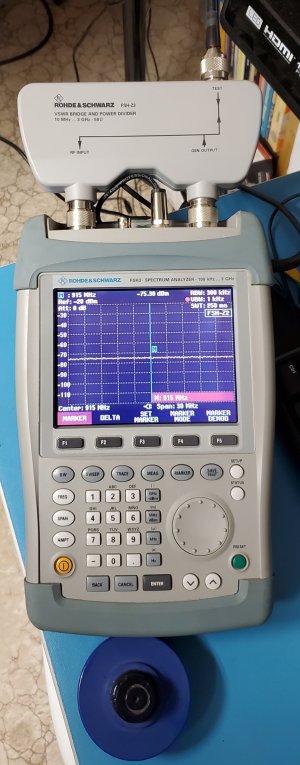
I regret now not getting the 6GHz version but even so the 3GHz has for the most part served me well. Haven't really used in in anger, so to speak, for a number of years. It even has the software in it to be able to find a short circuit in a wire.

Used it for developing the little Blue Wireless Operated Replica Mine (WORM) and my CANRF project.

1775860458738.jpeg
 
Reflectometer...is that essentially the same idea as a SWR meter?
Yes but the output is fed to the vertical input of the scope whilst the sweep generator also drives the horizontal scan. The net result is you get an impedance trace with frequency vs impedance. The reverse also works but you may need to use a leveled amplifier on the input.

I've just noticed your RS Spectrum analyser. Nice kit.
 
Yes but the output is fed to the vertical input of the scope whilst the sweep generator also drives the horizontal scan. The net result is you get an impedance trace with frequency vs impedance. The reverse also works but you may need to use a leveled amplifier on the input.
Now you got me curious.
I will be looking into that.
 
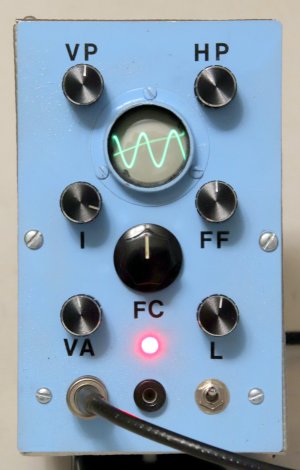
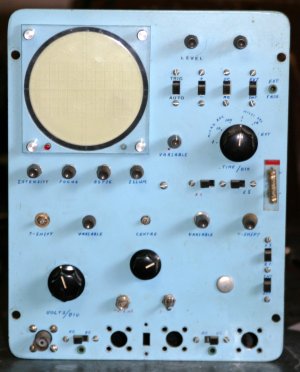
I also have a FNIRSI 1014D which I bought a couple of years ago, but I find the display isn't very stable, as a result I normally use my Tex 465 which I have had for 20 odd years, and other than replacing a resistor that was intermittent when I first got it has been great. It replaced my two home built scopes that I built as a teenager. First a 1 inch CRT (1CP31) one I built as a 16 year old then a 3 inch CRT (3WP1) triggered scope I built about 4 years later.The 3" is currently being overhauled as the HV filter caps are leaking ( after 60 years) and dragging down the 1250V HV CRT supply.
John
Scope 11.JPG
Scope.JPG
 
Hi John,

Wow I've not seen 1" or 3", or 5" inch scope tubes for years and years. I think the first scope tube that I had came from a Gov surplus sale. Brand new in a cardboard box covered in waxed paper and tape.
I remember making a 350 volt power supply for it, about a half of what it really wanted.
 
The 3" tube came from a surplus store on Queen street in Toronto as well as a 3KP1 tube I have. I also have a half dozen 5CP1 and 5AP1 tubes in my attic that I got in a surplus store in Edmonton for 50 Cents each and a couple of Textronics 3 inch CRTs! One of the 5CP1s was going to be made into an electron microscope, which never materialized.
John
 
As a youngster, I moved a lot. Some time in the early 70s, Pop Tronics had an article and a vendor selling a kit for a 1” oscilloscope using a 1CP31 tube. Seemed like a good idea to buy the kit. That kit and tube probably traveled 5000 miles and moved houses 10 times before I finally realized that I was never going to build it and gave it away.
 
Back
Top