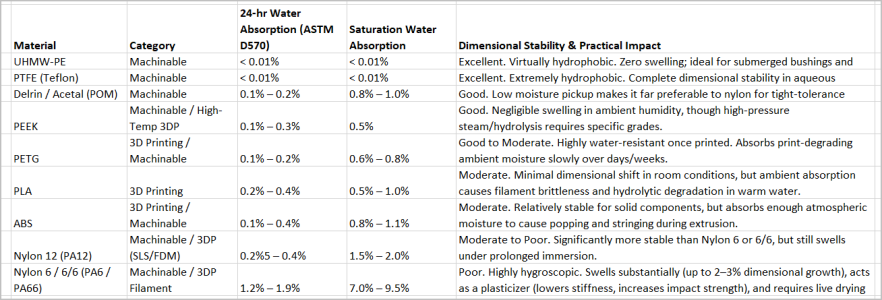
So we obviously fret about entrained water in filament when it causes us printing grief. But generally speaking, once printed, isn't it the exact same issue of the finished part sucking up water from the atmosphere? I mean it may not be problematic in many instances, we could seal/paint it. But I'm just saying a lot of stuff we make just sits there in its printed form. I didnt realize until just recently how many so called common machineable plastics do this same thing to some degree. You may choose a certain kind of bushing material on the baisis of its environment especially if perpetually submerged above & beyond its friction & wear properties for example.

-
Scam Alert. Members are reminded to NOT send money to buy anything. Don't buy things remote and have it shipped - go get it yourself, pay in person, and take your equipment with you. Scammers have burned people on this forum. Urgency, secrecy, excuses, selling for friend, newish members, FUD, are RED FLAGS. A video conference call is not adequate assurance. Face to face interactions are required. Please report suspicions to the forum admins. Stay Safe - anyone can get scammed.
-
The 2026 Calgary Area Meetup is set for Saturday May 30th at 10am. The signup thread is here! Robinhood has graciously offered to host the meetup again this year. Please note that you MUST RSVP to the notice linked above if you wish to come.
You are using an out of date browser. It may not display this or other websites correctly.
You should upgrade or use an alternative browser.
You should upgrade or use an alternative browser.
3D Printer Happened
- Thread starter Susquatch
- Start date

Well yes and no.
Moisture absorbed into the filament before printing turns into steam resulting in irregular filament extrusion. The PLA filament also becomes brittle and snaps with a cross-eyed glance at it. That results in broken pieces stuck inside the filament extrusion system and sometimes a huge issue with unclogging.
If moisture in the printed part is an issue then paint. Just like metal rusts or wood rots painting (and) filler is just part of the build process.
Moisture absorbed into the filament before printing turns into steam resulting in irregular filament extrusion. The PLA filament also becomes brittle and snaps with a cross-eyed glance at it. That results in broken pieces stuck inside the filament extrusion system and sometimes a huge issue with unclogging.
If moisture in the printed part is an issue then paint. Just like metal rusts or wood rots painting (and) filler is just part of the build process.

@Janger @TorontoBuilder @PeterT
I have a Bambu p2s with AMS 2 Pro. I also have PLA, PETG, and ABS Fillament. I have Tupperware containers for Fillament spools and they have small air relative humidity gauges.
I don't want to be constantly drying Fillament. I just want to dry it once and then keep it dry. Preferably with dessicant.
I live in the worst humidity conditions in Canada.
New filament comes in sealed bags and I assume it is dry.
I believe I grasp what the 3 of you are saying.
TB - Thank you for the very fullsome explanation of how air and Fillament differ. You have confirmed what I expected. The filament doesn't have the same water holding parameters that air has. So a sealed system at equilibrium at 70°F might have air at 10% Rh, but PLA at 40% of its capacity and dessicant at say 60%. Those numbers are just examples not what I really expect.
From what I can see after several novice tests is that the dessicant will reliably reduce the Rh of the air in a sealed container to about 10% at roughly 70°F. It doesn't seem to matter much if the dessicant is fresh. As long as it hasn't changed colour significantly yet, the air will reach 10%. It just takes time.
Note - I do not know how accurate the little humidity/temp gauges are. But I bought a set of eight and they all read consistently which at least suggests that they might be pretty good. The 10% limit might not be real though. 10% might be the lowest number they will display not the actual humidity of the air.
I'm very familiar with psychometric charts for water in air. So I get all that stuff about how temp affects Rh. What I'm not familiar with is the characteristics of water in various filaments and in dessicant. But you have confirmed what I suspected. They are not the same as air. What I am hoping though is that one can use a known Rh and temp of air to determine the actual humidity of various fillaments at 70F and at equilibrium. Specifically equilibrium humidity with air at 70F and 10% Rh - which seems to be a reliably achievable condition.
Despite advice to the contrary, I would prefer not to buy a dessicant dryer and I'd prefer not to use the drying capability of my AMS (to avoid damaging the PLA accessories inside there).
What I want to do is use a simple cheap toaster oven to refresh dessicant and then use dessicant to dry my filament. At least on the surface, this seems to work - albeit very slowly, but still plenty fast enough for an old beast like me.
I tried unsuccessfully to find charts for the various filaments that show equilibrium humidity vs air humidity. I don't wish to know as much as you know about that. I'd be happy to know what it is for air at 10% Rh at 70°F for each of the various fillaments. I suppose, I'm also interested in knowing how long it takes to get there if the filament was saturated with as much water as it can hold at that temp.
Similarly, I am interested in knowing how the dessicant behaves in the background. It seems to have a much more aggressive water absorption characteristic - much like an actual dehumidifier except without the need to use temperature to precipitate the saturated water. So I don't think I can use the humidity of the equilibrium air to determine the humidity of the dessicant. Does something like that exist for dessicant? Or is this one of those parameters you just have to accept? Ie the driving force of absorbing water is so high and the curve is so flat that it will keep working until it changes colour and then it's done and must be refreshed.
JA - I'm impressed at your weighing approach. If it turns out that my little gauge system is useless, I'll try doing that too. My problem with your method is that you can't know the initial or final humidity of the fillament using that method. You really only know how much water was removed. If the humidity meter system works, I won't need that method. But I'm prepared to do it if I need to.
I have a Bambu p2s with AMS 2 Pro. I also have PLA, PETG, and ABS Fillament. I have Tupperware containers for Fillament spools and they have small air relative humidity gauges.
I don't want to be constantly drying Fillament. I just want to dry it once and then keep it dry. Preferably with dessicant.
I live in the worst humidity conditions in Canada.
New filament comes in sealed bags and I assume it is dry.
I believe I grasp what the 3 of you are saying.
TB - Thank you for the very fullsome explanation of how air and Fillament differ. You have confirmed what I expected. The filament doesn't have the same water holding parameters that air has. So a sealed system at equilibrium at 70°F might have air at 10% Rh, but PLA at 40% of its capacity and dessicant at say 60%. Those numbers are just examples not what I really expect.
From what I can see after several novice tests is that the dessicant will reliably reduce the Rh of the air in a sealed container to about 10% at roughly 70°F. It doesn't seem to matter much if the dessicant is fresh. As long as it hasn't changed colour significantly yet, the air will reach 10%. It just takes time.
Note - I do not know how accurate the little humidity/temp gauges are. But I bought a set of eight and they all read consistently which at least suggests that they might be pretty good. The 10% limit might not be real though. 10% might be the lowest number they will display not the actual humidity of the air.
I'm very familiar with psychometric charts for water in air. So I get all that stuff about how temp affects Rh. What I'm not familiar with is the characteristics of water in various filaments and in dessicant. But you have confirmed what I suspected. They are not the same as air. What I am hoping though is that one can use a known Rh and temp of air to determine the actual humidity of various fillaments at 70F and at equilibrium. Specifically equilibrium humidity with air at 70F and 10% Rh - which seems to be a reliably achievable condition.
Despite advice to the contrary, I would prefer not to buy a dessicant dryer and I'd prefer not to use the drying capability of my AMS (to avoid damaging the PLA accessories inside there).
What I want to do is use a simple cheap toaster oven to refresh dessicant and then use dessicant to dry my filament. At least on the surface, this seems to work - albeit very slowly, but still plenty fast enough for an old beast like me.
I tried unsuccessfully to find charts for the various filaments that show equilibrium humidity vs air humidity. I don't wish to know as much as you know about that. I'd be happy to know what it is for air at 10% Rh at 70°F for each of the various fillaments. I suppose, I'm also interested in knowing how long it takes to get there if the filament was saturated with as much water as it can hold at that temp.
Similarly, I am interested in knowing how the dessicant behaves in the background. It seems to have a much more aggressive water absorption characteristic - much like an actual dehumidifier except without the need to use temperature to precipitate the saturated water. So I don't think I can use the humidity of the equilibrium air to determine the humidity of the dessicant. Does something like that exist for dessicant? Or is this one of those parameters you just have to accept? Ie the driving force of absorbing water is so high and the curve is so flat that it will keep working until it changes colour and then it's done and must be refreshed.
JA - I'm impressed at your weighing approach. If it turns out that my little gauge system is useless, I'll try doing that too. My problem with your method is that you can't know the initial or final humidity of the fillament using that method. You really only know how much water was removed. If the humidity meter system works, I won't need that method. But I'm prepared to do it if I need to.
@TorontoBuilder
I'm sorry, I see you already answered most of my question! It just took me so long to write my question (basically overnight) that I missed your earlier info.
Although you didn't give the specifics I wanted because you hadn't read my question yet, it's easy for me to see that my goals are achievable - even if I don't fully know the physics.
I gotta say, the "water suction" of dessicant that you describe is impressive. Fk, it makes me wonder about a full dessicant system for my barn instead of a dehumidifier! LOL!
I'm sorry, I see you already answered most of my question! It just took me so long to write my question (basically overnight) that I missed your earlier info.
Although you didn't give the specifics I wanted because you hadn't read my question yet, it's easy for me to see that my goals are achievable - even if I don't fully know the physics.
I gotta say, the "water suction" of dessicant that you describe is impressive. Fk, it makes me wonder about a full dessicant system for my barn instead of a dehumidifier! LOL!
So we obviously fret about entrained water in filament when it causes us printing grief. But generally speaking, once printed, isn't it the exact same issue of the finished part sucking up water from the atmosphere? I mean it may not be problematic in many instances, we could seal/paint it. But I'm just saying a lot of stuff we make just sits there in its printed form. I didnt realize until just recently how many so called common machineable plastics do this same thing to some degree. You may choose a certain kind of bushing material on the baisis of its environment especially if perpetually submerged above & beyond its friction & wear properties for example.
I think I understand your point. If I do, you are asking about the performance of various fillaments after printing and how that affects their usage.
Isn't that really just the fundamental characteristics of the plastics? In other words, don't use PLA in applications that it's not suited for? I'm guessing that how much water is in a particular piece of printed PLA isn't really important until you heat it up significantly. Even then, it might not matter much. My guess is that it only really matters during the printing process when you are melting the PLA to reform it. When it is solid, as in a printed part, I'm thinking the amount of water in it doesn't really matter much until you start getting to the melting point. Clearly, melting PLA (or any other plastic) is a much bigger concern in and of itself...... No?
@TorontoBuilder?
This is a bit like my outside Hygrometer tells me that the humidity is 99% but its not raining !
Ya, but at that Rh, all it takes is a cold surface or a pocket of colder air to form dew like crazy. Mist, Fog, and Rain are all just right around the corner!

TorontoBuilder
Sapientia et Doctrina Stabilitas
So we obviously fret about entrained water in filament when it causes us printing grief. But generally speaking, once printed, isn't it the exact same issue of the finished part sucking up water from the atmosphere? I mean it may not be problematic in many instances, we could seal/paint it. But I'm just saying a lot of stuff we make just sits there in its printed form. I didnt realize until just recently how many so called common machineable plastics do this same thing to some degree. You may choose a certain kind of bushing material on the baisis of its environment especially if perpetually submerged above & beyond its friction & wear properties for example.
The main reason we fret about water in the filament is because in the print head the filament rapidly rises in temperature.
IF we consider the issue as an extension of the analogy that heating acts to speed up the water pump, when that filament enters the nozzle, the fluid system changes, quite violently...
By stuffing the filament into 200C to 260C heat, you're introducing a massive, instantaneous thermodynamic phase change. Water's vapor pressure skyrockets exponentially, driving the "variable speed pump" into overdrive.
Because the hot end is tightly constricted, the water molecules flash boil into high pressure steam. The vapor cannot diffuse out of the filament quietly but instead, it expands well over 1,000 times its liquid volume instantly.
As that molten plastic exits the nozzle tip into the room environment, the trapped steam pressure drops instantly. The steam bubbles burst violently right at the nozzle exit.
Are far as post processing, if hygrothermal performance is going to be an issue you select a different filament, but those cases are few and far between IMO
I think I understand your point. If I do, you are asking about the performance of various fillaments after printing and how that affects their usage. Isn't that really just the fundamental characteristics of the plastics?
Yes. I'm just saying we forced to be aware of moisture implications when 3DP printing because when saturated causes us printing related problems. So we have to take mitigating measures ensuring the filament is sufficiently dry. I'm just pointing out this has always been the case of plastics as a finished product working in their environment whether we machine it, mold it, print it, or whatever. Many people think of plastic as impermeable, but they are sponges to various degrees. And its not just the water content, its the knock on effect to its properties. In many applications its just not an issue, but in certain applications it could be. Just like UV or operating temp has different implications to resins & plastics which could adversley affect them in that regard. More of a 'something to be aware of' comment if one was not already aware.
TorontoBuilder
Sapientia et Doctrina Stabilitas
I don't want to be constantly drying Fillament. I just want to dry it once and then keep it dry. Preferably with dessicant.
New filament comes in sealed bags and I assume it is dry.
This is not always the case. You'd expect it but things can go wrong, especially with cheap companies.
Filament is extruded and them immediately cooled via water bath. Guess what happens in this warm state?
What I want to do is use a simple cheap toaster oven to refresh dessicant and then use dessicant to dry my filament. At least on the surface, this seems to work - albeit very slowly, but still plenty fast enough for an old beast like me.
This is exactly what I do. Sort of.
I have an inkbird temperature controller, a bunch of metal dehydrator trays and a box.... I use colour change desiccant. Easy peasy.
Similarly, I am interested in knowing how the dessicant behaves in the background. It seems to have a much more aggressive water absorption characteristic - much like an actual dehumidifier except without the need to use temperature to precipitate the saturated water.
All you need to know is that desiccant is far more aggressive than any printing plastic. Get a 2 pound jug of desiccant for $25 bucks or less and you'll be very happy.
So I don't think I can use the humidity of the equilibrium air to determine the humidity of the dessicant. Does something like that exist for dessicant? Or is this one of those parameters you just have to accept? Ie the driving force of absorbing water is so high and the curve is so flat that it will keep working until it changes colour and then it's done and must be refreshed.
Just accept. Dry when you notice colour change and that's it.
I gotta say, the "water suction" of dessicant that you describe is impressive. Fk, it makes me wonder about a full dessicant system for my barn instead of a dehumidifier! LOL!
So, like hay.
TorontoBuilder
Sapientia et Doctrina Stabilitas
Yes. I'm just saying we forced to be aware of moisture implications when 3DP printing because when saturated causes us printing related problems. So we have to take mitigating measures ensuring the filament is sufficiently dry. I'm just pointing out this has always been the case of plastics as a finished product working in their environment whether we machine it, mold it, print it, or whatever
This is the engineering approach....
Not one, but two potential issues related to the hygroscopic nature of a plastic.
Nylon is our worst printing filament.... but there are cases where it's hygroscopic properties are beneficial too such as for living hinges, or gears.
Post printing nylon is dry and brittle, but a warm water bath makes it flexible....

I see the latest filaments I bought from Bambu say they are NOT dry and need drying before use! But they do have that little packet of desiccant inside the sealed bag and given @TorontoBuilder analysis the filament should be dry.... so this is contradictory. I wish there was a way to measure the water in filament more directly. Could a moisture meter for wood, walls, & plants be applied somehow? If it is really wet then the filament pops and crackles while printing and comes out lumpy from the nozzle.@Janger @TorontoBuilder @PeterT
I have a Bambu p2s with AMS 2 Pro. I also have PLA, PETG, and ABS Fillament. I have Tupperware containers for Fillament spools and they have small air relative humidity gauges.
I don't want to be constantly drying Fillament. I just want to dry it once and then keep it dry. Preferably with dessicant.
I live in the worst humidity conditions in Canada.
New filament comes in sealed bags and I assume it is dry.
True you don't know the initial or final water content of the filament - I can only go by the weight and relative humidity inside the dryer. Once the weight stops moving I assume it is as dry as I can get it.JA - I'm impressed at your weighing approach. If it turns out that my little gauge system is useless, I'll try doing that too. My problem with your method is that you can't know the initial or final humidity of the fillament using that method. You really only know how much water was removed. If the humidity meter system works, I won't need that method. But I'm prepared to do it if I need to.
@TorontoBuilder thank you for explaining the desiccant drying subtleties. Interesting.
TorontoBuilder
Sapientia et Doctrina Stabilitas
I see the latest filaments I bought from Bambu say they are NOT dry and need drying before use! But they do have that little packet of desiccant inside the sealed bag
One word: Liability
They say they need drying just in case. They also use belt and suspenders approach to risk mitigation. They manufacture the filament, and very likely have a post cooling drying cycle, then packaging in controlled environment, and they toss in a desiccant pack.
But since print farms use so much filament and drying is a timely and expensive hassle, som may try to skip it and then blame manufacturers for delivering a faulty product.
3D printing is now driven by commercial operations considerations.

BaronJ
Ultra Member
I agree, even with blocks of plastics you can't always account for the moisture content.Yes. I'm just saying we forced to be aware of moisture implications when 3DP printing because when saturated causes us printing related problems. So we have to take mitigating measures ensuring the filament is sufficiently dry. I'm just pointing out this has always been the case of plastics as a finished product working in their environment whether we machine it, mold it, print it, or whatever. Many people think of plastic as impermeable, but they are sponges to various degrees. And its not just the water content, its the knock on effect to its properties. In many applications its just not an issue, but in certain applications it could be. Just like UV or operating temp has different implications to resins & plastics which could adversley affect them in that regard. More of a 'something to be aware of' comment if one was not already aware.
View attachment 87731
I have had an experience with machining a piece from the end of a bar of Nylon 60 and making a thread protector for my lathe spindle. It initially screwed on quite nicely, then as the weather got better and warmer the thread protector got really tight, at one point I thought that I was going to have to turn it off the spindle. However a pipe wrench got it free. I had to re-cut the threads several times before it fit comfortably as it did before.
Just accept. Dry when you notice colour change and that's it.
OK, sounds like a plan to me. Normally, I want the numbers to backup the plan, but I'll trust your recommendation especially since it lined up with my instincts and move on to other shop problems.
This is not always the case. You'd expect it but things can go wrong, especially with cheap companies.
Filament is extruded and them immediately cooled via water bath. Guess what happens in this warm state?
Well that's not nice!
For the most part I've been buying brand name Fillament and transferring it to a Tupperware cereal box with a dessicant tray / spool stand on the bottom of the container. The tray has a slot for a small square humidity meter.
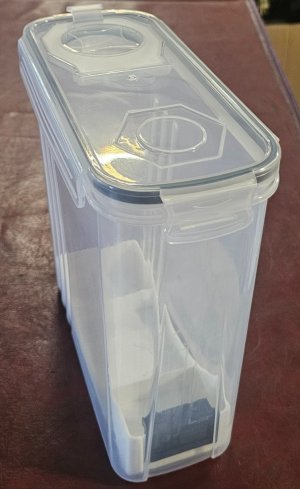
I think I'll just continue my practice of storing my filament that way and keep an eye on the humidity of the air in the container. If it fails to dry out, or the dessicant changes colour, I'll refresh the dessicant.
Thanks John
With just desiccant drying how long does it take to dry a spool?OK, sounds like a plan to me. Normally, I want the numbers to backup the plan, but I'll trust your recommendation especially since it lined up with my instincts and move on to other shop problems.
Well that's not nice!
For the most part I've been buying brand name Fillament and transferring it to a Tupperware cereal box with a dessicant tray / spool stand on the bottom of the container. The tray has a slot for a small square humidity meter.
View attachment 87748
I think I'll just continue my practice of storing my filament that way and keep an eye on the humidity of the air in the container. If it fails to dry out, or the dessicant changes colour, I'll refresh the dessicant.
Thanks John
TorontoBuilder
Sapientia et Doctrina Stabilitas
With just desiccant drying how long does it take to dry a spool?
Here is the problem...
While your desiccant will suck the moisture out of the air in your container at room temperature, the filament resists releasing moisture, to use my analogy again, at room temperature the variable speed pump is throttled right down.
Sound rules are, do not open filament until you need it... and then pop it in a heated drier before use to condition. Then seal it up after use.
Desiccant is a protectant, not a cure.
Guide to pre-printing drying times
Thats a good article.
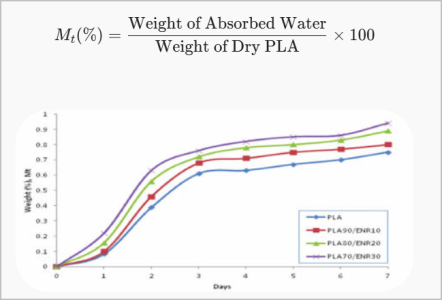
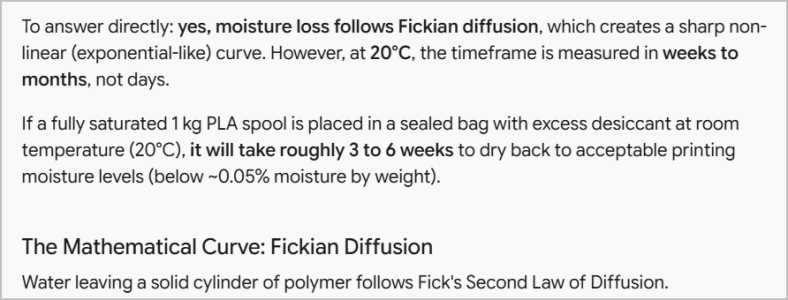
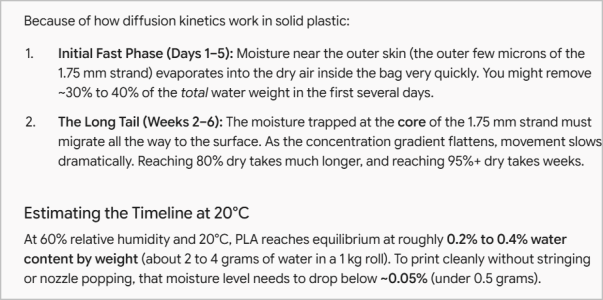
Trying to recreate what I AI-d before but this is the gist of it. I said if my max humidity was 60% at 20C shop temp & assume fully saturated filament because it was sitting on the printer for a long time, how long would it take to remove water in sealed bag with sufficient dessicant at same temp. In reality this is worst case, my humidity was 17% in winter & averaged 35-40% in the summer except for monsoon when it ent to 60%. But othergeographic areas could be much worse on average so that has to be accounted for.
I learned that not all PLA is the same, but typical PLA+ or Bambu basic is more like PLA90/100 (blue) curve. The graph shows diminishing returns, 5 days only gets you 70% water removal on mass basis. Obviously I was lazy enough to leave the spool exposed on the printer for a week, so properly storing in the sealed bag for the same time or longer seemed like my simple approach would do some good. Note that a 500g spool will not dry faster, the chart is on a filamant mass basis. Supposedly the outer filaments will be drier than deeper in the spool & outer filament will be first to enter the nozzle. This is because deeper in the spool, the moisture path has a longer more tortous path to get 'out' past its neigbour filaments towards the air/dessicant. Its small bonus points that work in favour but not not really the big picture. Possibly it explains when people say the first prints was great then it went for crap on the exat same job..
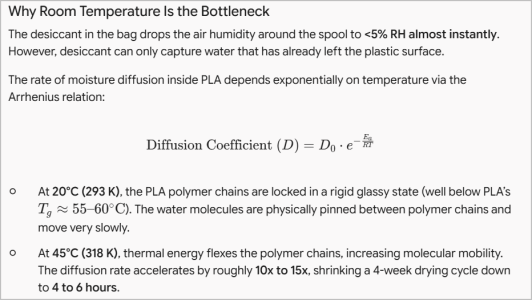
But as per the last screen grab, room temperature is the bottleneck on the simple bag method. To accelerate the water removal process you need to raise temperature which increases kinetic energy = a dryer. So if you are constantly swapping spools & wanting the the best filamant conditions, it requires a step up meaning elevated temperature control IMO.
Trying to recreate what I AI-d before but this is the gist of it. I said if my max humidity was 60% at 20C shop temp & assume fully saturated filament because it was sitting on the printer for a long time, how long would it take to remove water in sealed bag with sufficient dessicant at same temp. In reality this is worst case, my humidity was 17% in winter & averaged 35-40% in the summer except for monsoon when it ent to 60%. But othergeographic areas could be much worse on average so that has to be accounted for.
I learned that not all PLA is the same, but typical PLA+ or Bambu basic is more like PLA90/100 (blue) curve. The graph shows diminishing returns, 5 days only gets you 70% water removal on mass basis. Obviously I was lazy enough to leave the spool exposed on the printer for a week, so properly storing in the sealed bag for the same time or longer seemed like my simple approach would do some good. Note that a 500g spool will not dry faster, the chart is on a filamant mass basis. Supposedly the outer filaments will be drier than deeper in the spool & outer filament will be first to enter the nozzle. This is because deeper in the spool, the moisture path has a longer more tortous path to get 'out' past its neigbour filaments towards the air/dessicant. Its small bonus points that work in favour but not not really the big picture. Possibly it explains when people say the first prints was great then it went for crap on the exat same job..
But as per the last screen grab, room temperature is the bottleneck on the simple bag method. To accelerate the water removal process you need to raise temperature which increases kinetic energy = a dryer. So if you are constantly swapping spools & wanting the the best filamant conditions, it requires a step up meaning elevated temperature control IMO.
If you want to save some money/space on a filament dryer, you can use the heated bed on your printer & a cardboard box instead. I did this and revived some old PLA I had neglected. Functionally, it's pretty much the same as a dedicated filament dryer.
Question: would it be worthwhile to throw some desiccant in the filament dryer (or printer heated bed) while it's drying?
Question: would it be worthwhile to throw some desiccant in the filament dryer (or printer heated bed) while it's drying?