• Scam Alert. Members are reminded to NOT send money to buy anything. Don't buy things remote and have it shipped - go get it yourself, pay in person, and take your equipment with you. Scammers have burned people on this forum. Urgency, secrecy, excuses, selling for friend, newish members, FUD, are RED FLAGS. A video conference call is not adequate assurance. Face to face interactions are required. Please report suspicions to the forum admins. Stay Safe - anyone can get scammed.
  • The 2026 Calgary Area Meetup is set for Saturday May 30th at 10am. The signup thread is here! Robinhood has graciously offered to host the meetup again this year. Please note that you MUST RSVP to the notice linked above if you wish to come.

Working on my South Bend 9C

Just wondering, how much stick out did you have when center drilling? And do you face off the workpiece prior to drilling?
I suspect that your center drill has wandered slightly forcing the work piece over prior to starting....
On something like this, I would try and turn it between centers.
I feel your pain, there's always something laying in wait to mess with your day. I recently turned my nice countershaft into a banana when I put the keyway in for the cone pulley. 🙁
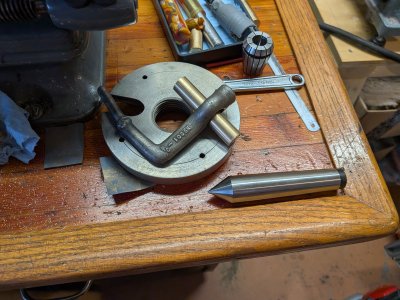
Stick out when center drilling was basically what you see here. So a good amount (it was the full 5/8" diameter).

And yep I did face it before center drilling!

Will need to order another rod and learn to turn between centers if that is the route to try next.

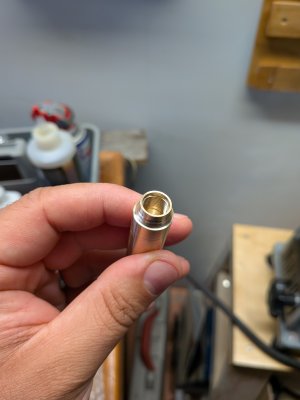
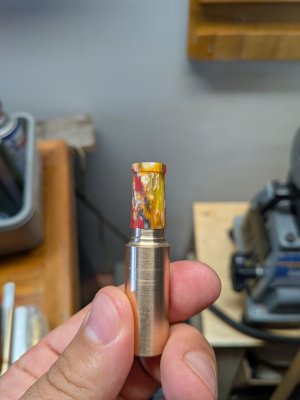
I may also for the time being shorten this and run it as a partial internal mandrel. Not ideal but may work out fine
 
OK, so it appears its one of 2 things:
1. As @140mower says the center was off center
2. The material has uneven stress "built in" and by machining it you are removing different amounts of it. Its far more prevalent on flat bar stock when milling, but can occur with round, depending on how it was made round and if it was straightened (during mfg or after).

Now for what to do about it. If a very straight part is required you have a few things you can do to help (one or all)
A. Have the end of the material chucked up much closer to the chuck to help with centering (if possible) or use a steady rest to stabilize while facing and center drilling
B. Turn between centers (yeah its a pain but works great for very straight shafts)
C. Try stress reliving the material before turning. Brass can be oven baked to stress relive it. I need to dig up the temperatures people have used but its well within your kitchens capabilities (like 450°F or 500°F) for a few hours.
 
Stick out when center drilling was basically what you see here. So a good amount (it was the full 5/8" diameter).

And yep I did face it before center drilling!

Will need to order another rod and learn to turn between centers if that is the route to try next.

I may also for the time being shorten this and run it as a partial internal mandrel. Not ideal but may work out fine
I'm a big fan of turning between centres.

If your part was clamped into the collet at an ever so slight angle then the centre hole and live center will bring it straight for turning and the same diameter all across. Release if from the live center and it springs back to where it was.

Make sure, (you probably did) that before you tighten down the collet that it's just firm but not tight and then put the center into the hole. A few manual turns of the spindle will straighten it out in the collet before you tighten it down.
 
Sounds like it's time to learn to turn between centers! Will have to see if I have suitably sized drive dogs and plate.
Drive dogs are easy enough to cobble up if you don't have the right size on hand. One trick is to turn a small 60° center on a suitable sized piece of stock in the three jaw and drive the part off one of the jaws. Keep it with your other centers and recut the angle each time you put it in the chuck.
 
Drive dogs are easy enough to cobble up if you don't have the right size on hand. One trick is to turn a small 60° center on a suitable sized piece of stock in the three jaw and drive the part off one of the jaws. Keep it with your other centers and recut the angle each time you put it in the chuck.
That's the easy way to do it if you don't have a drive plate for the drive dog.
For my South Bend I have this odd spindle taper so I bought an adapter for MT3. Unfortunately it sticks out way too much for my liking so the pin on the drive dog has to be much longer than I'd like.

Still they work. Here are a few examples. Eazy Peazy to make.

1778650845044.png
 
So what could be the culprit for a "sprung" piece when released from the live center?

Your comment about consistent diameter let's the tailstock off the hook horizontally, but not vertically. It could still be out a bit vertically where the tangent error is very low.

What it doesn't let off the hook is a spindle axis that doesn't point at the tailstock. If so, the tailstock center will force the part to follow the tailstock but its internal stresses will be out of line. When you remove the tailstock it will go where it wants to go which might well result in a wobble.

Turning between centers as others have suggested will fix this too.

Of course, the proper solution is to align the headstock with the bed and tailstock.
 
Huh, I didn't even think the headstock or spindle had any provision for alignment.

Now, is the bed properly untwisted/aligned/etc? No. That would need to start with a new stand/cabinet.
 
Huh, I didn't even think the headstock or spindle had any provision for alignment.

The heads on some lathes actually do have alignment provisions. Most don't. But it's all just relative. There is no practical difference between aligning the head with the ways and aligning the ways to the head.

Now, is the bed properly untwisted/aligned/etc? No. That would need to start with a new stand/cabinet.

Not necessarily. You can manipulate the head to bed alignment by shimming under the head or by articulating the bottom of the bed where it bolts to the stand.
 
@Susquatch I do mean to dig back into your alignment document. But I still think my base cabinet is so rickety it might be moot at this point?

Buttttt for now, looks like I've got a drive plate and suitability sized dog so when more rod arrives tomorrow we can try this again. Time to watch some videos on between center turning.
 

Attachments

  • PXL_20260513_181337350.jpg
    PXL_20260513_181337350.jpg
    2.5 MB · Views: 2
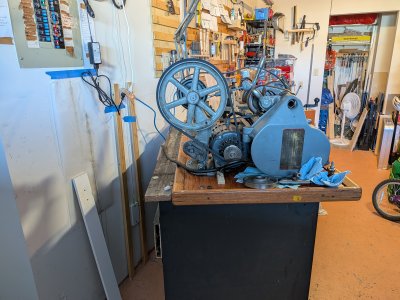
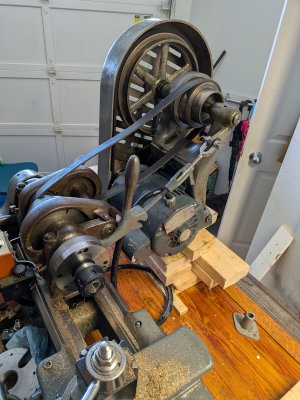
Wouldn't it be easier to get a longer serpentine belt and just move it back an inch? Or the lathe ahead an inch, or both.

I don't think you've aligned the lathe yet? Now would be much less work to move it properly
 
Wouldn't it be easier to get a longer serpentine belt and just move it back an inch? Or the lathe ahead an inch, or both.
You bet it would be!

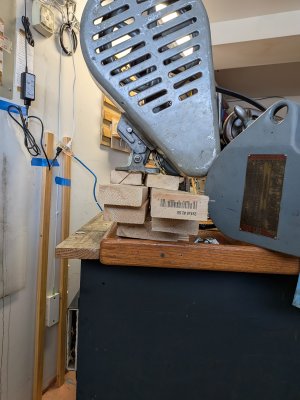
Can't move it back at all, as the guard hits the wall at extension.

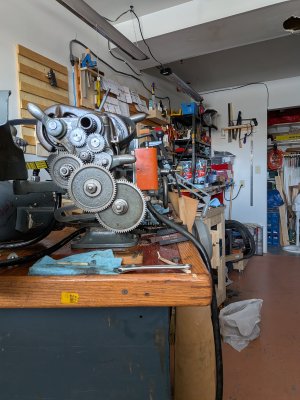
I guess I could move the lathe forward on the bench but then the handwheels would extend past the edge of the bench, which I don't love because I'll walk into them...
 

Attachments

  • PXL_20260520_203302690.MP.jpg
    PXL_20260520_203302690.MP.jpg
    1.8 MB · Views: 4
Back
Top