• Scam Alert. Members are reminded to NOT send money to buy anything. Don't buy things remote and have it shipped - go get it yourself, pay in person, and take your equipment with you. Scammers have burned people on this forum. Urgency, secrecy, excuses, selling for friend, newish members, FUD, are RED FLAGS. A video conference call is not adequate assurance. Face to face interactions are required. Please report suspicions to the forum admins. Stay Safe - anyone can get scammed.
  • The 2026 Calgary Area Meetup is set for Saturday May 30th at 10am. The signup thread is here! Robinhood has graciously offered to host the meetup again this year. Please note that you MUST RSVP to the notice linked above if you wish to come.

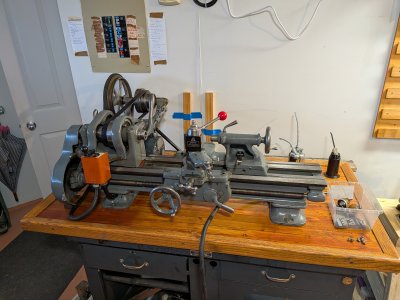
Working on my South Bend 9C

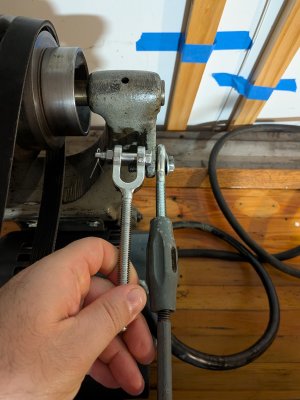
Latest musings while I wait for a new turnbuckle piece so I can finally start using this.

1) Taper attachment would be very cool. Unclear from my reading if that's compatible with the C-style carriage without power cross feed.

2) OEM 2 step motor pulley is too expensive. I am reasonably confident that my current motor pulley is just something off the shelf, and may in fact be a single version of this 2-step pulley... So mayhaps I try that out.

3) Debating refurbishing the existing drip oilers for the headstock or getting new ones. May do the same mod on the countershaft as well, since all of my spindles are total loss oilers...

4) Tailstock quill extension will be a must eventually. But I will likely need to outsource that to someone, since you kind of need a functioning lathe to modify the parts.

5) Small parts: will need to see if I can put together some more brass shims for shimming out backlash in the dials. Could also use some fresh taper pins for the cranks. And maybe grab some nylon washers for taking up slop in a few non-critical spots.

6) Some dial indicators/stops for the carriage will be good to do (I think I have one included, need to see if it's just a stop or can take an indicator).

7) Trying hard not to think about ELS and DRO and all those fun things just yet.
 
Golem, DRO is IMHO over-kill for the old SB9.
The dials, while small are very accurate & easy to use.
However, I love DRO on my mill, IMHO a necessity on a mill.
I believe u have a milling attatchment, so a carriage stop for a dial indicater would be easy to make. I made mine years ago on my milling attatchment before i had a mill, it’s very useful.
I’ve never needed, or used a quill extension, something to think aboot i guess.
 
My Meuser has both left and right micrometer stops. Todays job requires 14 pieces of equal length and I'm using the rh stop alone as a fixed stop. Butt the carriage to the stop, slide the work to the tool, reset the carriage to the stop with a 1/4" piece of tool steel in between the carriage and the stop and part it off. Nothing fancy but quick, easy and accurate.
 
Oh yeah I was going to ask if anyone had guesses about that!
If the original drive had a way of locking the spindle then you can manually turn the spindle to a specific degree setting and lock it. Next using a tool on the carriage set up to work as a shaper. Move back and forth to cut internal or external splines.
 
Golem, DRO is IMHO over-kill for the old SB9.
I humbly disagree. DRO makes machining, especially precision machining, much more enjoyable & repeatable. 20 years ago, heck 10 years ago, when DRO kits were relatively expensive this was something to ponder. Now the kits from Asia are so cheap & reliable, much smaller form factor & generally more adaptable to smaller machines. And old machine potentially benefits by DRO even more because those are typically the ones with issues: lead screw & feed screw backlash wear, often absence of locks on slide ways, looser fits on sliding surfaces... The DRO mitigates most all of this. It will not lie because it displays absolute displacement. Arguably you can make a crappy machine produce better parts, or at least less chance of user error.
 
If the original drive had a way of locking the spindle then you can manually turn the spindle to a specific degree setting and lock it. Next using a tool on the carriage set up to work as a shaper. Move back and forth to cut internal or external splines.

Hi Michael,

Cutting keyways or splines by winding the carriage back and forth is time consuming hard work ! And hard on the saddle in terms of wear and tear.

I made a hand slotter that fitted into the toolpost to do that job, whilst it worked very well it was still a time consuming job. Almost as bad as milling on the lathe.
 
Small parts: will need to see if I can put together some more brass shims for shimming out backlash in the dials. Could also use some fresh taper pins for the cranks. And maybe grab some nylon washers for taking up slop in a few non-critical spots.

It's easy to get over concerned about backlash. Especially if you have a mill or friends who have mills.

But the good news is that lathes are not the same as mills. Yes, you can get in trouble with too much backlash but it isn't nearly as common or as likely as it is on a mill.

Most lathe work automatically takes up the backlash through tool pressure. And it is rare to do anything that could cause a sudden grab like often happens on certain milling operations.

I don't worry about backlash myself. It is there, and I know it's there. Knowing about it is 99% of dealing with it.
 
The electronics is all academic at this point. I won't know how much I feel the need until I actually get hand on with it. Anything that will streamline my shaping process will be good though.

Very interesting re: the shaper possibility. Not on my list to bother with, but I wonder which previous owner was doing that!

Backlash hunting is my obsessive side coming out 😉

@DavidR8 @jcdammeyer @jorogi @140mower are all welcome to come by for an inspection and pot of coffee any time 😉
 
The electronics is all academic at this point. I won't know how much I feel the need until I actually get hand on with it. Anything that will streamline my shaping process will be good though.

Very interesting re: the shaper possibility. Not on my list to bother with, but I wonder which previous owner was doing that!

Backlash hunting is my obsessive side coming out 😉

@DavidR8 @jcdammeyer @jorogi @140mower are all welcome to come by for an inspection and pot of coffee any time 😉
Same goes if you want a demo of my ELS. I just used the bore to depth feature to clean up a 3D printed hole so a large tapered bearing would slide in.

Yes. I could have set the carriage stop and just turned the handle by hand the last bit after releasing the lead screw half nut. But that requires paying attention....
 
Hi Michael,

Cutting keyways or splines by winding the carriage back and forth is time consuming hard work ! And hard on the saddle in terms of wear and tear.

I made a hand slotter that fitted into the toolpost to do that job, whilst it worked very well it was still a time consuming job. Almost as bad as milling on the lathe.

Hi Micheal,

Attached is a copy of an article describing a hand slotting attachment for a lathe. This is the one that mine for the Myford was based on.
 

Attachments

I was considering replacing the icky trico oilers on the headstock and adding a pair to the countershaft. But they're $200 a pop soooo I'll see how well I can disassemble and clean these I guess!
 
Oooooo. Look at that fancy new wedge style AXA Tool Post! I take it that it fit just fine!
 
Back
Top