• Scam Alert. Members are reminded to NOT send money to buy anything. Don't buy things remote and have it shipped - go get it yourself, pay in person, and take your equipment with you. Scammers have burned people on this forum. Urgency, secrecy, excuses, selling for friend, newish members, FUD, are RED FLAGS. A video conference call is not adequate assurance. Face to face interactions are required. Please report suspicions to the forum admins. Stay Safe - anyone can get scammed.

JCDammeyer's 42 projects

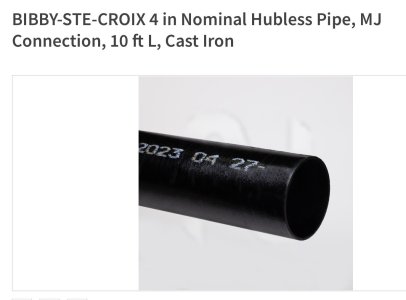
One of these, depending on the diameter and length of the break.
And a shopvac is your friend when digging this sort of hole and you don't want anymore debris to fall in.
 
+1 on using a shop vac. Its amazing. I used one with a pressure washer to do my own "hydro-vac" excavation for sonotubes, worked amazingly in ground that was near impossible to dig with a shovel. Be sure to use a foam filter if using a shop vac, and empty frequently as it gets heavy fast.
 
One of these, depending on the diameter and length of the break.
And a shopvac is your friend when digging this sort of hole and you don't want anymore debris to fall in.
Too long and underground. Plus at this point given how much I've dug up already I think I'd like to replace it with the same white pipe used for the clean-out and the rest of the sewer down to the road.

But. It's the problem of accessing under or even behind the perimeter drain.

So the suggestion is just loosen the dirt to the right of the hole and use the shop vac to pull it out of the hole?

I suppose if I used the shop vac to clean around that opening I could temporarily glue down a cover over the hole and then continue with excavation.
 
+1 on using a shop vac. Its amazing. I used one with a pressure washer to do my own "hydro-vac" excavation for sonotubes, worked amazingly in ground that was near impossible to dig with a shovel. Be sure to use a foam filter if using a shop vac, and empty frequently as it gets heavy fast.
I dug three 6 foot holes to put in the posts that held up the business sign for the kennel. The sign was 20ft by 4 ft so quite a large sail area for the middle of the bald prairie and I only wanted to do it once.
I had a 36 inch auger to start and then used 6 feet of vacuum hose and a 6 foot bar for the rest. Probably wouldn't work if the soil was wet but that isn't a problem in southern Saskatchewan.
After this weekend it's all very wet.
 
Well now I have the ability to watch things float by. I started digging on the other side of the curb first removing the 8"-10" of flower bed soil. The stuff below that wasn't super hard and it was pretty easy to push the square spade down and along the direction of the pipe to clear out the dirt.

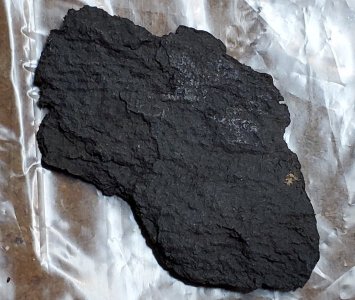
Suddenly as I scraped along the top of the pipe this was included in the dirt picked up 12-16" from the inside edge of the curb. Which is almost exactly where the camera said there was an issue.
View attachment 71741

After that it was hand digging and breaking off crumbly pieces from the edge of the pipe. Cleaned out as best as I could and then went in and flushed a clean toilet to wash it down to see what it looked like. This is with the water still flowing. the shape of the pipe around the hole is not round. Obviously at some point in time this pipe had been crushed and cracked. Likely the plumber's clean out too exacerbated the problem shattering more of the pipe.

View attachment 71742

At this point any disturbance puts more dirt into the pipe so I have a plastic bag over it held down with a large rock. The frustrating part is that there's the perimeter drain pipe and roof drain pipe to the right of this still underground and above the sewer pipe. Then the planter. Then poured concrete entrance walkway.

And did I or did I not also hit the pipe with the @DavidR8 magic post?

Don't really know what sort of coupling to buy to fix this.
You might have to check with Bartle and Gibson.
 
It works wet, I was actively applying water via the pressure washer and sucking up the loosened material. It can be hard on the shop vac, but works and saves your back and is worth it if you are over 30 years of age...
 
You might have to check with Bartle and Gibson.
Thanks. Yes. But it's reached a point where I'm not sure I want to do this myself. At least the squished down part isn't squished anymore. So less chance of a blockage now.
I wonder how well old W.E.S.T. EPOXY will stick to this pipe?
 
Pipe o.d.? Length of broken section? I used to work for B&G, lots of options available. keep in mind you’re only dealing with gravity-fed low-pressure. There are pipe repair clamps that are split lengthwise and clamp around the pipe o.d..
 
I suppose if I used the shop vac to clean around that opening I could temporarily glue down a cover over the hole and then continue with excavation.

Maybe you missed my earlier suggestion. It works well both temporary and permanent.

Fixing the hole is as easy as splitting a section of plastic pipe, spreading it, and slipping it over the hole. In fact, the "sleeve" can even be glued on. Note, if the section won't spread wide enough, you may need to cut a wider strip out of it.

You can also add a rubber sleeve. They come in split and solid. For the solid ones, you slip them over one or the other pipe, put the repair pipe in, slide the rubber back over the joint and tighten the clamp.
 
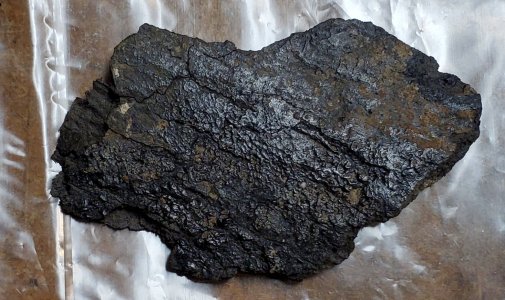
Everything I read about Transite type pipe says it's a mixture of asbestos and cement. This doesn't seem to have cement and it's odd that it's totally black. Haven't seen any photos online that show black pipe and as thin has this stuff is. Might still be asbestos fibres but mixed with something else?

I'm going to wash one of the fragments and see if, when dry, epoxy bonds to it. It's rough on the outside so a standard rubber pipe fitting likely won't seal and if tightened down too much might even crush the pipe.
 
I'm going to wash one of the fragments and see if, when dry, epoxy bonds to it. It's rough on the outside so a standard rubber pipe fitting likely won't seal and if tightened down too much might even crush the pipe.
Personally, I would have more faith in the sleeve than the epoxy on something buried in the ground. The sleeves tend to self seal and conform to the underlying pipe. They don't need to be torqued down a lot to seal. It's not exactly fresh spring water running through that pipe and it's not holding pressure or constantly full either so the , ahem, solids, will tend to seal any small leaks.
 

Attachments

  • Fragment-Side1.jpg
    Fragment-Side1.jpg
    171.1 KB · Views: 3
  • FragmentSide-2.jpg
    FragmentSide-2.jpg
    317 KB · Views: 3
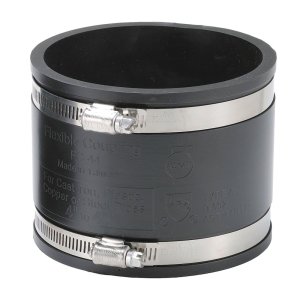
Lord knows what the heck that is. Doesn't look like any broken piece of pipe I've ver seen, and I started selling plumbing stuff in 1978. Cut out the broken section, get a couple of appropriate rubber couplings, and a chunk of PVC DWV pipe. Rubber coupling is pretty soft and will conform to the o.d. of the pipe, and the compression load from the hose clamp is distributed evenly around the pipe o.d. so it's unlikely to crack anything. Doesn't need to be cranked down to 1000 ft-lbs, just tighten it enough that the coupling doesn't slide. Solved.

These couplings are usually tested to 15 PSI, will last forever on a drain line.

p_1000119990.jpg
 
Lord knows what the heck that is. Doesn't look like any broken piece of pipe I've ver seen, and I started selling plumbing stuff in 1978. Cut out the broken section, get a couple of appropriate rubber couplings, and a chunk of PVC DWV pipe. Rubber coupling is pretty soft and will conform to the o.d. of the pipe, and the compression load from the hose clamp is distributed evenly around the pipe o.d. so it's unlikely to crack anything. Doesn't need to be cranked down to 1000 ft-lbs, just tighten it enough that the coupling doesn't slide. Solved.

These couplings are usually tested to 15 PSI, will last forever on a drain line.

View attachment 71788
Tis strange. I will need two since the hole is longer than one of these.
Then there's still the pipe seeking post that @DavidR8 gave me. The dirt line on it was at the depth of this pipe and it looks like it's right in line. But the other drain pipes are in the way.
I guess I could gamble that that part isn't damaged.
Or replace the entire length up to the inspection point which is white PVC installed when the septic tank was decommissioned.

A number of years we had a landscape architect plan some renovations. We didn't do a lot of what was on the plans. Ran out of money. Now we could put in this flat patio taking out the planter that is there now.

So take out the concrete block planter which is actually falling apart and pretty ugly and at the same time replace the entire length of 58 year old pipe.

1761088180551.png
 
Back
Top