@BaronJ
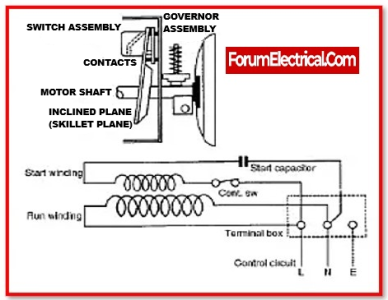
Never seen one like it either. Found an image and some information (had to improve the text otherwise it was similar to the lower wiring diagram):
View attachment 86253
Taken from
Fractional & Subfractional Horsepower Electric Motors Third Edition:
"17-7. Other Starting Switches. Many forms of centrifugal starting switches have been developed and used. One form, developed by the Ohio Electric Company, had a stationary member consisting of two stationary slip rings, secured to the front end shield and connected inseries with the auxiliary winding; the rotor carried a single brush which spanned the two rings, closing the circuit when the motor was at stand still; as the rotor came up to speed, centrifugal force caused the brush to move radially outward, away from the slip rings, thereby opening the starting-winding circuit. Another quite different arrangement was the skillet type, developed by Delco: the stationary member carried a skillet-shaped arm which bore the stationary switch contacts; the governor weight was washer-shaped and slid along a radial switch pin,against a coil-restraining spring; in earlier models, the switch pin was mounted in a hole in the shaft, but in later models it is supported by a boss or projection which is cast integral with the aluminum end ring of the rotor. Westinghouse has used many forms of starting switches. A number of motor manufacturers still use their own design of centrifugal switches; most of these designs use a phenolic spool, arranged to slide along the shaft to actuate the stator member; the spool is caused to move by weights, moving outward due to centrifugal force, acting through a toggle linkage; the toggle idea, of course, is to make the rotor member snap-acting, for reasons already explained. One such switch is illustrated in Fig. 17-6. Many of the above-mentioned switches were discussed in greater detail in Chap. XVIII of an earlier work."
@Garzweiler
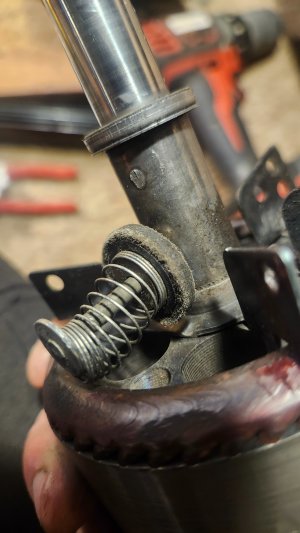
Does any of that look or sound familiar to the motor you're working with? In that diagram above the "governor assembly" looks similar to what you posted.