• Scam Alert. Members are reminded to NOT send money to buy anything. Don't buy things remote and have it shipped - go get it yourself, pay in person, and take your equipment with you. Scammers have burned people on this forum. Urgency, secrecy, excuses, selling for friend, newish members, FUD, are RED FLAGS. A video conference call is not adequate assurance. Face to face interactions are required. Please report suspicions to the forum admins. Stay Safe - anyone can get scammed.
  • The 2026 Calgary Area Meetup is set for Saturday May 30th at 10am. The signup thread is here! Robinhood has graciously offered to host the meetup again this year. Please note that you MUST RSVP to the notice linked above if you wish to come.

Working on my South Bend 9C

How about in threading mode with clamshell engaged on threading leadscrew? I havent tried it in a while but it seemed to me it required some gronk when I was hand finishing threads. Not a crazy amount, but enough that i didnt think I had a good feel

It was never a big problem Peter. I never tried it with a heavy cut though. The depth of cut would probably matter A LOT.
 
I've worked with quite a few resins & composite materials. I have an unsubstantaited hunch the threading results are related to the material or setup in conjunction with material. Not to get into details but its very easy to prove. Chuck up a piece of free maching brass, 12L14 or even common 6061 aluminum & cut the threads using the same dimensions & setup. The die cut threads should be acceptably nice & accurate. If not, it points at mechanical/setup issues (assuming the die is new & good gondition).
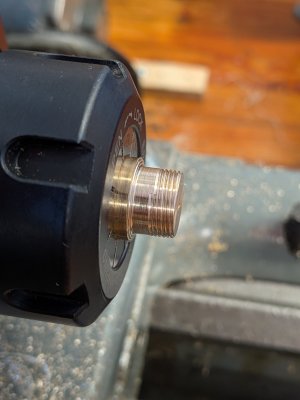
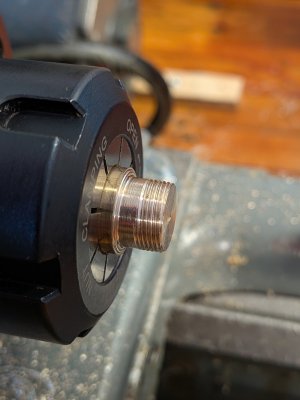
Late response but I've been down sick the last week. Finally had the chance to do a pass in brass as noted.
 

Attachments

  • PXL_20260616_231331442.jpg
    PXL_20260616_231331442.jpg
    742.7 KB · Views: 10
  • PXL_20260616_231325572.jpg
    PXL_20260616_231325572.jpg
    927.7 KB · Views: 10
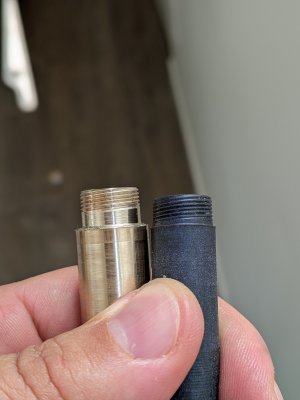
I know photos of metal can be deceiving (tend to pick up light & make surfaces look worse). But It think these threads are better than your pen blank? What is your own opinion up close 1:1?
 
I know photos of metal can be deceiving (tend to pick up light & make surfaces look worse). But It think these threads are better than your pen blank? What is your own opinion up close 1:1?

^This @Golem Pens

I saw your comparison. But like Peter, I can't judge from a photo. I'd like to know what YOU think when YOU lay an eyeball on it right up close and personal.
 
Maybe I missed it but how are you holding the die & how are you advancing it into the work?

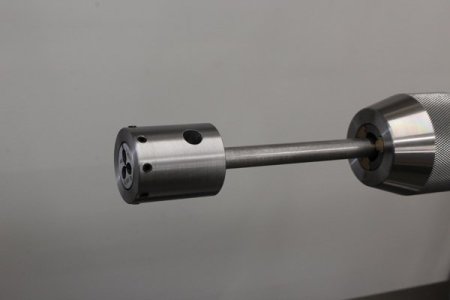
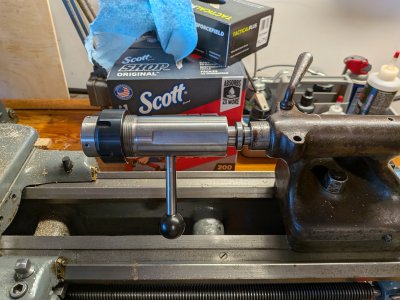
I wasnt getting consistent results on fine threads and/or delicate fiddly parts using the typical methods, so ended up turning up some die heads which spin on a rod held in TS. Also I must have 5 different die diameters to contend with by now & generally most die wrenches are crap. Much better results using a die head. I can thread under power just holding the head & release, or else insert a tommy bar on bigger threads to crank. I think I can improve fine threading some more with shorter rod held in a floating reamer mechanism, next on the to-do list.
 

Attachments

  • 25032503.jpg
    25032503.jpg
    16.1 KB · Views: 2
  • 24042506.jpg
    24042506.jpg
    14.6 KB · Views: 3
  • 24042505.jpg
    24042505.jpg
    40.7 KB · Views: 3
  • 24042502.jpg
    24042502.jpg
    49.9 KB · Views: 3
Great question. And that blank is especially hard to see detail on due to the colours. Here's a comparison with an older one. https://photos.app.goo.gl/jNStajkuferCfdWA9

Honestly, I'm not sure I'm reliably nailing the OD enough between pieces make a super accurate comparison.
Hi Michael,
To me the threads on the plastic (Black) one look flattened on one side, maybe the blank was slightly over size.
 
Maybe I missed it but how are you holding the die & how are you advancing it into the work?

I wasn't getting consistent results on fine threads and/or delicate fiddly parts using the typical methods, so ended up turning up some die heads which spin on a rod held in TS. Also I must have 5 different die diameters to contend with by now & generally most die wrenches are crap. Much better results using a die head. I can thread under power just holding the head & release, or else insert a tommy bar on bigger threads to crank. I think I can improve fine threading some more with shorter rod held in a floating reamer mechanism, next on the to-do list.
Hi Peter,

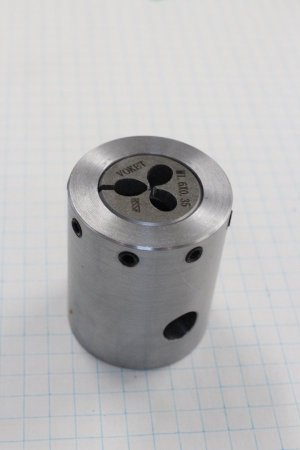
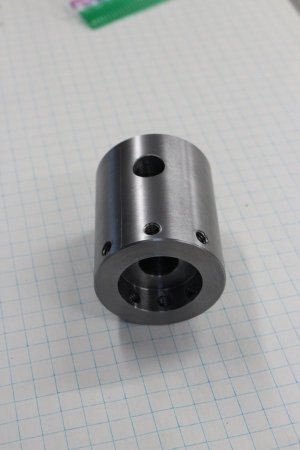
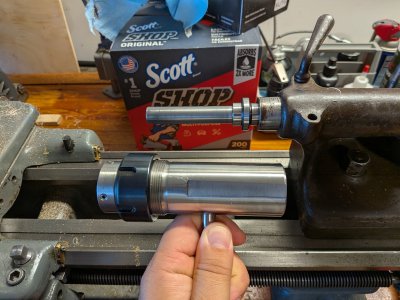
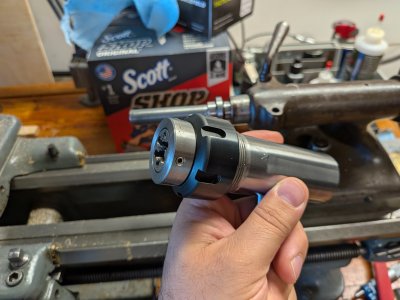
The shaft on my tailstock is 13 mm diameter and much shorter only about 25 mm into the die holder. I also have several size die holders that fit on the same tailstock holder.
 
Maybe I missed it but how are you holding the die & how are you advancing it into the work?
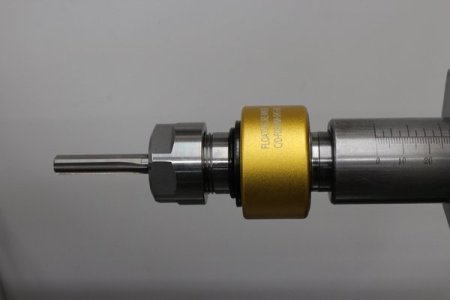
A somewhat similar setup in fact.
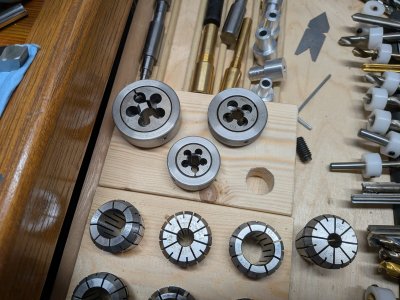
The main piece uses an er32 collet to swap in other dies or taps in their own holders.

I've only used hand power for tapping with this.
 

Attachments

  • PXL_20260617_133211883.jpg
    PXL_20260617_133211883.jpg
    1.8 MB · Views: 6
  • PXL_20260617_133220509.jpg
    PXL_20260617_133220509.jpg
    1.6 MB · Views: 5
  • PXL_20260617_133230886.jpg
    PXL_20260617_133230886.jpg
    1.2 MB · Views: 6
  • PXL_20260617_133238495.jpg
    PXL_20260617_133238495.jpg
    2 MB · Views: 6
A somewhat similar setup in fact.

That aspect looks good. What got me thinking about a floating reamer holder was the potential for the die to be off relative to work center axis. Example, DOC of a 1mm pitch thread = 0.613mm = 0.024". Thats considered a relatively course thread for finicky fastener work. I know my TS is 3-4 thou high. Lets say the die/holder gap is another 0.002". Lets say the ER /holder gap is is 0.001" just for numbers. Collective off-center could be as high as (0.004 + 0.002 + 0.001) / 0.024 = 0.29 so 29% of thread depth. Thats actually quite a bit in terms of thread form. And of course left/right TS off-axis could add to that. A finer 0.8 pitch = 0.433mm = 0.017" so the same hypothetical setup off center gets even more magnified relative to pitch. Of course we hope the tolerances could align to help cancel one another out but we have no control of this.
 
That aspect looks good. What got me thinking about a floating reamer holder was the potential for the die to be off relative to work center axis. Example, DOC of a 1mm pitch thread = 0.613mm = 0.024". Thats considered a relatively course thread for finicky fastener work. I know my TS is 3-4 thou high. Lets say the die/holder gap is another 0.002". Lets say the ER /holder gap is is 0.001" just for numbers. Collective off-center could be as high as (0.004 + 0.002 + 0.001) / 0.024 = 0.29 so 29% of thread depth. Thats actually quite a bit in terms of thread form. And of course left/right TS off-axis could add to that. A finer 0.8 pitch = 0.433mm = 0.017" so the same hypothetical setup off center gets even more magnified relative to pitch. Of course we hope the tolerances could align to help cancel one another out but we have no control of this.

That's why earlier I was wondering if I may want to try and account for the bed wear by shimming the tailstock up a bit (I think I've got the L/R alignment in hand). Obviously that only addresses it for a given location on the bed, but I cut these threads within a pretty narrow range of distance.
 
Two words. "SINGLE POINT".

I've done the die in the tailstock thing and have a tailstock die holder that I have four sizes for.

Mine has a shorter length than @PeterT's does. But I can see the advantage of the long shaft which I agree might act a bit like a floating reamer holder.

Will that help? I dunno.

In general I just don't like threading with a die on the lathe. Even floating, I cannot imagine them holding a true center. The teeth in the die cannot be identical and we all know how non-homogeneous most materials are which can't help but lead the die off center. I guess that applies 10 fold to the mixed layers of @Golem Pens plastic stock.

As @PeterT 's math shows, it doesn't take much. But I really don't think it needs to be off center to screw up the screw! Other factors and forces will contrive to do it regardless.
 
That's why earlier I was wondering if I may want to try and account for the bed wear by shimming the tailstock up a bit (I think I've got the L/R alignment in hand). Obviously that only addresses it for a given location on the bed, but I cut these threads within a pretty narrow range of distance.

What you could do if you havent already is tempoarily remove the die, put a dial test indicator in your lathe chuck & rotate about the die cup ID. If thats reading fine, say within 0.001" in both primary orientations, then odds are good the die runout should not be too far off assuming its a nice sliding fit. With DTI in, you could also tug on the sliding assembly to see if that varies.

I forgot you mentioned potential bed wear but also most lathe TS start out high (3-5 thou, all depends) so it could be they are serving to cancel one another. The DTI test will reveal whats going on. And it might not be quite that simple with bed wear depending on offset distance as you say, especially if the TS is pointing downhill but may not have actually displaced itself downhill depending on where wear occurs. Where exactly would you anticipate shimming the TS?
 
Back
Top