
-
Scam Alert. Members are reminded to NOT send money to buy anything. Don't buy things remote and have it shipped - go get it yourself, pay in person, and take your equipment with you. Scammers have burned people on this forum. Urgency, secrecy, excuses, selling for friend, newish members, FUD, are RED FLAGS. A video conference call is not adequate assurance. Face to face interactions are required. Please report suspicions to the forum admins. Stay Safe - anyone can get scammed.
-
The 2026 Calgary Area Meetup is set for Saturday May 30th at 10am. The signup thread is here! Robinhood has graciously offered to host the meetup again this year. Please note that you MUST RSVP to the notice linked above if you wish to come.
You are using an out of date browser. It may not display this or other websites correctly.
You should upgrade or use an alternative browser.
You should upgrade or use an alternative browser.
Working on my South Bend 9C
- Thread starter Golem Pens
- Start date


Garyt
Well-Known Member
Practice on plastic is a good idea but a tool grab can pull plastic out of the chuck because the material is so flexible but that can be good because nothing gets damaged except the practice (test) work piece.I highly recommend getting a piece of PVC pipe and threading that to get the dance moves down.
Single point threading is one of thr most satisfying thing I can do on my southbend.

Golem Pens
Michael
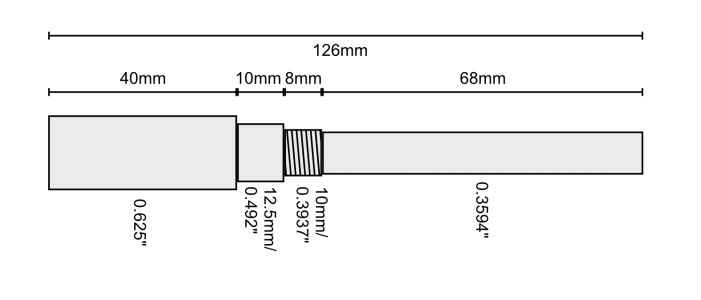

Alright there is my plan for dimensions of one of the mandrels...
I think it will be extremely difficult to cut that mandrel to 4 decimal places. In particular, there is no need for precision like that on a threaded section. The mated part will not know the difference. The fit is on the tapered sides of the thread not on its internal/external diameter.
Also, are you missing the center on the far right end? It is unlikely that you can cut a mandrel that long without it. Your mandrel is 2x too long to do that. In fact, at that length to diameter ratio, even a center might not be enough. As above 4 places is too difficult to cut on such a long piece on such a small diameter. You will almost certainly have chatter marks that will be 5 tenths in variation.
Golem Pens
Michael
No I'm not actually targeting 4 decimal places, just dumped in the output of the conversion. And I didn't indicate the center, no. I consider this a fancy napkin sketch, not a real schematic, I don't know how to do real ones.
No I'm not actually targeting 4 decimal places, just dumped in the output of the conversion. And I didn't indicate the center, no. I consider this a fancy napkin sketch, not a real schematic, I don't know how to do real ones.
OK, no problem. I'm sure you are not alone.
So, it's good that there will be a center in the tailstock. That is a very long slender part. It will be interesting to see if using a center is enough.
Golem Pens
Michael
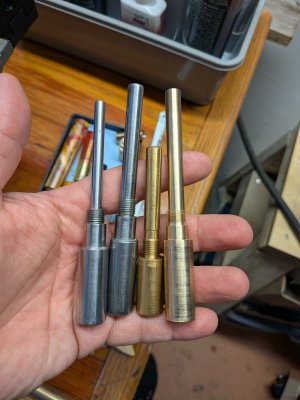
I've got a few from other sources, but they all vary in some way. They're all the wrong threading.
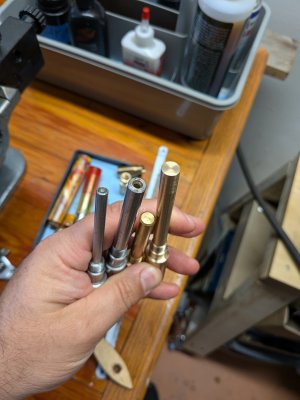
From left to right: shorter and narrower (in mystery steel), pretty much exactly the same maybe a bit shorter (also mystery steel), same but shorter (brass), and my first wobbly one.
From left to right: shorter and narrower (in mystery steel), pretty much exactly the same maybe a bit shorter (also mystery steel), same but shorter (brass), and my first wobbly one.
Attachments
From left to right: shorter and narrower (in mystery steel), pretty much exactly the same maybe a bit shorter (also mystery steel), same but shorter (brass), and my first wobbly one.
Looks like the two steel ones were made using a center. Neither brass one was. Yet brass would need a center far more than steel would. Not hard to imagine why the long brass one is wobbly.
Golem Pens
Michael
Well I made the brass one too long and parted off the bit with the center drilling. But, won't be doing that this time!
Well I made the brass one too long and parted off the bit with the center drilling. But, won't be doing that this time!
Once upon a time, maybe 50 years ago, I did that too. It's a one-time mistake you never forget.

only one time?????Once upon a time, maybe 50 years ago, I did that too. It's a one-time mistake you never forget.
only one time?????
Yup. That's the only time I remember anyway. It was a complicated part and I had a lot of hours into it. I damn near quit making stuff when it broke off. After that I paid much closer attention to order of ops. No more drilling or reaming thin stock......
Golem Pens
Michael


Two things.
1. Is that still installed in the chuck from when you cut it? Or did you remove it or loosen it between then and the video?
2. Did you use a center in the tailstock or a steady to cut it?
Golem Pens
Michael
1) It has not yet been removed from, or moved in the chuck at all (wasn't going to until I was done threading too).
2) It's had a live center in the entire time.
2) It's had a live center in the entire time.
1) It has not yet been removed from, or moved in the chuck at all (wasn't going to until I was done threading too).
2) It's had a live center in the entire time.
OK.
In that case, how is your tailstock center alignment?
And how is your spindle alignment?
Golem Pens
Michael
Well. I thought they were fine.OK.
In that case, how is your tailstock center alignment?
And how is your spindle alignment?
I aligned the tailstock to the headstock when I set it up not long back. The pinch something between two dead centers method.
I haven't done anything for spindle alignment, just checking run out etc when I was setting that up too.
I notice that you are checking without the tailstock support. It could be it basically sprung out when the tailstock was released. An off center tailstock shouldn't create runout, it creates taper.
If you put the tailstock back in, is it good?
There are a few things here that you can check to see what is going on.
1. Use a micrometer - is the diameter consistent? If so, tailstock alignment is likely good, if theres a taper tailstock alignment is suspect but that still doesn't fully explain the runout - except that in order to mate with an out of alignment tailstock the material needs to be deflected of axis, and when the lathe stopped the material / chuck clamping took the set of the misalignment.
2. Measure runout with the tailstock in place. Does that change the runout? If so, it could be the chuck end or the material. Chuck end could be the chuck or spindle bearings. Is the material well clamped? Even though its a collet, there could be lump on the stock creating a bad grip and a pivot point.
If you put the tailstock back in, is it good?
There are a few things here that you can check to see what is going on.
1. Use a micrometer - is the diameter consistent? If so, tailstock alignment is likely good, if theres a taper tailstock alignment is suspect but that still doesn't fully explain the runout - except that in order to mate with an out of alignment tailstock the material needs to be deflected of axis, and when the lathe stopped the material / chuck clamping took the set of the misalignment.
2. Measure runout with the tailstock in place. Does that change the runout? If so, it could be the chuck end or the material. Chuck end could be the chuck or spindle bearings. Is the material well clamped? Even though its a collet, there could be lump on the stock creating a bad grip and a pivot point.
Golem Pens
Michael
@Mike R great diagnostic questions thank you!
1. Diameter is consistent across the whole length. I had been checking that during the process so was expecting that.
2. With the tailstock and live center set up, it runs dead straight (well, within reason). No variation in runout along the length.
3. The base of material held in the collet was turned down from rod so shouldn't be any lumps or bumps. I turned down that end, then flipped it in the collet to hold it for all the operations on this end. And I did clean and inspect the chuck and collet before starting and when swapping the piece around, no gunk in there.
4. I didn't notice anything amiss between centers drilling and mounting the live center, it seemed to line up dead on with the centering hole.
So what could be the culprit for a "sprung" piece when released from the live center?
1. Diameter is consistent across the whole length. I had been checking that during the process so was expecting that.
2. With the tailstock and live center set up, it runs dead straight (well, within reason). No variation in runout along the length.
3. The base of material held in the collet was turned down from rod so shouldn't be any lumps or bumps. I turned down that end, then flipped it in the collet to hold it for all the operations on this end. And I did clean and inspect the chuck and collet before starting and when swapping the piece around, no gunk in there.
4. I didn't notice anything amiss between centers drilling and mounting the live center, it seemed to line up dead on with the centering hole.
So what could be the culprit for a "sprung" piece when released from the live center?

140mower
Don
Just wondering, how much stick out did you have when center drilling? And do you face off the workpiece prior to drilling?
I suspect that your center drill has wandered slightly forcing the work piece over prior to starting....
On something like this, I would try and turn it between centers.
I feel your pain, there's always something laying in wait to mess with your day. I recently turned my nice countershaft into a banana when I put the keyway in for the cone pulley. 🙁
I suspect that your center drill has wandered slightly forcing the work piece over prior to starting....
On something like this, I would try and turn it between centers.
I feel your pain, there's always something laying in wait to mess with your day. I recently turned my nice countershaft into a banana when I put the keyway in for the cone pulley. 🙁