
-
Scam Alert. Members are reminded to NOT send money to buy anything. Don't buy things remote and have it shipped - go get it yourself, pay in person, and take your equipment with you. Scammers have burned people on this forum. Urgency, secrecy, excuses, selling for friend, newish members, FUD, are RED FLAGS. A video conference call is not adequate assurance. Face to face interactions are required. Please report suspicions to the forum admins. Stay Safe - anyone can get scammed.
-
The 2026 Calgary Area Meetup is set for Saturday May 30th at 10am. The signup thread is here! Robinhood has graciously offered to host the meetup again this year. Please note that you MUST RSVP to the notice linked above if you wish to come.
You are using an out of date browser. It may not display this or other websites correctly.
You should upgrade or use an alternative browser.
You should upgrade or use an alternative browser.
Tips/Techniques What are you printing today?
- Thread starter djberta
- Start date
Tips/Techniques


pdentrem
Ultra Member
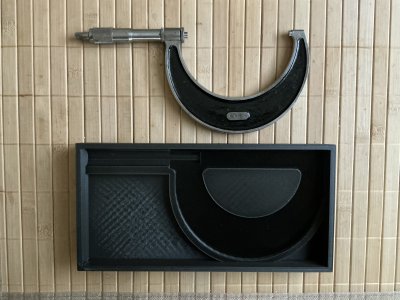
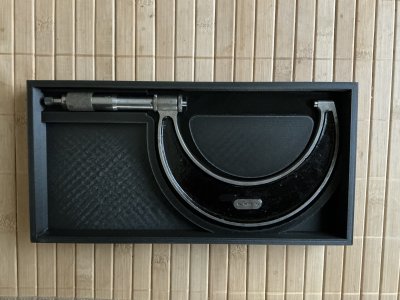
Bought an old Starrett 220 3-4 mic with original box. The box stinks to high heaven so drew a simple tray to storage the mic in the tool cabinet. I used Onshape instead of Autocad to gain more experience with it.
Pierre

Pierre
Starrett Model 220 3-4" micrometer tray/case by pdentrem | Download free STL model | Printables.com
Could not find one for this size so designed one. | Download free 3D printable STL models
www.printables.com
Last edited:
Mic box looks good. I messed around with generic clasps so the box can have a secure lid. In my case I have to stack them as opposed to laying open in a drawer or whatever. Some pics for ideas.
These clasps are .... 'ok' but still open for improvement. They are still a bit too secure. A lot of the clasps you see on injection molded plastic are easy to replicate in 3DP but they work because the material is quite a bit more flexible than PLA, so that changes the stiffness & therefore clasp length. Even the hinges are basically V-grooves but last a lifetime of opn/close because they are vinyl or whatever.
These clasps are .... 'ok' but still open for improvement. They are still a bit too secure. A lot of the clasps you see on injection molded plastic are easy to replicate in 3DP but they work because the material is quite a bit more flexible than PLA, so that changes the stiffness & therefore clasp length. Even the hinges are basically V-grooves but last a lifetime of opn/close because they are vinyl or whatever.
Attachments
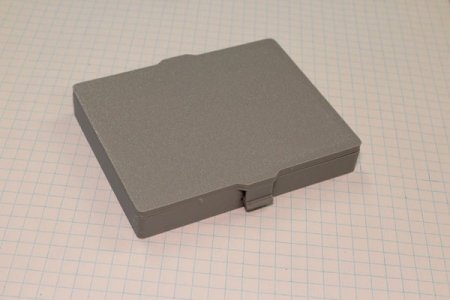
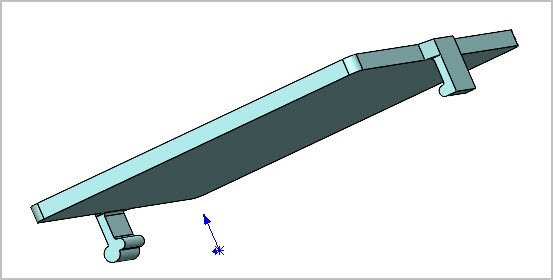
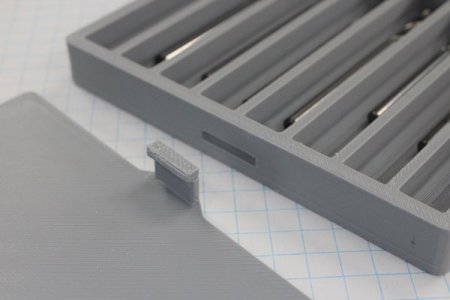

These clasps are .... 'ok' but still open for improvement.
For my environment, clasps are a bad idea. If you close the box when the shop is warmed up, condensation will form inside when the box cools overnight. So I prefer open stacking trays.
The Prairie is a very different environment. But I'd prolly do trays there too - just for the space efficiency if nothing else.

pdentrem
Ultra Member
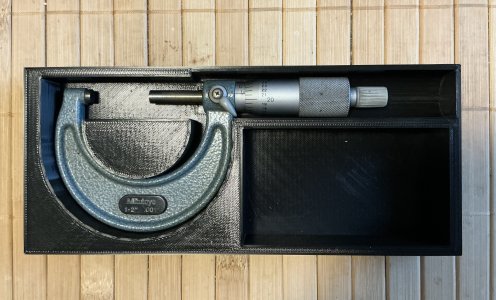
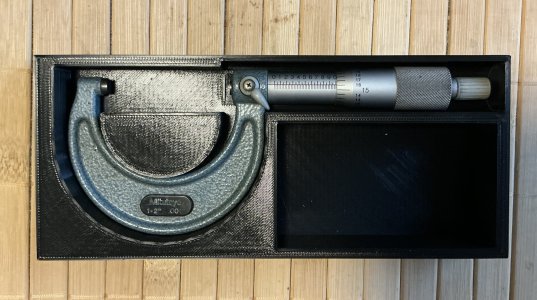
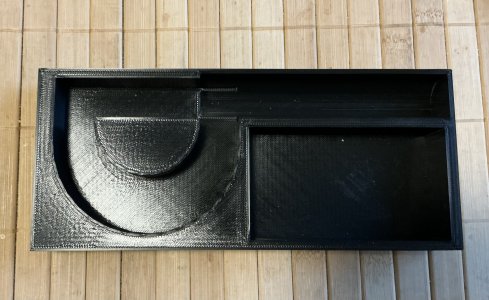
1-2” micrometer tray. Extra room for the barrel!
Pierre
Pierre
For my environment, clasps are a bad idea. If you close the box when the shop is warmed up, condensation will form inside when the box cools overnight. So I prefer open stacking trays.
The Prairie is a very different environment. But I'd prolly do trays there too - just for the space efficiency if nothing else.
True, however I posit how much condensation you get is a function of how big the column of air is over the surface is. For me, getting it in drawers solves the problem, no rust yet.... so would open or closed would be moot so long as its in a drawer.
I go with kind of full drawer inserts with a pocket for tools ..... you're going hate it, but talk a place for everything 🙂 . I guess the main purpose of the tray, for me anyway, is organization; stopping drawer jumble and damage from everything banging together. Condensation is controlled by removing the big column of air (drawers), trying to maintain temp and running a dehumidifier in the summer. We all live in different climates, but in doing that I'm never had a rust problem (well except with the dehumidifier tank overflowed and leaked all over a cardboard box of tools 🙁🙁🙁)
Most of mine are PLA, but I wonder if it could be risky - it absorbs water so can it also give moisture off? i.e. to the metal thing touching it? Don't know, so far ok, but I do keep the shop dry
pdentrem
Ultra Member
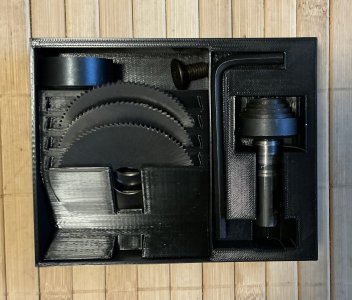
Just a refresh of this print. It is printed in two pieces. The blade box which holds 5 blades and in printed vertically and the tray which is printed flat.
Pierre
Pierre
True, however I posit how much condensation you get is a function of how big the column of air is over the surface is. For me, getting it in drawers solves the problem, no rust yet.... so would open or closed would be moot so long as its in a drawer.
That approach hasn't worked for me in the past. Before I started dehumidifying and temperature control in my shops, I had far too many bad ugly surprises opening drawers and fancy storage containers. In the absence of controlled air, I think the probability of localized rust depends on the conditions in the trapped "column" of air - mostly in the storage box, but secondarily in the drawer enclosure. So much depends on what the conditions were when the box / drawer was closed, how well sealed they are, what the overall thermal inertia is, what kind of oil film or corrosion protection exists, etc etc. I hate rusted tools and especially rusted metrology. So my risk tolerance is probably lower than others.
If I understand your thoughts, I think that the drawer / cabinet volume does play a significant role in mitigating the rust risk. In simple terms, the sheer volume slows down the rate of temperature change, as does the tool enclosure. But it only slows it down. If the condition swing takes place over a long enough period of time, eventually rust is inevitable. It's that inevitability in our humidity conditions that I can't tolerate.
I go with kind of full drawer inserts with a pocket for tools ..... you're going hate it, but talk a place for everything 🙂 . I guess the main purpose of the tray, for me anyway, is organization; stopping drawer jumble and damage from everything banging together.
I don't hate that! I actually LOVE it. Especially the damage prevention. Valuable instruments are not like screw drivers. I'm looking forward to getting a 3D printer in large part for that very reason! I can't wait to make stacking trays (with designed in open air circulation) to put instruments and valuable tools in. The trick is that the box must be open to the air. I want my full system air control to be able to protect all my stuff and it can't do that if things are in individual enclosed containers/boxes. If air gets trapped in an enclosed space and the temp drops below the dew point, then moisture can condense inside the box even though it doesn't form in the drawer because the drawer air gets dehumidified in some way. Air in the container can't get dehumidified. It holds whatever water it had when it was closed. If the temperature of that space drops low enough to trip the dew point for that amount of water, rust can form.
Most of mine are PLA, but I wonder if it could be risky - it absorbs water so can it also give moisture off? i.e. to the metal thing touching it? Don't know, so far ok, but I do keep the shop dry
This is outside my experience and knowledge envelope.
But I'd guess that you are correct. Since you can dry the filaments, they must be giving off moisture. That begs the question: Under what conditions?
After I get my printer I plan to do some filament moisture testing. Maybe I'll know more after that.
I don't hate that! I actually LOVE it.
Well, it would mean abandoning your beloved piles; a slight move from stacker in the direction of filer 😀

Canadium
Ian
I'm 100% on that! I think I can see the difference in rust in my shop depending on whether things were out in the open or closed in a drawer. Just think about it. When there is a heavy dew in the morning do you have a heavy dew in your house as well? I don't know about you but I don't! And that applies even if there is no heating going on in the house. Because my house is closed and has a smaller volume of air in it than the vast column of air outdoors!...r I posit how much condensation you get is a function of how big the column of air is over the surface is. For me, getting it in drawers solves the problem, no rust yet.... so would open or closed would be moot so long as its in a drawer.
Well, it would mean abandoning your beloved piles; a slight move from stacker in the direction of filer 😀
Yup. But very slight. I'm still more of a piler than a filer. I like to think of it as organized chaos.
I have a 400/800 watt quartz heater hanging from the ceiling in my shed/workshop. Used all winter into the late spring. It is a small space 11’ by 9’ and I run it at 400 all the time and set to 800 when I am working with my lathe.
Pierre
Nice. Guaranteed to work.
Heating the space increases the temp which reduces relative humidity.
That's exactly how I deal with it in my shop all winter. Works great.
Dehumidify in summer, heat in winter. Works great.
I'm 100% on that! I think I can see the difference in rust in my shop depending on whether things were out in the open or closed in a drawer. Just think about it. When there is a heavy dew in the morning do you have a heavy dew in your house as well? I don't know about you but I don't! And that applies even if there is no heating going on in the house. Because my house is closed and has a smaller volume of air in it than the vast column of air outdoors!
Nope. The reason there is no dew in the house is that it's warmer inside. Radiation outdoors dissipates heat quickly. Inside it bounces around and is reabsorbed. If you measured the temp outside you would find it is much cooler outside than inside. That's why dew forms outside but not inside. The height of the air column has nothing to do with it.
Canadium
Ian
There must be a scientific way to test this out. Say we cut up a dozen or so coupons of bare steel that are in all ways equal and expose them to different environments for a year. Exposed in the unheated shop, in a drawer in the unheated shop, in a sealed plastic bag, etc. Would the results lead us to any useful conclusions? Or how better to design the experiment?Nope. The reason there is no dew in the house is that it's warmer inside. Radiation outdoors dissipates heat quickly. Inside it bounces around and is reabsorbed. If you measured the temp outside you would find it is much cooler outside than inside. That's why dew forms outside but not inside. The height of the air column has nothing to do with it.
Canadium
Ian
Seems to me the heaviest dews happen in late summer. So here is my experiment for a late summer dewey night. I'm going to leave an inverted jar on my deck table exposed to the air. If the size of the air column has nothing to do with it there should be just as much dew under the jar in the morning as there is elsewhere on the table. If the size of the column of air matters on the other hand as I believe it does then there will be a lot of dew on the table everywhere except under the jar.Nope. ......The height of the air column has nothing to do with it.