• Scam Alert. Members are reminded to NOT send money to buy anything. Don't buy things remote and have it shipped - go get it yourself, pay in person, and take your equipment with you. Scammers have burned people on this forum. Urgency, secrecy, excuses, selling for friend, newish members, FUD, are RED FLAGS. A video conference call is not adequate assurance. Face to face interactions are required. Please report suspicions to the forum admins. Stay Safe - anyone can get scammed.
  • The 2026 Calgary Area Meetup is set for Saturday May 30th at 10am. The signup thread is here! Robinhood has graciously offered to host the meetup again this year. Please note that you MUST RSVP to the notice linked above if you wish to come.

Tips/Techniques What are you printing today?

Tips/Techniques
Nope. The reason there is no dew in the house is that it's warmer inside. Radiation outdoors dissipates heat quickly. Inside it bounces around and is reabsorbed. If you measured the temp outside you would find it is much cooler outside than inside. That's why dew forms outside but not inside. The height of the air column has nothing to do with it.

My thoughts on this needed revision - I got it wrong. It's not water dropping out of the air, so agreed the column size doesn't matter. it's condensation forming on contact with air at 100% humidity and cooler tool. What having the stuff in a drawer or inside a box does is limit the amount of air its exposed to.
 
What having the stuff in a drawer or inside a box does is limit the amount of air its exposed to.

This I agree with. There is only so much water that can be held in a given volume of air at a given temperature. At smaller volumes, this matters. At higher volumes, it doesn't. That's partly why dessicants work in small enclosed spaces but are useless in the open air.

That said, rust on a precision surface is rust. No amount is acceptable.
 
Seems to me the heaviest dews happen in late summer. So here is my experiment for a late summer dewey night. I'm going to leave an inverted jar on my deck table exposed to the air. If the size of the air column has nothing to do with it there should be just as much dew under the jar in the morning as there is elsewhere on the table. If the size of the column of air matters on the other hand as I believe it does then there will be a lot of dew on the table everywhere except under the jar.

It's always a good thing to do experiments like this. Its also good to challenge common assumptions. And especially good to question characters like me.

In your experiment, it will be important to consider the effect of wind or moving air. A still volume of air only holds so much water (as @Mcgyver points out). Non-moving air will get depleted of its water faster than moving air. But this has both positive and negative implications. Among other effects, moving air has a much smaller boundary layer which reduces the effect. That's why orchards run big fans to reduce frost (frozen dew).

To learn something from this, we have to reduce the number of variables.

Consider balancing your jar on the heads of three nails that hold the jar an inch or 2 above the table.

Perhaps also in an open box also sitting on nails.

Of course, these suggestions only address the wind variable - there may be others. Certainly temperature is another.
 
It's always a good thing to do experiments like this. Its also good to challenge common assumptions. And especially good to question characters like me.

In your experiment, it will be important to consider the effect of wind or moving air. A still volume of air only holds so much water (as @Mcgyver points out). Non-moving air will get depleted of its water faster than moving air. But this has both positive and negative implications. Among other effects, moving air has a much smaller boundary layer which reduces the effect. That's why orchards run big fans to reduce frost (frozen dew).

To learn something from this, we have to reduce the number of variables.

Consider balancing your jar on the heads of three nails that hold the jar an inch or 2 above the table.

Perhaps also in an open box also sitting on nails.

Of course, these suggestions only address the wind variable - there may be others. Certainly temperature is another.
I would guess that the best dewey nights will be perfectly still and the wind will not be a variable. I don't see why you would want to balance anything on nails? Actually I think McGyver has already adequately made the point. A smaller volume or column of air will have less water in it so the smaller the volume of air you expose your tools to the less rust you are likely to have on your tools. The most extreme example would be coating your steel in a thin coating of oil. That blocks air contact totally and we all know that it works.
 
My thoughts on this needed revision - I got it wrong. It's not water dropping out of the air, so agreed the column size doesn't matter. it's condensation forming on contact with air at 100% humidity and cooler tool. What having the stuff in a drawer or inside a box does is limit the amount of air its exposed to.
I don't entirely agree with this. While the worst rusting is sure to occur when there is condensation on the tool at 100% humidity some rusting will occur on steel even without condensation and with humidity levels greater than about 60%. Completely eliminating any semblance of even the smallest amount of rusting may be impossible. But if we are concerned with only the worst case scenarios as when there is condensation then yes.
 
My error was assuming the column of air a thing is exposed to matters as the moisture doesn't fall of out the air like it rain, it condenses on contact. At 100% humidity, water condenses out of the air, i.e. fog or mist, but doesn't necessarily drop. I think if the air were perfectly still, there'd be no advantage in a drawer over a bench .... but of course its not still, and being on the bench means it's exposed to a lot more air as it moves about than in the drawer with minimal airflow.

The result is same, better in a drawer because less air to be in contact with it, just not for the reasons I thought, i.e. the column of air above is not precipitating out moisture.
 
It always bothers me when people use the term Relative Humidity since it changes with temperature and that 'feels like' copyrighted term from the weather network has people believing they can tell the difference.

For our shops and condensation the 'dew point' is what is interesting and it can be calculated if you have the temperature and the RH reading from a sensor (they are cheaper).

If the dew point is say 15C then at that point the air is saturated and moisture starts be released from the air. If you keep your shop cool at 14C and open the doors during the day allowing in 20C air that has that dew point the cast iron, steel parts need to warm up above 15C to avoid cooling the localized air and condensing moisture.

If OTOH, you know in your area the dew point never rises above 15C keep the shop and all the tools at 16C or warmer and you won't have moisture condensing. All a dehumidifier does is lower the dew point temperature. Bring that down to 12C and the 14C tools are above the dew point and again no moisture and no rust.
 
I don't entirely agree with this. While the worst rusting is sure to occur when there is condensation on the tool at 100% humidity some rusting will occur on steel even without condensation and with humidity levels greater than about 60%. Completely eliminating any semblance of even the smallest amount of rusting may be impossible. But if we are concerned with only the worst case scenarios as when there is condensation then yes.

Ya, that's true. Although the difference is night and day, rust does occur even without dew. Our testing showed that different metals and different surface finishes react differently at various relative humidities. As @jcdammeyer points out, the trouble with using relative humidity is that's its only valid for a given temperature. 60% might be fine at 70F, but as the temperature falls, the relative humidity sky rockets.

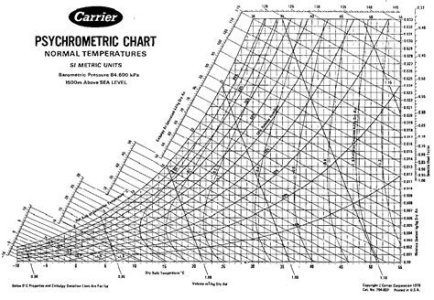
Here is a psychometric chart for anyone who wants the details. I taught engineering thermodynamics at university so I'd be happy to help anyone who wants to dive in.

download (1).jpeg

Even so, some metals and metal surfaces will start rusting even at low relative humidities.

That's why my shop is dehumidified to 45% across the full range of operating temperatures, and why I keep the temperature above 45F all winter long.
 
One of the former owners of my place of work, told us how his previous company he worked at protected some of their metal stocks. They were using liquid nitrogen for some processes which would vent slowly over time. Instead of venting to atmosphere, they plumbed a line into storage bins to displace the air with said nitrogen. There was no danger to the employees as the vents from the storage bins was to the outside of the building.
 
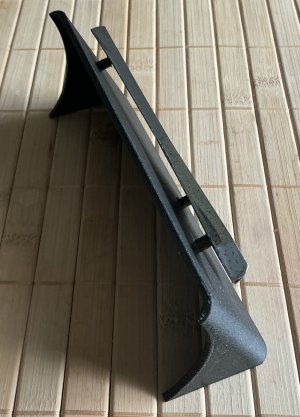
Printing the adafruit heat insert press. I had all the parts here on hand so was a quick little print last night and I have it assembled here today> I did have to design and print a holder for my specific heat iron.
 

Attachments

  • Video Project 1.gif
    Video Project 1.gif
    2.3 MB · Views: 16
  • Video Project 2.gif
    Video Project 2.gif
    2.8 MB · Views: 16
I didnt know the forum app would accept GIF. Is that the native format of printer camera or do you convert it in a video app, like MP4 to GIF?
I used clipchimp, original mp4 was stupid big and in 4K. Who needs 4K for vids of 3d printing? First time using clipchimp went really easy. Way easier the using some of the online converters.
 
Back
Top