• Scam Alert. Members are reminded to NOT send money to buy anything. Don't buy things remote and have it shipped - go get it yourself, pay in person, and take your equipment with you. Scammers have burned people on this forum. Urgency, secrecy, excuses, selling for friend, newish members, FUD, are RED FLAGS. A video conference call is not adequate assurance. Face to face interactions are required. Please report suspicions to the forum admins. Stay Safe - anyone can get scammed.
  • The 2026 Calgary Area Meetup is set for Saturday May 30th at 10am. The signup thread is here! Robinhood has graciously offered to host the meetup again this year. Please note that you MUST RSVP to the notice linked above if you wish to come.

Show us your shops!

Terminology

a "mud slab" is concrete poured directly onto subgrade/subsoil, there is no insulation below a mud slab, not a lot of variation in the term.


the heating is either in the topping or the main/structural slab, commercial or residential


Sorry for the latest topic wandering…

Ryan, with your area’s wild daily temperature swings in winter, do you have to modify your slab heating controls? Hysteresis?

As you know from living in Wpg, we get cold and stay cold.

that is beyond my scope, i only know they work, have witnessed the installation on many occasions, and also have had to drill into slabs containing heating pipes, praying the scan was correct....because those suckers are close to the surface
 
Yup. I did a 15 story office building on clay before I retired. It was a fight from beginning to end between guys like me who wanted to be innovative and the guys who wanted same old same old.

I lost a few battles, but I won a few too. To avoid piles through the clay to the bedrock miles down, we engineered a huge self righting boat that quite literally floated on the clay. It was an amazing engineering accomplishment.

Yet even today my hackles go up thinking about some of the battles I lost.
I enjoyed my years working with structural engineers, I hired the same firm for the last 15 years I was working, two partners had their phd, one with a masters, the best group of guys I worked with. Specialized in high rise steel and cast in place concrete. I was the technical/ construction partner in a mid sized architectural practice and I would develop the structural systems with the engineers. I learned so much from those fellows, they were always open to new ideas and understood the realities of construction. I never questioned their designs, they didn’t over design nor did they cut corners. They were often challenged by contractors who questioned their designs but they were open to alternative approaches but did not bend to unreasonable demands.
 
Yup. I did a 15 story office building on clay before I retired. It was a fight from beginning to end between guys like me who wanted to be innovative and the guys who wanted same old same old.

I lost a few battles, but I won a few too. To avoid piles through the clay to the bedrock miles down, we engineered a huge self righting boat that quite literally floated on the clay. It was an amazing engineering accomplishment.

Yet even today my hackles go up thinking about some of the battles I lost.
In central Texas (College Station) the popular solution for residential buildings was to over excavate, put down a couple of feet of sand, pour the foundation, back fill with more sand with an embedded irrigation system that automatically maintained a specific moisture level, effectively taking the clay out of the picture.

We designed a refrigerated warehouse for outside Dallas back in the early 2,000’s: the contractor did water injection for 3 weeks before the moisture levels stabilized and the inspector allowed them to start final grading and foundation work - if they couldn’t reach stabilization within 4 weeks the owner would have had to find a new site. Initial GeoTech obtained by the owner indicated it would be OK. At the same time we had designed an identical (to the degree possible given the locations) warehouse for the same owner in Central Florida: in the middle of orange groves, on “ball bearing” sand. Both facilities have been expanded several times and are going strong.
 
1788099990157.png

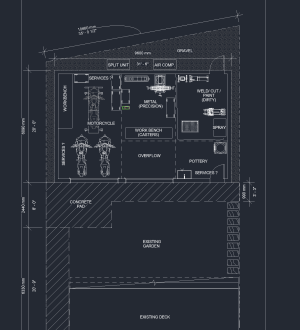
I selected a builder and have been going back and forth on some generate quotes for different components. The hydronic heating in concrete will most likely be a go. Still under consideration is connecting cold water and drain from the house and have the tankless heater for the slab heating double to heat water from a small sink. Aiming to start construction in March.

I still have a single garage at the front that I may leave for messier welding, cutting, and grinding, otherwise maybe a nice tiny project car in the future.

Realistically, I won't be spending much time messing around yet but just trying to get this built so my old man can see this completed. I'm his full-time caregiver plus in the middle of a big research project so this kinda fun will be for years later.

Open to any and all input on the shop layout!
 
do you keep it inside or outside enclosed in a little shed? Pros/cons?

Not really big but I have 30 gallon stand up dual cylinder that I keep in the heated/cooled garage.

Pro - not subject to climate changes so very little condensation build up in the tank.

Con - noise but it doesn't run constantly like in a business shop so tolerable.

Are the broken lines in the shop walls or showing the different areas?
 
Not really big but I have 30 gallon stand up dual cylinder that I keep in the heated/cooled garage.

Pro - not subject to climate changes so very little condensation build up in the tank.

Con - noise but it doesn't run constantly like in a business shop so tolerable.

Are the broken lines in the shop walls or showing the different areas?

I am also thinking about a 30 gallon stand up outside in fear of noise and saving space but that's true that it's not a business production so it'll rarely be on. I'll have some overhead space so may even consider throwing it up there.

The broken lines are just for me to visualize the bays as it was suggested by others. I think the biggest anchors are motorcycle space on the left and the lathe and mill in centre back, otherwise everything else can move as my usage and interests ebb and flow.
 
I'll throw down some large format concret pavers on the gravel in the odd triangle space in the back. That'll let me do some rougher work like grinder or messy welding.
 
Not sure what the dashed line around the outside of the building and garden etc. are, if they are the property line, watch the corner of the shop, left top corner, if there is a roof overhang it may be over the property line.
Not sure if you have 3 bikes, if one is on the lift, might be a bit tight between lift and bikes to get by end of lift.
If the concrete pad is not already existing outside the motorcycle door possibly make it at least to the edge of the door. It’s sometimes nice to work outside on things.
Air compressor, an old style piston type maybe much quieter then the oil less types, my larger oil less I gave away, to much noise, the older piston unit makes very little noise, you can stand beside it and have a conversation, (as long as it’s not old deaf people talking to each other, doesn’t matter where your are then). Plus it can be worked on, and yes, where ever you put a compressor, make sure you can get around it to change a belt, check oil, drain it etc.
A few things that might help, there may never be a perfect shop layout, but it is what you can work with. The bigger the shop, the easier layout can be, until you put more in it.
 
The bigger the shop, the easier layout can be, until you put more in it.
That's like the 4x4 saying, the bigger the tires the bigger the stuck. lol

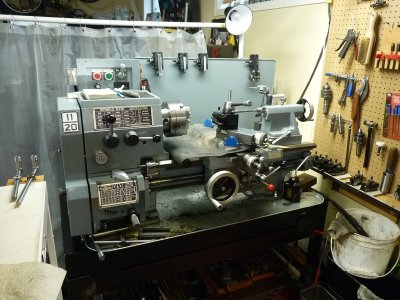
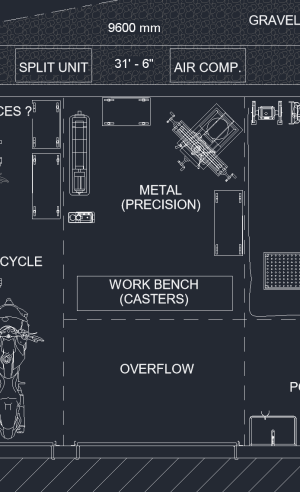
Not sure what mill you have but I put mine at a 45 degrees cw to what you show, allows full head travel in/out and full X travel but gives a bit more wall clearance. I would swap the lathe and toolbox/bench around, this gives you the wall space for pegboard and just as important gives full access behind the lathe.
1788107631172.jpeg

As per @Bandit, watch the property lines but an overhang at the back door by the compressor would let you do dirty work outside out of the rain/snow if need be. Having the grinder right beside the mill isn't the greatest place with all the nasty dust the grinder will throw.
 
Folks with a larger air compressors, do you keep it inside or outside enclosed in a little shed? Pros/cons?
Have a 60 gallon twin cylinder Sanborn inside. It's noisy but, as has been noted, it ain't running all the time. And, if I'm using an air tool that calls for a lot of air, it's noisier than the compressor across the shop & I'll sometimes have hearing protection on anyway. I can usually drain it in the winter time (semi-attached garage w/ no heat of its own).

A 60 gallon doesn't take up that much more floor space than a 30. It is taller, tho.
 
Not sure what the dashed line around the outside of the building and garden etc. are, if they are the property line, watch the corner of the shop, left top corner, if there is a roof overhang it may be over the property line.
Not sure if you have 3 bikes, if one is on the lift, might be a bit tight between lift and bikes to get by end of lift.
If the concrete pad is not already existing outside the motorcycle door possibly make it at least to the edge of the door. It’s sometimes nice to work outside on things.
Air compressor, an old style piston type maybe much quieter then the oil less types, my larger oil less I gave away, to much noise, the older piston unit makes very little noise, you can stand beside it and have a conversation, (as long as it’s not old deaf people talking to each other, doesn’t matter where your are then). Plus it can be worked on, and yes, where ever you put a compressor, make sure you can get around it to change a belt, check oil, drain it etc.
A few things that might help, there may never be a perfect shop layout, but it is what you can work with. The bigger the shop, the easier layout can be, until you put more in it.

I currently have 2 bikes, no lift. The extra bikes (up to 4) and lifts are nice to haves in the future. You're right that it seems tight, so I have to rethink my priorities and maybe expand that space into the other areas... hmm...maybe i'll flip the workbench to the top and have toolboxes to the left.

I'll concrete pad is new and in discussion with the partner and her garden space. She was pissed at the bigger pad before... it's an ongoing negotiation 😱

This is the biggest shop I can build, unfortunetly. Another life perhaps 🙂
 
That's like the 4x4 saying, the bigger the tires the bigger the stuck. lol

Not sure what mill you have but I put mine at a 45 degrees cw to what you show, allows full head travel in/out and full X travel but gives a bit more wall clearance. I would swap the lathe and toolbox/bench around, this gives you the wall space for pegboard and just as important gives full access behind the lathe.
View attachment 86195

As per @Bandit, watch the property lines but an overhang at the back door by the compressor would let you do dirty work outside out of the rain/snow if need be. Having the grinder right beside the mill isn't the greatest place with all the nasty dust the grinder will throw.

1788110794690.png

Do you mean like this? This seems better for machining. My original intent was thinking my motorcycle stuff might creep to the right, so keeping the machines clear on the back all would allow for this creep? That curvy line around the grinding/welding is where I'm thinking of hanging a bunch of welding curtains that I can pull open and close as needed to deal with any flyoffs, but yes I'll move the grinder to the far side instead.

I may not legablly able to do an overhang from the building large enough to have an outdoor work area but was also thinking of that exterior has a nice work space. I'll probaly throw up a pop-up tent when I need or build some other separated shelter later on if I find myself using this outdoor space a lot.
 
For my money, I'd swap the metal work and bike bays. Easy to clean bikes, not so easy to keep metal work clean.

If your lathe has a through spindle, you need to keep the head side open to insert longer stock. So I'd orient the lathe along the left wall with the tailstock in the corner. I'd also put the long workbench opposite the lathe - operator between them. If you have the room, do the same with the mill on the opposite side of the bay or on the wall to the right of the lathe. Most mill work is on the right side of the mill if you are right handed.

You don't need room behind a mill, but you do with a lathe.

An alternative is the lathe and mill opposite each other with operator in the middle and a bench/tool cabinet to one side and open on the other. This creates a machining aisle. Very handy and easy to work in. Not only that, but it provides space for another machine (eg surface grinder) behind the mill.
 
That's like the 4x4 saying, the bigger the tires the bigger the stuck
I don't mind getting stuck, if there's something to winch to. If there's nothing to winch to why did you drive in there 🙄

Swamps are the best, wait until it's winter, dig a hole in mud then you're in freezing water yanking winch cable through mud in February to get a machine out
 
For my money, I'd swap the metal work and bike bays. Easy to clean bikes, not so easy to keep metal work clean.

If your lathe has a through spindle, you need to keep the head side open to insert longer stock. So I'd orient the lathe along the left wall with the tailstock in the corner. I'd also put the long workbench opposite the lathe - operator between them. If you have the room, do the same with the mill on the opposite side of the bay or on the wall to the right of the lathe. Most mill work is on the right side of the mill if you are right handed.

You don't need room behind a mill, but you do with a lathe.

An alternative is the lathe and mill opposite each other with operator in the middle and a bench/tool cabinet to one side and open on the other. This creates a machining aisle. Very handy and easy to work in. Not only that, but it provides space for another machine (eg surface grinder) behind the mill.

Good points. I'll play around with this scheme. The only reason I had to keep the bike are on the left is the ease of moving them in and out, including my own during daily summer rides. I can envision sometime in the future of helping others with their bikes too so there's going to enough traffic that feel too old and tired to dance them through into the middle bay.
 
The bike lift will take up at least as much room as a big bike, a wheeled lift can be moved around and put in other areas. Some have stood a lift on end when not being used. Cabinets, tool boxes on wheels can be moved as needed, to where needed. Welding table on wheels can be the same. Sometimes a bunch of stuff can be moved this way or that to make a larger area for a larger one time project. The lathe and mill could be a little harder to move around but can be done until a final spot is found for them.
Put wall electrical boxes/outlets higher than expected bench heights, that way if a bench does need to be moved, an outlet may still be used. Lathe and mill maybe harder to move around depending on electrical needs, (220/240 and or 3phase), but a cable with plug ends may help for in-term placement. AND make sure the breaker panel can be gotten to, it is nice to have a larger panel then “thought” needed, for that “extra” circuit for something. Try to get the large amperage users close to the breaker box if possible, less expensive wire to run a shorter distance. What appears to be a kiln? may need a little extra juice, if on wheels maybe able to be moved closer to breaker box when used.
Taking everyone’s hints/suggestions will help, however sometimes just doing it is the only way. It really nice not to have to do things over and less expensive too, so many of the ideas of others are from expensive learning, myself included.
Fully agree about moving bikes!
 
I’d put the grinders/welders on a bench on castors. Storage drawers underneath. Wheel em outside whenever possible. Or at least (in winter) to an area far away from the lathe and milling machine. Lathe and milling machine in area on far right of your drawing- ie as far away from welding on chassis’s and grinding on them as possible. Wouldn’t waste space on a dedicated paint booth. For the limited amount of time your actually painting just hang some plastic sheets and rig up an exhaust fan. Or better yet, send the work out.

To this end I think (because I don’t have to answer to your wife) an outside concrete pad is essential.
 
Back
Top