• Scam Alert. Members are reminded to NOT send money to buy anything. Don't buy things remote and have it shipped - go get it yourself, pay in person, and take your equipment with you. Scammers have burned people on this forum. Urgency, secrecy, excuses, selling for friend, newish members, FUD, are RED FLAGS. A video conference call is not adequate assurance. Face to face interactions are required. Please report suspicions to the forum admins. Stay Safe - anyone can get scammed.

Show us your shops!

Not sure if I should start a separate thread, but I'm looking for suggestion on workshop layout and interior finishes. I'm looking to build a ~30x20' shop in workshop in my city backyard and wondering how people define and delineate between wood and metal areas (or any two, possibly conflicting types of work) in a single, large space. Are there changes in flooring or wall material between the different types of work at hand? Do you block off some areas for welding? I notice some of you have relatively finishes floors while others have just bare concrete.
 
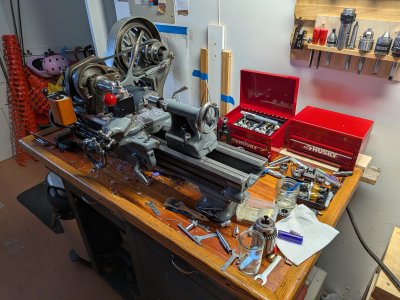
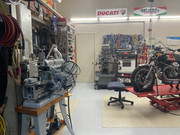
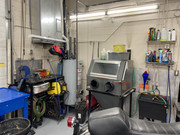
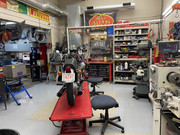
My shop before I started to beat up the epoxy floor I laid down this past spring. Presently building a new house / shop and hope to set it up to be more efficient with more flexibility for placing motorcycle lifts and machine tools.
Machine tools support my motorcycle restorations, I am not and never will be a machinist.


This already looks like a great space. What happened with the epoxy and will your new shop also be with epoxy? I am imagining a similar division in my future workshop with a mix of motorcycle, wood, and metal work but leaning towards a finished floor.
 
Weld outside as much as possible. Wall between machine shop and wood working/grinding/painting. At my place, I heat only machine shop side and rest is used more in summer. Esp as rest shares space with my wife’s car in winter! Appropriate cautions re fire prevention safety.

About floor, I splurged and put in a high solids industrial epoxy. Not Home Depot type of pretend product. Wearing well, and makes space less dusty and brighter.

Have fun! And build a bigger shop… you’ll need/want it in a few years…
 
I am loosing access to the shop I have enjoyed for over ten years, I sold the building the shop was in and new owners are not interested in renewing a lease, hence I am
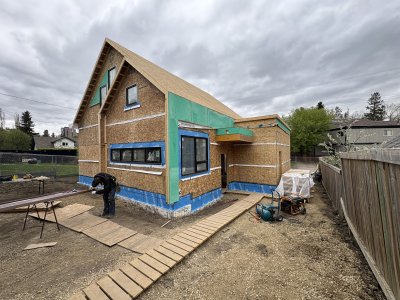
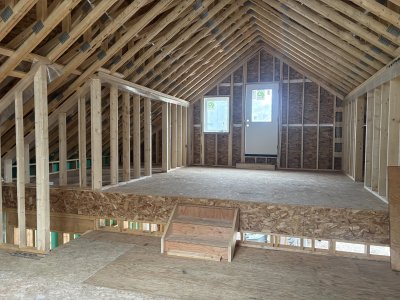
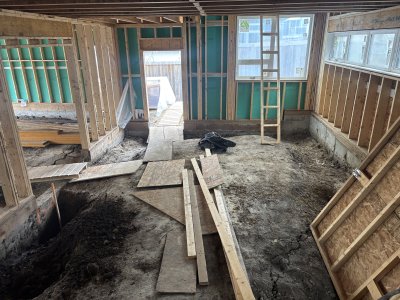
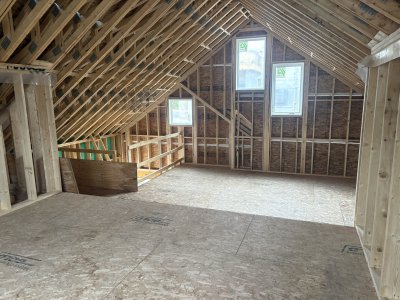
Building a new home with a detached garage/shop. Pictures are of the shop/garage.
The garage area is 24feet x 39 feet, one 18’x’ overhead door and one 10’x8’ overhead door. Attached to the end of the garage facing the house is a 30’ x 15’ shop with an upper loft and a developed area over the garage section. I have an open to below space in the loft through which I can hoist things to the upper level (motorcycles mostly). There is a pair of 3,x7’ steel doors between shop and garage, 1-1/2 hour labeled. I have a 2 hour fire resistance rating between ship and garage.
The shop is designed as a ‘backyard house’ that a future owner can finish and rent as a 2 bed apartment around 1100sq feet.
All of my welding, grinding and painting will be in the garage area with the 10’ wide door. I have separate furnace and exhaust for both areas.
For flooring I will go with epoxy floor for the shop area but not the welding area.grinding and welding have not been kind to my existing shop epoxy floor.
The garage has a 11’ ceiling to accommodate a 4 post car lift. The shop has a 9’ ceiling and the upper level is a vaulted roof truss space that extends way up to the 10/12 ridge (8/12 interior ridge of truss).
I have designed the shop loft floor to support 800 lbs from crane rails (barn door track) to lift things inside the main level of the shop. A similar barn door crane rails will be installed in the upper level for hoisting things from main to upper level.
I will line some of the garage area walls with a plastic panel for car washing. Floor drains with sumps for shop and garage. My electricial service is 200 amps, I have plenty of 220v single phase tools and welders, compressor etc.
 

Attachments

  • IMG_4400.jpeg
    IMG_4400.jpeg
    3.6 MB · Views: 16
  • IMG_4394.jpeg
    IMG_4394.jpeg
    6 MB · Views: 17
  • IMG_4396.jpeg
    IMG_4396.jpeg
    6.4 MB · Views: 15
  • IMG_4395.jpeg
    IMG_4395.jpeg
    5.6 MB · Views: 16
Seriously jealous.
Also curious how you are getting away with a floor drain, I've been led to believe that is a no go around here (Ottawa).
 
Seriously jealous.
Also curious how you are getting away with a floor drain, I've been led to believe that is a no go around here (Ottawa).
My garage/shop sanitary drains by gravity to a sump tank buried beneath the house walk out basement floor slab (10 feet deep) a sealed sump (fiberglass) has two commercial grade grinder pumps that cycle between each other on demand and lift all sewage, including grey water to the combined sanitary storm in the street at the front of the house. The whole system is independently vented and routed. Local authorities approved the whole system with engineering design supplied by the equipment suppliers.
I did have to keep the garage slab 2” lower than the shop side, this for carbon monoxide entrapment without having to upgrade all near ground receptacles in the shop. This is common in all public works type shops we designed, offices, washrooms etc all on the upper slab elevation.
You don’t need a 2 hour fire separation between a garage and adjacent house, 1 hour for residential but 1-1/2 hours for vehicle parking
and adjacent occupancy for commercial and 2 hour for vehicle repair and adjacent occupancy. I chose a 2 hour separation too hold my insurance comp to a payout if there were ever a fire between spaces.
Again I always default to how will the insurance company try to get out of paying a claim and what can I do to address this.
 
I'm
Weld outside as much as possible. Wall between machine shop and wood working/grinding/painting. At my place, I heat only machine shop side and rest is used more in summer. Esp as rest shares space with my wife’s car in winter! Appropriate cautions re fire prevention safety.

About floor, I splurged and put in a high solids industrial epoxy. Not Home Depot type of pretend product. Wearing well, and makes space less dusty and brighter.

Have fun! And build a bigger shop… you’ll need/want it in a few years…

Have you found welding outside in winds and what not cause any issue? I am an amateur at best and thinking that indoor will serve me best. Also being deep in the city means the lot sizes are small and neighbours are looking into my backyard so I don't want to blind anyone, or more likely receive complaints from a few asshole neighbours. And on that note, I'm not fortunate enough like some of you to be able to build a larger shop due to zoning bylaws (unless I rip up my 30x10 deck to make room).

Does that industrial epoxy stuff require specialized equipment and hiring out or can be DYI?
 
I'm


Have you found welding outside in winds and what not cause any issue? I am an amateur at best and thinking that indoor will serve me best. Also being deep in the city means the lot sizes are small and neighbours are looking into my backyard so I don't want to blind anyone, or more likely receive complaints from a few asshole neighbours. And on that note, I'm not fortunate enough like some of you to be able to build a larger shop!

Does that industrial epoxy stuff require specialized equipment and hiring out or can be DYI?
I installed and prepped my current shop for epoxy. I would never do it myself again. My hand held (rental) diamond grinders were a nightmare to control dust and a professional with big vacuum type grinders can do the job in a day. I maybe saved $1K doing it myself but my quality of application is so so at best. One had to grind down the existing concrete to a ‘white’ surface. Forget about just acid etching, no where near good enough prep.
I used commercial products, not your Home Depot quality.
 
I'm


Have you found welding outside in winds and what not cause any issue? I am an amateur at best and thinking that indoor will serve me best. Also being deep in the city means the lot sizes are small and neighbours are looking into my backyard so I don't want to blind anyone, or more likely receive complaints from a few asshole neighbours. And on that note, I'm not fortunate enough like some of you to be able to build a larger shop due to zoning bylaws (unless I rip up my 30x10 deck to make room).

Does that industrial epoxy stuff require specialized equipment and hiring out or can be DYI?
For stick, I’m exclusively outside. Also for mig (with gas) on no wind days, but realistically more indoors for mig and tig with windows open and a fan in them. Haven’t used much flux core.

I’d guess industrial epoxy could be done by anyone, but I had limited spare time when the shell of my shop was put up, so I contracted out some of the job including the acid etch and epoxy for the floor.

I’m impressed, as an ex Torontonian, you can fit a good sized shop in.

Forgot to mention- suggest framing in overhead lifting capacity with one or two I beams.
 
Well sounds like if I'm going epoxy floor I'm definitely finding a pro with the tools to do it.

I am leaning towards finishing the entire floor, and then putting down some sort temporary flooring to designate a welding area. I'll move/grow/shrink the floor area as I figure out my usage, maybe hang some welding curtains around or something. I like this flexibility as I figure things out and grow with the shop. If this doesn't make sense someone let me know!
 
Not sure if I should start a separate thread, but I'm looking for suggestion on workshop layout and interior finishes. I'm looking to build a ~30x20' shop in workshop in my city backyard and wondering how people define and delineate between wood and metal areas (or any two, possibly conflicting types of work) in a single, large space. Are there changes in flooring or wall material between the different types of work at hand? Do you block off some areas for welding? I notice some of you have relatively finishes floors while others have just bare concrete.

20 x 30 would accommodate three 20ft bays or two 15' work bays. Very nice.

Mine is setup with three bays. One for metal, one for wood, and one for storage. The wood and metal areas are just separated by racks that I can hang sheets on if i want.

I do all welding outside. I dont like sparks rolling into places where i cant see em.
 
Back
Top