• Scam Alert. Members are reminded to NOT send money to buy anything. Don't buy things remote and have it shipped - go get it yourself, pay in person, and take your equipment with you. Scammers have burned people on this forum. Urgency, secrecy, excuses, selling for friend, newish members, FUD, are RED FLAGS. A video conference call is not adequate assurance. Face to face interactions are required. Please report suspicions to the forum admins. Stay Safe - anyone can get scammed.
  • The 2026 Calgary Area Meetup is set for Saturday May 30th at 10am. The signup thread is here! Robinhood has graciously offered to host the meetup again this year. Please note that you MUST RSVP to the notice linked above if you wish to come.

Seismometer

JohnP

Well-Known Member
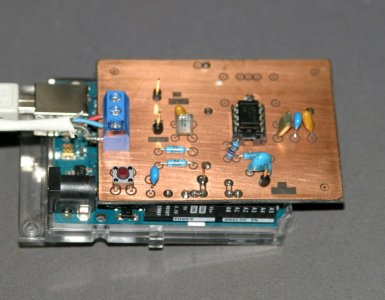
Here is another of my latest projects. While not exactly metal working, it did involve the use of the lathe and mill in its manufacture. It’s a vertical seismometer. Consists of two rare earth magnets suspended on a light spring, centred in a coil of 2500 turns of #38 wire with a third magnet below in an aluminum tube acting as a eddy current damper. You may recognize the spring, it’s a “Slinky Junior”. The small output voltage generated as the magnet moves in the coil due to ground movement is fed to a single IC amplifier. A program in an Arduino UNO takes he output of the amp, converts it to a digital stream and sends it to a logging program in my computer which displays it as a seismogram in real time.
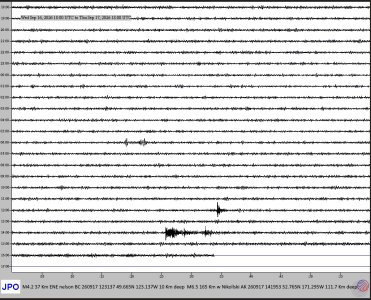
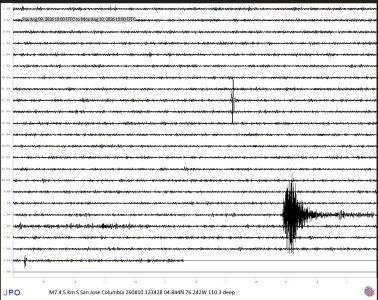
Here are a couple of typical seismograms, the latest from the 17th of this month, a M4.2 quake in Nelson BC and a M6.5 off the Aleutians, the second seismogram shows a M 7.4 quake in Columbia on the 10th Aug.
The furthest I have picked up a quake so far is from Indonesia.
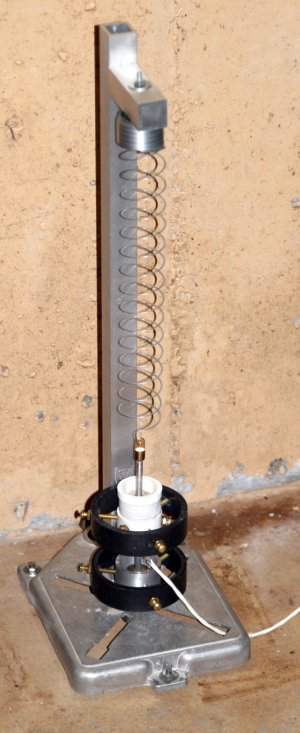
Seismo1.JPGamp1.JPG260917.jpg260810.jpg
 
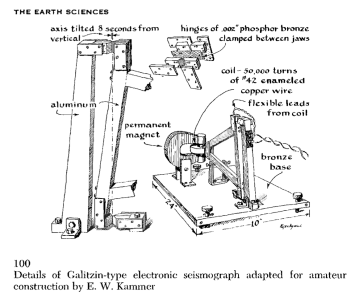
Interesting build. Ever since the first time I read The Scientific American Book of Projects for the Amateur Scientist, (C.L. Stong, Simon & Schuster, New York, 1960) back in the mid-60's (I since found an ex-library copy in virtually unread condition with dust jacket, only borrowed twice in a 5 year period; also have a PDF) I have wanted to build a seismograph:

Screenshot 2026-09-26 at 11.38.40 AM.png
Although the book has been the inspiration for several projects for my offspring and sub(?)-offspring, this project was and will remain a dream.
 
A program in an Arduino UNO takes he output of the amp, converts it to a digital stream and sends it to a logging program in my computer which displays it as a seismogram in real time.
Thats a cool device. I'm just self-plodding myself into Arduino with some online courses. Your output chart looks a lot more custom for the purpose than typical Arduino terminal mode. Are you driving the data to some sort of generic plotting/charting app?
 
Chazz
I still have the SciAm issue where C.L. Stong described the seismometer in his Amateur Scientist column. As a teenager I was an avid reader of his column. I also have my penciled notes where I intended to build one, only took me about 70 years to get around to it! The one he describes is what is called a "LaCoste pendulum seismometer", or a "swinging gate seismometer". It records the horizontal vibrations from an earthquake whereas mine records the vertical.
Peter
The Arduino program only takes the amplified weak signal from the seismo and does some filtering to pass only low freqs in the order of 3-4 Hz then passes it through the A/D to convert it to a digital stream. That is then sent to the computer which is running a dedicated seismometer logging program called jAmaseis, which plots the output from the seismometer in real time. The plotting program I am using is from here, https://www.iris.edu/hq/inclass/software-web-app/jamaseis. It was originally designed for use in schools as a learning tool.
As an aside I recorded two quakes yesterday, a M 5.0 one in China. and a M6.6 one off New Caledonia in the south pacific.
John
 
Last edited:
Lucky7
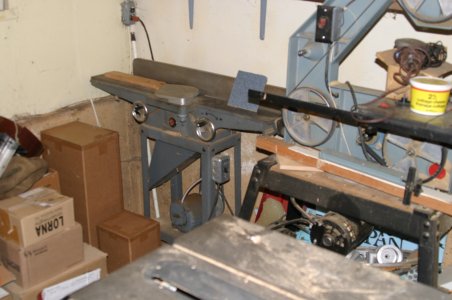
It just sits on the cement floor in the corner of my workshop. My shop used to be the carport attached to the house. It had been closed in and insulated to convert it to a shop before we bought the house in '89. The back end, where the seismo is, is walled off and is my wood shop. When I use any of the power tools there they create havoc with it. It is in the tall brown box in the back left of the pic. The box is a draft cover, as even walking by it gives a strong output.
Craig
The US Geological Survey has a web site, https://earthquake.usgs.gov/earthquakes/map/?extent=-76.1008,-339.60938&extent=84.92832,222.89063, that lists all the earthquakes that occur around the world and is updated in real time. It shows their location on a world map, and if you click on any one it gives all the details of it. Any time I see anything that looks interesting I check the site to see if it was a quake or just a heavy truck going by.
John
IMG_8396.JPG
 
Interesting build. Ever since the first time I read The Scientific American Book of Projects for the Amateur Scientist, (C.L. Stong, Simon & Schuster, New York, 1960) back in the mid-60's (I since found an ex-library copy in virtually unread condition with dust jacket, only borrowed twice in a 5 year period; also have a PDF) I have wanted to build a seismograph:

Heh. I still have the original paperback copy I bought in the 70s. I'd always been drawn to the X-ray generator, but at the same time thought it was probably a sign of good judgement that I never actually tried to build it.

But that does remind me of one of those great lost opportunities: When I was in my teens I discovered that a neighbor of my grandparents had a garage full of cool shit, which included hundreds (perhaps thousands - I never got an actual count) of mil surplus crystals in their original dessicant packaging. So I hooked him up with a local electronic surplus dealer friend (Art Fritz of Arttz Electronics aka 6GB Electronics) out in Airdrie, in case there's anyone else here who knew him - VE6GB) and Art took the lot off his hands. But way in the back of that garage was a fluoroscope that I never had a chance to get a closer look at - might have even been fun to fire up.
 
Last edited:
Here is another of my latest projects. While not exactly metal working, it did involve the use of the lathe and mill in its manufacture. It’s a vertical seismometer. Consists of two rare earth magnets suspended on a light spring, centred in a coil of 2500 turns of #38 wire with a third magnet below in an aluminum tube acting as a eddy current damper. You may recognize the spring, it’s a “Slinky Junior”. The small output voltage generated as the magnet moves in the coil due to ground movement is fed to a single IC amplifier. A program in an Arduino UNO takes he output of the amp, converts it to a digital stream and sends it to a logging program in my computer which displays it as a seismogram in real time.

Nice little low-noise layout there. I can make out the LTC logo, but not the part number.
 
Heh. I still have the original paperback copy I bought in the 70s. I'd always been drawn to the X-ray generator, but at the same time thought it was probably a sign of good judgement that I never actually tried to build it.
I agree, but it is still tempting; maybe see what the dog looks like?


But that does remind me of one of those great lost opportunities: When I was in my teens I discovered that a neighbor of my grandparents had a garage full of cool shit, which included hundreds (perhaps thousands - I never got an actual count) of mil surplus crystals in their original dessicant packaging. So I hooked him up with a local electronic surplus dealer friend (Art Fritz of Arttz Electronics aka 6GB Electronics) out in Airdrie, in case there's anyone else here who knew him - VE6GB) and Art took the lot off his hands. But way in the back of that garage was a fluoroscope that I never had a chance to get a closer look at - might have even been fun to fire up.
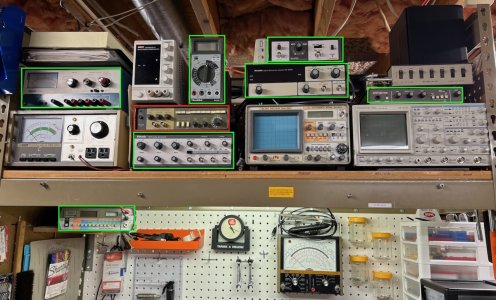
I went through an electronics phase, even built a few projects from Alfred P. Morgan's books. I also assembled (figuratively and literally thanks to HeathKit) a reasonably decent collection of test equipment:

HeathKit Test Equipment.jpeg
Green outlines I built, red were purchased used (no outline are commercial units). Sadly, sledom used now, but they don't take up much space and not worth the trouble to sell.

The one memory of Stong's book that sticks with me is from a grade school science fair that my daughter participated in (her project was a comparison of static electricity charge generated by different material combinations, measured with a homemade electroscope): one of the students had copied the photos (and graphs) from the book for the wind tunnel project – my wife wouldn't let me tell the school about it, so my daughter lost interest.
 
someidiot
The IC is a Linear Technology LT1677 low noise precision op amp. Have the schematic and PCB layout if you are interested.

Another of C.L. Stong's projects from SciAm that I wanted to make was a electron microscope using a CRT. Still have the 5CP1 CRTs and the old frig compressor for the vacuum pump I was going to use.
John
 
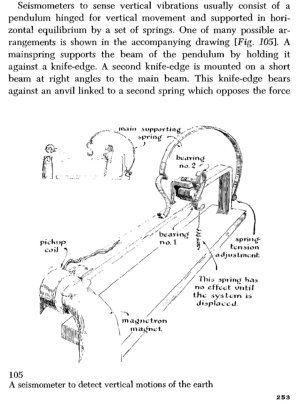
I liked the unusual (and sometimes complex) mechanisms that were developed for some if the projects, like the spring mount for this vertical movement seismometer:

IMG_3678.jpeg

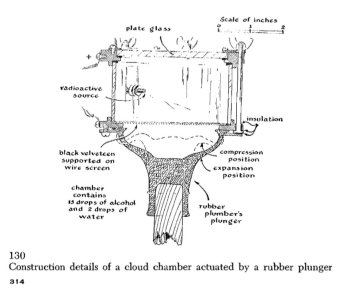
I think my favorite use of “unusual” items used in an apparatus was this Cloud Chamber:
IMG_3679.jpeg
 
I went through an electronics phase, even built a few projects from Alfred P. Morgan's books. I also assembled (figuratively and literally thanks to HeathKit) a reasonably decent collection of test equipment:

So, when it comes to the rod length check, present company (that is, in regard to machine tools) has me so outgunned it's just stupid.

But you my lil' puppy now...

Oscilloscopes: Tektronix all the way - from 7000-series mainframes to 2467B. Okay, one HP digitizing scope.
Curve Tracer: Tek - the big ol' 575 dinosaur.
Logic Analyzers: Mainly Tek (little portables to big mainframes), but also some HP and Arium.
Meters: HP and Fluke - and my trusty Simpson 260s!
Power Supplies: HP and the usual random shit.
Counters: HP and Fluke.
Signal Generators: Mostly Wavetek, GenRad noise generator
Device Programmers: (much) Data I/O, Advin.
Other: Audio Precision, HP distortion analyzer, Tek TM506 fulla plugins, and god knows what other junk that's not springing to mind.
And up on a high shelf, where I just make fun of it from time to time: Huntron Tracker.
EDA: Mentor Graphics under HP-UX on PA-RISC
X Terminals: Mostly old Silicon Graphics Indigo, Indy, and Indigo2.
 
Last edited:
Back
Top