• Scam Alert. Members are reminded to NOT send money to buy anything. Don't buy things remote and have it shipped - go get it yourself, pay in person, and take your equipment with you. Scammers have burned people on this forum. Urgency, secrecy, excuses, selling for friend, newish members, FUD, are RED FLAGS. A video conference call is not adequate assurance. Face to face interactions are required. Please report suspicions to the forum admins. Stay Safe - anyone can get scammed.
  • The 2026 Calgary Area Meetup is set for Saturday May 30th at 10am. The signup thread is here! Robinhood has graciously offered to host the meetup again this year. Please note that you MUST RSVP to the notice linked above if you wish to come.

Seismometer

JohnP

Well-Known Member
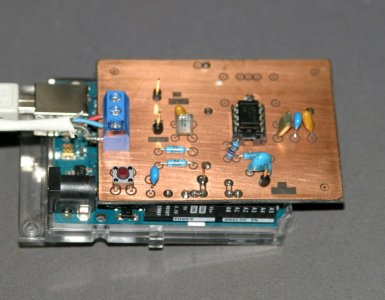
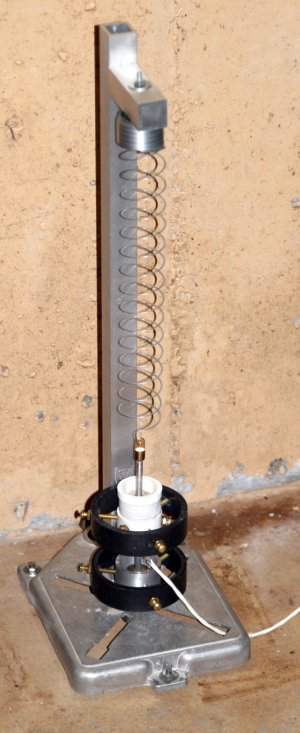
Here is another of my latest projects. While not exactly metal working, it did involve the use of the lathe and mill in its manufacture. It’s a vertical seismometer. Consists of two rare earth magnets suspended on a light spring, centred in a coil of 2500 turns of #38 wire with a third magnet below in an aluminum tube acting as a eddy current damper. You may recognize the spring, it’s a “Slinky Junior”. The small output voltage generated as the magnet moves in the coil due to ground movement is fed to a single IC amplifier. A program in an Arduino UNO takes he output of the amp, converts it to a digital stream and sends it to a logging program in my computer which displays it as a seismogram in real time.
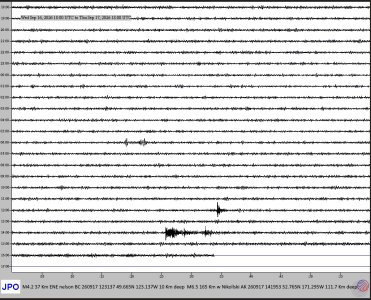
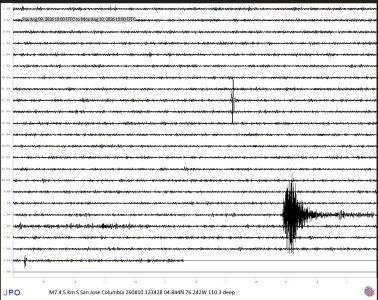
Here are a couple of typical seismograms, the latest from the 17th of this month, a M4.2 quake in Nelson BC and a M6.5 off the Aleutians, the second seismogram shows a M 7.4 quake in Columbia on the 10th Aug.
The furthest I have picked up a quake so far is from Indonesia.
Seismo1.JPGamp1.JPG260917.jpg260810.jpg
 
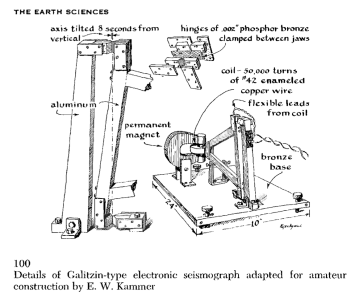
Interesting build. Ever since the first time I read The Scientific American Book of Projects for the Amateur Scientist, (C.L. Stong, Simon & Schuster, New York, 1960) back in the mid-60's (I since found an ex-library copy in virtually unread condition with dust jacket, only borrowed twice in a 5 year period; also have a PDF) I have wanted to build a seismograph:

Screenshot 2026-09-26 at 11.38.40 AM.png
Although the book has been the inspiration for several projects for my offspring and sub(?)-offspring, this project was and will remain a dream.
 
A program in an Arduino UNO takes he output of the amp, converts it to a digital stream and sends it to a logging program in my computer which displays it as a seismogram in real time.
Thats a cool device. I'm just self-plodding myself into Arduino with some online courses. Your output chart looks a lot more custom for the purpose than typical Arduino terminal mode. Are you driving the data to some sort of generic plotting/charting app?
 
Chazz
I still have the SciAm issue where C.L. Stong described the seismometer in his Amateur Scientist column. As a teenager I was an avid reader of his column. I also have my penciled notes where I intended to build one, only took me about 70 years to get around to it! The one he describes is what is called a "LaCoste pendulum seismometer", or a "swinging gate seismometer". It records the horizontal vibrations from an earthquake whereas mine records the vertical.
Peter
The Arduino program only takes the amplified weak signal from the seismo and does some filtering to pass only low freqs in the order of 3-4 Hz then passes it through the A/D to convert it to a digital stream. That is then sent to the computer which is running a dedicated seismometer logging program called jAmaseis, which plots the output from the seismometer in real time. The plotting program I am using is from here, https://www.iris.edu/hq/inclass/software-web-app/jamaseis. It was originally designed for use in schools as a learning tool.
As an aside I recorded two quakes yesterday, a M 5.0 one in China. and a M6.6 one off New Caledonia in the south pacific.
John
 
Last edited:
John, curious about where and how you mounted the instrument to avoid local environmental noise. Looks like your basement? Close enough to bedrock?
 
Lucky7
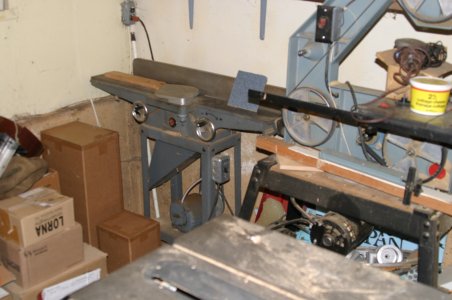
It just sits on the cement floor in the corner of my workshop. My shop used to be the carport attached to the house. It had been closed in and insulated to convert it to a shop before we bought the house in '89. The back end, where the seismo is, is walled off and is my wood shop. When I use any of the power tools there they create havoc with it. It is in the tall brown box in the back left of the pic. The box is a draft cover, as even walking by it gives a strong output.
Craig
The US Geological Survey has a web site, https://earthquake.usgs.gov/earthquakes/map/?extent=-76.1008,-339.60938&extent=84.92832,222.89063, that lists all the earthquakes that occur around the world and is updated in real time. It shows their location on a world map, and if you click on any one it gives all the details of it. Any time I see anything that looks interesting I check the site to see if it was a quake or just a heavy truck going by.
John
IMG_8396.JPG
 
Back
Top