• Scam Alert. Members are reminded to NOT send money to buy anything. Don't buy things remote and have it shipped - go get it yourself, pay in person, and take your equipment with you. Scammers have burned people on this forum. Urgency, secrecy, excuses, selling for friend, newish members, FUD, are RED FLAGS. A video conference call is not adequate assurance. Face to face interactions are required. Please report suspicions to the forum admins. Stay Safe - anyone can get scammed.
  • The 2026 Calgary Area Meetup is set for Saturday May 30th at 10am. The signup thread is here! Robinhood has graciously offered to host the meetup again this year. Please note that you MUST RSVP to the notice linked above if you wish to come.

Reid 618HA surface grinder conversion to VFD & how to set XSY-AT1 parameters

If I try to start the mill with the pot above 10% it just shuts down and I have to turn off the power, let it reset and turn the pot down.
To me that sounded like the torque compensation you were talking about.

To me, it sounds like SLV mode that isn't setup correctly. If so, when you get this working you are gunna be a very happy camper!

Most guys just want variable speed. That's only because they didn't know how much better SLV mode is.

@TorontoBuilder explains it at the functional level. I like to explain it at a higher level that's easier for us mere mortals to understand.

A motor with a position sensor can be better controlled because a computer can know exactly where a motor actually is vs where it should be. Put a bit differently, if a motor isn't where the computer thinks it should be, a computer that understands the motors operating requirements can send it the exact voltage and current corrections necessary to get it to where it should be optimally. In essence, SLV is a mode that the computer uses to know the position of the motor rotor without needing a sensor. It uses the motors own back emf and feedback from the motors power absorption to know its position. Knowing its position and operating parameters allows it to optimize the phase and power applied to the motor as a perfect match within the basic driving frequency. Basically changing the driving power to match what the motor needs at each tiny fraction of rotation. At the level of a human operator, thus translates to a motor that is happy happy happy. It's quieter, smoother, and more responsive than it could ever be otherwise.

A normal VFD outputs a variable frequency 3-phase sinusoidal voltage chopped at the operating carrier frequency. A VFD operating is SLV mode outputs a more precise non-sinusoidal waveform that much more closely matches (leads and lags) what the motor needs at the sub waveform level.

I am fairly certain that the best VFDs do this better than the lesser ones do. But anything is better than nothing. SLV mode is quite literally a paradigm step forward in motor control.
 
The manual above is for a Durapulse GS21-23PO, I have one on the drill press and one on the chipmaster and I can't really say I have had any problems with either,
The durapulse is a very good drive for the chipmaster, and out of the box its default set-up is 220v 60Hz with ~4.0 V/Hz default linear curve. Any motor will run unloaded with apparent ease until the default settings so I'd not expect you to encounter many problems until you push the chippie.

However, you've bought a thoroughbred and you've got it hooked to a cart. You could set-up field oriented control. You SHOULD set-up field oriented control... especially for user safety. I was planning on buying a higher end Teco VFD just to get FOC option to run my chipmaster. Where did you buy your VFDs I'd like to price shop.

It's an overkill drive on a drill press, unless this is a monster drill press with a 3HP motor, that does most of your big drilling operations.
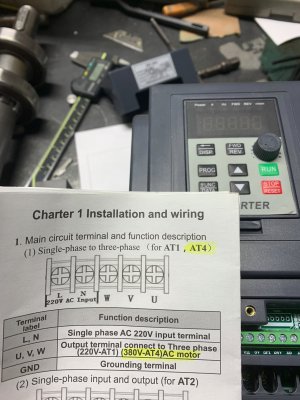
the mill has a cheapo XSY-AT4 AT4-2200X vfd. I couldn't find a programing manual for that one but managed to get it running fairly well but I have to turn the pot way down to about 10% to start the motor and then turn it up to the speed I want.
If I try to start the mill with the pot above 10% it just shuts down and I have to turn off the power, let it reset and turn the pot down.
That you must turn the potentiometer down very low in order to avoid tripping the VFD is a good clue. Did you ever note the ERR code that pops up when the VFD trips? This can help confirm my suspicions.

Okay I need more info... I thought I remembered that you scored an almost new craftex kneemill from up around Barrie? Maybe I'm thinking of someone else?

Why are you running a 220 to 380V VFD, rather than the standard VFD? The craftex has single phase motor... so obviously something is going on here.

I'll assume it may be to power a dual voltage 220/440 3ph motor at the high voltage.

Pics please

Until that is answered I can't offer more.
To me that sounded like the torque compensation you were talking about.
In my opinion it is not a voltage compensation issue, but rather a mismatch on the v/Hz curve compared to what the motor needs, because out of the box the XSY-AT4 is configured to chinese 380V, 50Hz industrial motors. To use this drive on a north american motor requires that many parameters be modified.

If a you simply hooks up a standard North American 220V / 60Hz motor and leave the v/Hz profile at factory defaults the VFD will supply an over-clocked voltage compared to what your motor needs. This is sort of like the raw torque compensation boost, but it is not caused by parameter P72 being too high.

Turning the potentiometer way down to 10% allows the motor to start up because it drops the the target frequency command down to roughly 5 Hz, which yields a very low safe start-up voltage.

A safe baseline voltage that doesn't completely saturate the motor core right away. It allows the reletively heavy milling spindle to slowly crawl past its breakaway friction zone and start spinning. Once the motor is rotating, it builds internal back-EMF which naturally opposes incoming current, allowing you to manually wind the pot back up without triggering a crash.
 
To me, it sounds like SLV mode that isn't setup correctly. If so, when you get this working you are gunna be a very happy camper!

Most guys just want variable speed. That's only because they didn't know how much better SLV mode is.

@TorontoBuilder explains it at the functional level. I like to explain it at a higher level that's easier for us mere mortals to understand.

A motor with a position sensor can be better controlled because a computer can know exactly where a motor actually is vs where it should be. Put a bit differently, if a motor isn't where the computer thinks it should be, a computer that understands the motors operating requirements can send it the exact voltage and current corrections necessary to get it to where it should be optimally. In essence, SLV is a mode that the computer uses to know the position of the motor rotor without needing a sensor. It uses the motors own back emf and feedback from the motors power absorption to know its position. Knowing its position and operating parameters allows it to optimize the phase and power applied to the motor as a perfect match within the basic driving frequency. Basically changing the driving power to match what the motor needs at each tiny fraction of rotation. At the level of a human operator, thus translates to a motor that is happy happy happy. It's quieter, smoother, and more responsive than it could ever be otherwise.

A normal VFD outputs a variable frequency 3-phase sinusoidal voltage chopped at the operating carrier frequency. A VFD operating is SLV mode outputs a more precise non-sinusoidal waveform that much more closely matches (leads and lags) what the motor needs at the sub waveform level.

I am fairly certain that the best VFDs do this better than the lesser ones do. But anything is better than nothing. SLV mode is quite literally a paradigm step forward in motor control.
IMO field oriented control is a much better option than vectorless control. That's why it is a premium feature typically found on higher end VFDs and not Teco's base models.

For a lathe the primary concern in many cases is torque control. FOC manages torque control by breaking current control into two separate components

Direct current magnetizing power to control the magnetic flux, keeping the flux at precisely the optimal level so the core never becomes starved or saturated.

and

Torque quadrature current whcih adjusts to rotate the magnetic field to boost the torque, thereby allowing much more torque at very low speeds.

I often had to explain complex issues to people without an engineering background, and lacking patience I learned how to speak in layman's terms and use a lot of analogy... this is what happens when you work directly with clients who know little to nothing
 
FOC manages torque control by breaking current control into two separate components

I'm not familiar with that mode. Always something else to learn. I'll have to take your word that it's better. I'll only add that I'd take your word for such things much more easily than I might take someone else's.

I often had to explain complex issues to people without an engineering background, and lacking patience I learned how to speak in layman's terms and use a lot of analogy... this is what happens when you work directly with clients who know little to nothing

IMHO, you do an excellent job. But I still think it goes waaaay over most people's head. LOL.
 
I'm not familiar with that mode. Always something else to learn.
You don't have a A510 or mess around with performance ebike motors, so I'm not surprised you haven't heard of FOC. It adds about $200 - $300 to the cost of VFD.

When I get mine lathe I'll make a video comparing sensorless to POC on the low end for threading... and another case with deep cuts. It's why I wanted 5HP on tom's lathe.

I'll only add that I'd take your word for such things much more easily than I might take someone else's.
Thank you, that's saying a lot.

IMHO, you do an excellent job. But I still think it goes waaaay over most people's head. LOL.
People need to get smarter, but they can take solace that my cognitive capabilities will start declining faster and hence my explanations will get dumber... 😛
 
Did you ever note the ERR code that pops up when the VFD trips? This can help confirm my suspicions.
When it pops the error code is ERR 1
Okay I need more info... I thought I remembered that you scored an almost new craftex kneemill from up around Barrie? Maybe I'm thinking of someone else?
Yes that was me.
Why are you running a 220 to 380V VFD, rather than the standard VFD? The craftex has single phase motor... so obviously something is going on here.
I wanted to get the mill on a VFD and bought one inexpensively and only realized when I got it home that it was for 380v.
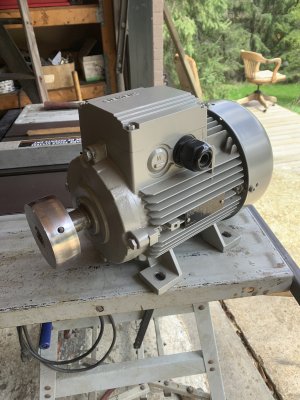
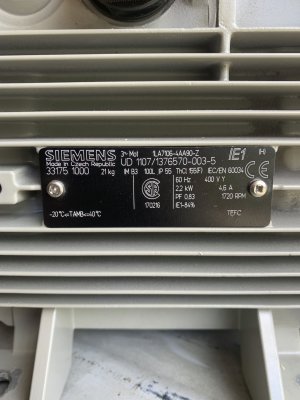
So I p/u a 400v 3hp motor for the mill to match the VFD.
 

Attachments

  • IMG_0348.JPG
    IMG_0348.JPG
    1.6 MB · Views: 2
  • IMG_0398.JPG
    IMG_0398.JPG
    1.6 MB · Views: 2
  • IMG_0399.JPG
    IMG_0399.JPG
    1.4 MB · Views: 2
However, you've bought a thoroughbred and you've got it hooked to a cart. You could set-up field oriented control. You SHOULD set-up field oriented control... especially for user safety. I was planning on buying a higher end Teco VFD just to get FOC option to run my chipmaster. Where did you buy your VFDs I'd like to price shop.
Well one of these days when you get up to my shop maybe you can play around with the programing and I'll feed you well.
I bought the Durapluse vfd's from Automationdirect, not cheap but the service they have is amazing.
The first vfd I bought from them crapped out after a couple of months, they sent me a new one before I had even shipped the broken one back to them. Also the techs there actually work any problems you are having while you're talking to them on the phone. Great company to deal with.
 
I wanted to get the mill on a VFD and bought one inexpensively and only realized when I got it home that it was for 380v.
So I p/u a 400v 3hp motor for the mill to match the VFD.
Booyah!

My memory is not pooched. I was also correct in assuming that you ended up with a motor that was ~400v. I knew the craftex came with single phase motor, and assumed you may have gotten a dual voltage motor and wanted to use higher voltage for some reason. I was going to say make it 220v and we'd reprogram the drive. No biggie, we'll just reprogram the drive to address the issue.

I can see why you wanted to put a VFD on the mill, because that gives you a very damn good heavy mill with fine tuning ability.


I have your fix ready, but before we reprogram anything, let's do a fast diagnostic.

On the XSY AT series, Err 6 stands for general software overcurrent, but you are throwing Err 1, which is a hardware level panic switch.

Err 1 means the internal transistors saw a sudden, massive current spike that crossed the physical threshold of the drive's power chip. It shuts down immediately to protect the internal IGBTs from frying.

Your VFD is trying to drive a heavy, dead weight 3.0 HP (2.2 kW) Siemens motor with high breakaway inertia, and it is launching it on a severely misconfigured V/Hz profile.

This instantly overloads the drive's output stage. One major reason for that immediate, destructive current surge is the VFD's internal voltage doubling rectifier circuit, which aggressively tries to charge the DC bus capacitors to the absolute max right at startup.

The only other conditions that throw an Err 1 are direct short circuits. In those cases, adjusting the potentiometer won't make a bit of difference, the motor won't spin at all.

Because your 10% trick actually works, we know your drive's hardware isn't completely shorted out yet, but your factory V/Hz math is totally broken.

Here is how to verify that it is a parameters and motor combination issue.

Completely power off the VFD, wait 5 minutes for the internal capacitors to discharge fully, and disconnect the U, V, and W motor leads completely from the bottom of the VFD terminal strip.

Leave the motor completely unhooked, power the drive back up, turn his pot to 10%, and press the RUN button.

If the VFD runs cleanly without a load and displays a target frequency, the VFD hardware is fine. The Err 1 was caused by the extreme motor loading and faulty V/Hz parameters under load.

Try that please.
 
Also the techs there actually work any problems you are having while you're talking to them on the phone. Great company to deal with.
I use Teco from emotors direct because they too have excellent support and I have local pick up option as well.

I also use emotors direct because it is a privately held, strictly Canadian industrial distributor.

But the DuraPulse seems to offer Field Oriented Control for hundreds of bucks less. That sucks.
 
Back
Top