• Scam Alert. Members are reminded to NOT send money to buy anything. Don't buy things remote and have it shipped - go get it yourself, pay in person, and take your equipment with you. Scammers have burned people on this forum. Urgency, secrecy, excuses, selling for friend, newish members, FUD, are RED FLAGS. A video conference call is not adequate assurance. Face to face interactions are required. Please report suspicions to the forum admins. Stay Safe - anyone can get scammed.
  • The 2026 Calgary Area Meetup is set for Saturday May 30th at 10am. The signup thread is here! Robinhood has graciously offered to host the meetup again this year. Please note that you MUST RSVP to the notice linked above if you wish to come.

Onboard battery charger/maintainer causing throttle body sensor to go spastic?

Elektrishun

Ultra Member
Car has been sitting for a week awaiting a replacement tire. Went to start vehicle, wouldn't start, battery voltage measured to be 11.38 volts. Maybe the dash cam that was left plugged in drained it down??? No problem, there is an onbaord NOCO charger/maintainer installed. Plugged it in, walked away. Few minutes later I hear a "clicking". Look under the hood and it sounds like it is coming from the throttle body. Unplug the charger from the AC outlet, disconnect the plug from the throttle body, plug the charger back in - no sound. Good...kinda. Now the battery charger starts clicking and flashing that it's in an error loop??? Check battery voltage with multimeter again - 3.8 volts?!?!? Where the h-e-double hockey sticks did all the other volts go? Unplug charger, pull battery, put battery on MotoMaster battery charger (the old school type). Been charging all through Thanksgiving dinner, battery is not even warm to the touch, charging at 2.9 amps according to clamp meter and charger gauge.

Next test - reconnect NOCO charger/maintainer with battery outside vehicle. Does it worK? Answer____________

Still trying to understand what happened.

To be continued...
 
Just took the MotoMaster charger off. Battery voltage = 12.78 Volts

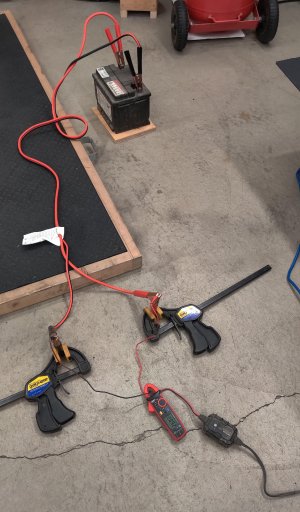
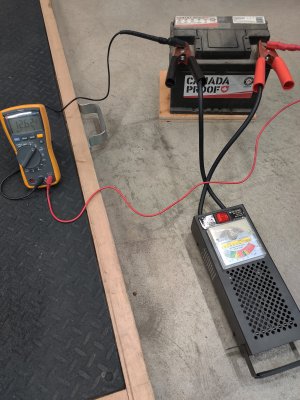
Since the NOCO has ring terminals and the battery has clamping style posts I will connect jumper cables to the charger ring terminals, connect the other end of jumpers to the battery posts, and then plug in the charger. See what happens.
 
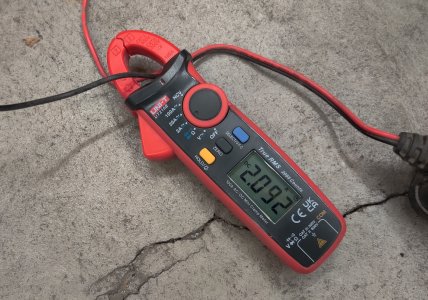
Meter.jpg

Charger.jpg

Same as MotoMaster charger - drawing 2 amps, which is this charger's max. No issues with charger or battery - outside the vehicle.

This charger was used about 2 months ago when doing some diagnostic work for the lights issue. Battery ran down after the headlights were left on. Plugged charger in and 2 hours later started the vehicle.

2 worth mentioning things have happened since then:

- I added a relay to bypass the failed relay in the BCM (details in this thread; https://canadianhobbymetalworkers.c...ical-repair-question.20868/page-2#post-252964 ). According to my son the repair has worked trouble free for weeks BUT we have never used the onboard charger since that installation.

- the vehicle went in for a general inspection at my son's friend's garage about a week ago. A road trip was planned but due to the tire issue it has sat while waiting for the replacement.

So, is it the PICO bypass relay with it's internal diode?
 
2 versions of what went wrong from AI:

Gemini 3:

Why is this happening?
The NOCO Genius 2D is an ultra-compact 2-amp maintainer. It is meant to keep a healthy battery topped up, or very slowly charge a low battery. [1, 2]
If your Mazda's battery is deeply depleted (under 10.5 to 11 volts), the following cycle happens the moment the charger supplies its 2 amps of current: [1]

  1. The Wake-Up: The NOCO injects voltage into the electrical system. Your Mazda’s Engine Control Unit (ECU) senses this rise in voltage and boots up. [1, 2]
  2. The Click (High Demand): As part of its startup routine, the ECU energizes the Main Relay and sends power to open/test the Electronic Throttle Body actuator. [1, 2]
  3. The Voltage Drop: The motorized throttle body sensor draws more current than the tiny 2-amp NOCO can provide. Because the battery is too dead to back it up, the system voltage immediately crashes back down. [1, 2, 3]
  4. The Reset: The ECU loses power due to the voltage drop, the relay snaps shut (making a clicking sound), and the system turns off. [1]
  5. The Loop: With the load gone, the NOCO builds the voltage back up, the ECU wakes up again, and the loop repeats, creating a fast, continuous clicking/chattering sound. [1, 2]


Claude AI:

Your two observations (clicking at the throttle body and the NOCO flashing red) probably have a common cause: the battery was so deeply discharged that the car’s electronics were behaving badly, and the charger couldn’t cope with it.


What likely happened


  • At 11.37 V the battery was already deeply discharged. Then the reading of 3.8 V at the posts after charging attempts suggests a cell was struggling or the surface voltage collapsed under load. A healthy 12V lead-acid battery should never read that low at rest, even when dead.
  • The throttle body clicking is typical of the electronic throttle actuator (and sometimes the PCM/relay) being fed low or unstable voltage. When the charger connected, the system woke up, saw low voltage, and the throttle motor tried to run its self-check or relearn and couldn’t finish. Unplugging the connector stopped the noise, which fits.
  • The NOCO’s flashing red light and clicking: the Genius units have a built-in fault detection. Red flashing generally means a fault, such as a battery that won’t accept charge, a possible dead cell, or too little voltage detected. Clicking from the charger is its internal relay cycling as it tries and fails to start. With the car’s electronics also drawing current and the battery in poor shape, the charger couldn’t stabilize.


I will reinstall the battery at full charge (after a load test) and put the charger back in, too.

After letting the car/battery sit for 15 minutes or more to do it's onboard testing/re-calibrating I will start the vehicle and let it idle for several minutes to continue any onboard computer re-calibrations, diagnostics etc.

Shut it all down and then try plugging in the NOCO battery charger/maintainer. It's called a NOCO Genius 2D for a reason.😕 Thankfully, I still have that MotoMaster "dumb" charger.
 
Not my field of expertise but 3.8v is not a good sign. My guess is if it reaches 'normal' looking voltage by whatever restorative charge, it could be a false reading of actual heath if the deep discharge caused permanent degradation. A load test would be more meaningful IMO.
 
Just took the MotoMaster charger off. Battery voltage = 12.78 Volts

Since the NOCO has ring terminals and the battery has clamping style posts I will connect jumper cables to the charger ring terminals, connect the other end of jumpers to the battery posts, and then plug in the charger. See what happens.

I have no direct experience with that vehicle. But lots of experience with charging and starting systems.

When batteries get low, lots of funky things happen.

The battery should be charged out of the vehicle with a regular high amperage charger. None of this 2 amp stuff. At least 10 amps or more. The battery can be left in the vehicle for charging as long as one terminal is totally disconnected.

A good time to do a load test is when the battery is charged but disconnected. A load test is an essential test when evaluating batteries.

Poor battery connections can cause all kinds of misleading symptoms. Clean the terminals, the connections, and tighten them down. Even if they look and feel great, they can be poor. You can use a voltmeter to test the terminal connectors. A poor connection will generate a voltage across the terminal under load. A good connection won't.

Don't ignore the battery ground connection as well as starter connections.

Some cars with the autostart stop fuel saving feature have an auxiliary battery for starting. If so, it must be checked too.

Some cars have a sensor that let's the ECU evaluate battery condition. Algorithms in the ECU can remember a bad battery and if so the ECU may need resetting.

All recent cars have an onboard diagnostic system that can be read with an aftermarket OBD reader. Sometimes they can show problems that conventional diagnostics can't.
 
Anyone else miss points ignition an a simple 2 barrel carb?

Not to take away from anything in the previous posts, but I recently learned me something on batteries thanks to the new job's training modules. The product we sell and service runs exclusively on deep cycle GEL and AGM style batteries. What I learned is on those specific types of batteries, a 10 amp standard carbon pile charger will absolutely ruin them. Chargers like the Noco mentioned above are the preferred unit. Next I learned that load testing these types of deep cycle battery isn't an accurate means of checking the batteries health. The standard test is going off the measurement in volts. When these batteries show as an example, 12.25 volts, they're actually past 50% depletion in charge (or something REALLY close to that).

My only purpose to mentioning this is to hopefully save someone from nuking a really expensive item.
The GEL unit's are far more spendy than AGM, but their life span is about double that of AGM when they're used and maintained accordingly.

Good luck @Elektrishun with this situation...keep us posted...I think it's creepy though that AI was that specific as to what it could be...wow
 
The battery should be charged out of the vehicle with a regular high amperage charger. None of this 2 amp stuff. At least 10 amps or more.

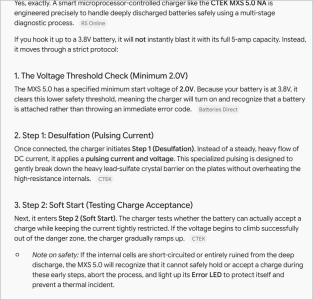
I disagree on putting the boots to current. If you use a 'smarter' smart charger capable of high current, when its faced with a low voltage state it will initially trickle/pulse current as it steps through its algorithm. Only when its satisfied of the battery charge state health will it allow itself to ramp to full/max current. I've seen this firsthand on a CTEK on both healthy & unhealthy batteries

1791900714860.png
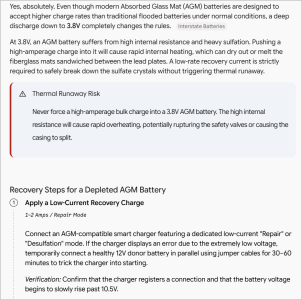
1791900738016.png

1791900786960.png
 
Next I learned that load testing these types of deep cycle battery isn't an accurate means of checking the batteries health. The standard test is going off the measurement in volts. When these batteries show as an example, 12.25 volts, they're actually past 50% depletion in charge (or something REALLY close to that).
I looked into this a bit when i was considering handheld testers. Recreated table below. Most all support the various common chemistries (note variants of AGM). My mechanic friend says they are 'ok' for quick diagnostic & wont get horribly tricked like by using old school lead acid load tester on modern pack. But they use more elaborate consoles in the shop which have more diagnostic bells & whistles.

1791901549970.png
 
I disagree on putting the boots to current. If you use a 'smarter' smart charger capable of high current, when its faced with a low voltage state it will initially trickle/pulse current as it steps through its algorithm.

That is a good clarification that I mostly agree with Peter. I didn't distinguish between a low charge and a partially suphated charge (which needs a low initial charge rate) and I should have. That's my bad.

To be clearer, your clarification isn't really about low vs regular voltage charging. It's really about one or more cells within the battery itself having a partially suphated cell. Most lead acid vehicle batteries have 6 internal cells - each has a nominal 2V rating.

If a battery that has been sitting has a sulphate or partially suphated cell or a voltage in any of its 6 cells that has less than its nominal 2V on it, it shouldnt be charged quickly until it does. Normally this happens because that cell is partially suphated.

So what voltage is ok? Therein lies the problem. We might think that lead acid batteries have been around forever and nothing has changed. So the decision voltages are fixed. That's a very bad assumption. There are many different designs many of which have widely differing construction, chemistry, and life expectancy.

There is also a very big difference between a sulphated battery and a dead battery. They are not the same thing. A dead battery just needs charging, and a sulphated battery needs reconditioning or it needs to go for recycling at the big battery place in heaven.

There are also many commercial reconditioners that will recover sulphated cells fairly reliably, but our past testing couldn't establish a trust level that the corporation could support. For most of us, the best solution is a standard every day low trickle charge that can desulphate a marginal cell in a slow controlled manner. This of course must be followed by a high rate charger to bring the battery up to a full charge.

Pulse chargers work - SOMETIMES - I'm not a big fan of them though and I don't own one. Yes, some charger manufacturers claim that they have universal testers that can reliably pulse condition every battery chemistry and construction out there, but our testing didn't validate that capability.

Coincidentally, I actually do have experience with your Ctek. Back someplace around the turn of the century, Ctek (a swedish outfit as I recall) approached us to market their chargers through our parts division. They claimed they had invented this new pulse charging system that would perform miracles. We had already been working with other companies with the same or similar technology - they all claimed to be inventors, so we just added them to our test and evaluation program. None of them met our expectations at the time so there was no need to worry about who had the most valid patents. But I have been retired for 20 years. It is entirely possible that many of these outfits would or have met those standards now. It's also possible that other auto companies have endorsed them.

When folks ask me about smart chargers, I usually tell them to save their money. Buy a cheap trickle charger and a big fast charger (or a combo) and you can charge almost any battery that is worth saving. Any battery that won't charge that way is best replaced lest it strand you in the middle of the night in a place you don't want to be. I simply can't recommend reconditioning a partially sulphated battery on anything other than a temporary bandage basis.

Yes, I know that anecdotally we have all had differing experiences. I'm ok with that. It was ever thus.

 
Update:

To test that the NOCO Genius 2D wasn't faulty I continued charging the battery with it last night. I checked about every hour to see if there was any warmth to the battery or charger. No signs of trouble. Left it charging overnight. This morning the charger indicated the battery was FULLY charged.

Checked the voltage. Battery voltage was 12.8V.

Took the charger off, waited an hour, then checked the voltage. Voltage still at 12.8V

Connected the old school load tester with multimeter connected. Started 10 second load test. Needle in CCA "green zone" and appears to be within the 590 CCA spec. Voltage dropped to about 11.4V. After releasing test button it jumped up to 12.3V. A few seconds later it was at 12.6V. After a half hour it is at 12.74 and still slowly climbing. IMO battery is good.

IMG_20261013_100744.jpg

Next, put it back on the MotoMaster charger and fully charge it before putting it back in the vehicle along with the onboard charger. Then continue the same steps as mentioned in previous post before attempting to start the vehicle.

I think the lesson here is that if everything appears to be trouble free after the final step of plugging in the NOCO charger I have at least discovered its limitations on bringing back a deeply discharged battery. Knowing the vehicle had sat a week I should have checked the battery voltage BEFORE attempting to start the vehicle. Likely the NOCO would have been able to charge the battery without issue. After attempting to start the vehicle the battery was discharged beyond the capability of this charger.
 
I have the NOCOGENIUS-2D myself permanently installed for maintenace. My issue is longer periods of non use in winter. The car is parked but battery still powering background draws typical on modern cars; door locks, motion sensors, alarm maybe, surfing the internet... whatever it does its sucking juice. Maintenance chargers have features orientated to this specific purpose which are beyond a similar low current rate basically dumb trickle charger - Overcharge Protection, Desulfator, Temperature Compensation, Force Mode, For Lead-Acid (Wet, Gel, AGM, SLA). Temperature compensation is apparently a nice to have in our climate, the algorithm behaves differently at -40C winter day than 'normal' temp which was an issue for older gen maintainers. Anyway these are intended as maintaners of otherwise healthy batteries, they are not miracle workers than can repair a defective battery as @Susquatch put it There is also a very big difference between a sulphated battery and a dead battery. They are not the same thing. A dead battery just needs charging, and a sulphated battery needs reconditioning or it needs to go for recycling at the big battery place in heaven.

The observation that charger A topped up a few more maH into a battery that charger B said 'full' probably has more to do with its algorithm nuances. One might say stop at 200 mah rate, another may be 50. Not necessarily better, just different. BTW if you see a 13.8-14.x voltage fresh off a charger (charger disconnected), dont panic. Its a known phenomenon called Surface Charge (or a Surface Charge Effect). Its an artificial potential difference that dissipates to its normal resting state over a bit of time.

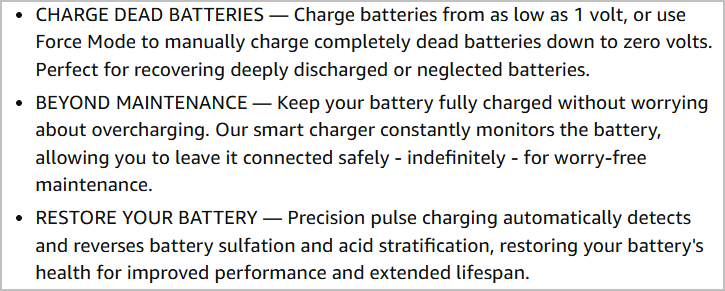
NOCO blurb
1791916160217.png
 
I'm not a big fan of voltage testing on a completely unloaded battery. You can get misleading results. If your battery is totally gone it may tell you. A battery that test's at 3.8 volts has gone bad. It should never test this low. I like to turn on the key but not start the engine. The battery now has a bit of a load on it and the result will be more accurate.

I regularly walk away from vehicles with batteries installed for over 6 months. I make sure they are fully charged before and after storage. I can't say I have had any issues.
 
Many cars/trucks have trouble when a battery/s are out putting less then 12.5 +/-volts when cranking it seems the computers don’t like that.
My Ram Diesel can be a real pita, it will not start, even turn over, gauge lights may not even work. All appearances of low/dead battery. A load test with older style pile tester shows a battery that in past years would have been good for an engines, but doesn’t cut the mustard now. If it does start, there will be some things not working or not working properly. Put a good set of higher end batteries in and a different truck comes out of hiding.
The batteries in it when bought (used) seemed fine when warmer and started to cause problems part way through the winter, replaced them with Mopar Ram batteries, managed to get most of a year from them, then the old problems started again. Finished the winter with them and replaced them with after market a bit less then top end. A major difference, a very different truck. We will see in time what happens, but truck will now go to high idle when warming up, the battery saver crap will now switch off and a couple of other things now seem to work better.
 
Back
Top