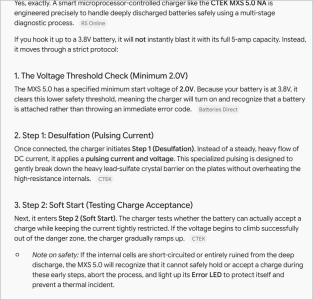
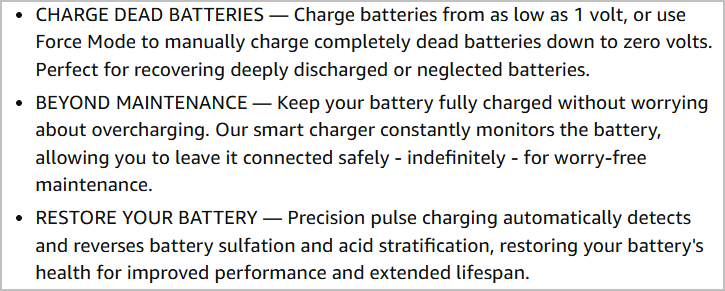
I disagree on putting the boots to current. If you use a 'smarter' smart charger capable of high current, when its faced with a low voltage state it will initially trickle/pulse current as it steps through its algorithm.
That is a good clarification that I mostly agree with Peter. I didn't distinguish between a low charge and a partially suphated charge (which needs a low initial charge rate) and I should have. That's my bad.
To be clearer, your clarification isn't really about low vs regular voltage charging. It's really about one or more cells within the battery itself having a partially suphated cell. Most lead acid vehicle batteries have 6 internal cells - each has a nominal 2V rating.
If a battery that has been sitting has a sulphate or partially suphated cell or a voltage in any of its 6 cells that has less than its nominal 2V on it, it shouldnt be charged quickly until it does. Normally this happens because that cell is partially suphated.
So what voltage is ok? Therein lies the problem. We might think that lead acid batteries have been around forever and nothing has changed. So the decision voltages are fixed. That's a very bad assumption. There are many different designs many of which have widely differing construction, chemistry, and life expectancy.
There is also a very big difference between a sulphated battery and a dead battery. They are not the same thing. A dead battery just needs charging, and a sulphated battery needs reconditioning or it needs to go for recycling at the big battery place in heaven.
There are also many commercial reconditioners that will recover sulphated cells fairly reliably, but our past testing couldn't establish a trust level that the corporation could support. For most of us, the best solution is a standard every day low trickle charge that can desulphate a marginal cell in a slow controlled manner. This of course must be followed by a high rate charger to bring the battery up to a full charge.
Pulse chargers work - SOMETIMES - I'm not a big fan of them though and I don't own one. Yes, some charger manufacturers claim that they have universal testers that can reliably pulse condition every battery chemistry and construction out there, but our testing didn't validate that capability.
Coincidentally, I actually do have experience with your Ctek. Back someplace around the turn of the century, Ctek (a swedish outfit as I recall) approached us to market their chargers through our parts division. They claimed they had invented this new pulse charging system that would perform miracles. We had already been working with other companies with the same or similar technology - they all claimed to be inventors, so we just added them to our test and evaluation program. None of them met our expectations at the time so there was no need to worry about who had the most valid patents. But I have been retired for 20 years. It is entirely possible that many of these outfits would or have met those standards now. It's also possible that other auto companies have endorsed them.
When folks ask me about smart chargers, I usually tell them to save their money. Buy a cheap trickle charger and a big fast charger (or a combo) and you can charge almost any battery that is worth saving. Any battery that won't charge that way is best replaced lest it strand you in the middle of the night in a place you don't want to be. I simply can't recommend reconditioning a partially sulphated battery on anything other than a temporary bandage basis.
Yes, I know that anecdotally we have all had differing experiences. I'm ok with that. It was ever thus.