• Scam Alert. Members are reminded to NOT send money to buy anything. Don't buy things remote and have it shipped - go get it yourself, pay in person, and take your equipment with you. Scammers have burned people on this forum. Urgency, secrecy, excuses, selling for friend, newish members, FUD, are RED FLAGS. A video conference call is not adequate assurance. Face to face interactions are required. Please report suspicions to the forum admins. Stay Safe - anyone can get scammed.
  • The 2026 Calgary Area Meetup is set for Saturday May 30th at 10am. The signup thread is here! Robinhood has graciously offered to host the meetup again this year. Please note that you MUST RSVP to the notice linked above if you wish to come.

New Water Heater

Yes and yes.
OK.
Original panel 100A service with ground to a post in the concrete by the copper drain pipe. Also copper wire running from a second ground post (under the breaker panel) to the water pipe which was copper going through the wall before PEX. For all we know there's a connection along that wall under the concrete between the two.

Now we have a brand new 200A service which included new wires from the pole. I buried one of those large ground plates into the earth as per code. That plate wire connects to the wire you see above the PEX valve but also runs parallel to the wire that went to the original post.

However that new ground terminates inside the 200A service box again as per code.

The 200A service box supplies, through a 100A breaker, power to the original 100A panel and now provides the ground to it too. The connection to the original post in the concrete floor by the copper drain pipe was disconnected as there was no evidence that it was even useful.

The one thing I did not photograph when the perimeter drain tile was redone is what they did with the plate. It was hanging from the wire but whether they buried it horizontally or vertically I don't know.

Does that all make sense?
Yes, makes sense.

I was wondering about your installation because the PEX would obviously nullify the use of the water line as a ground rod because of where the ground conductor is clamped. Since you have a ground plate buried outside that should take care of establishing an earth ground for all your electrical equipment. Sounds like that second ground rod in the concrete floor, which you stated is connected ("bonded") to the main copper water line, is still used as a ground rod, too.

Last question, only because I am curious about these things, the neutral terminal bar and ground terminal bar in the old panel would have been originally "common" to each other with a "bonding" screw. Now that the old panel has become a sub-panel fed from the new 200A service that screw has been removed - correct?
 
Yes, makes sense.

I was wondering about your installation because the PEX would obviously nullify the use of the water line as a ground rod because of where the ground conductor is clamped. Since you have a ground plate buried outside that should take care of establishing an earth ground for all your electrical equipment. Sounds like that second ground rod in the concrete floor, which you stated is connected ("bonded") to the main copper water line, is still used as a ground rod, too.

Last question, only because I am curious about these things, the neutral terminal bar and ground terminal bar in the old panel would have been originally "common" to each other with a "bonding" screw. Now that the old panel has become a sub-panel fed from the new 200A service that screw has been removed - correct?
You're going make me look aren't you. ;-)
 
That's the default setting and was on the old one too. When you mix the hot with cold it goes further. Remember, as soon as you take out some water from the tank it's replaced with cold so the overall temperature of the water drops. It means if the washing machine is using hot water your shower may not see 40C water.
Plus I've set our shower heads to restrict max hot water so one can't really get scalded by the water.
HI Guys,

Our hot water temperature is set for 40 degrees, primarily for the shower, we don't have any other hot water needs other than the bowl full for dish washing.
 
Just got my home insurance policy renewal. Just in case anyone was looking for another reason to replace an aging hot water tank.

View attachment 84416
I was questioning the premium on my house insurance with the agent and he suggested that my 10+ year old water heater had something to do with the high cost and suggested I replace the heater. I told him give me a quote that reflected me replacing my water heater and he RELUCTANTLY did so and then finally told me it made no difference.
Insurance seems to always have a clause for why they are not going to cover you for the things you thought you were covered for and were paying premiums for.
 
I think their excuse is that the tank will rust out and fail,,, eventually. You don't get a discount for having a new HWT or having a poly tank, Rheem Marathon, that has nothing to rust.
 
I think their excuse is that the tank will rust out and fail,,, eventually. You don't get a discount for having a new HWT or having a poly tank, Rheem Marathon, that has nothing to rust.
That water heater did eventually fail and leak. I sold the house and told the new owner that the heater was on borrowed time and it lasted a couple more years and then sprung a leak. I think it was near 20 years old. My previous heater also failed in about that time or a bit more.
 
I was questioning the premium on my house insurance with the agent and he suggested that my 10+ year old water heater had something to do with the high cost and suggested I replace the heater. I told him give me a quote that reflected me replacing my water heater and he RELUCTANTLY did so and then finally told me it made no difference.

I can see that, but we are talking premiums not coverage exemptions. I wonder if this is a case where its old but still within the allowable range? And this may well vary by insurer, I'm about to start looking for alternative quotes because TD goes up every year. All hat hail damage has to be paid by someone & it aint gunna be them. But my gut feel is they are all in the same game. Or a cheap quote might mean bad service come claim time.

Anyway the excerpt I included of my recent policy update states the exemption - no coverage for water damage if tank >15 years old. So if the tank craps & it takes 25K to repair damage, that expense is entirely on you. When it comes to water damage, its amazing how fast the damage can rack up with a couple mm of water. And an uncanny correlation to happening the week you go on vacation, or New Years Day at -35C.
 
Remember, as soon as you take out some water from the tank it's replaced with cold so the overall temperature of the water drops. It means if the washing machine is using hot water your shower may not see 40C water.

Mine holds temp because the hot water stays at the top draw end and the cold stays at the bottom. I thought all water heaters were like that.
 
When it comes to water damage, its amazing how fast the damage can rack up with a couple mm of water. And an uncanny correlation to happening the week you go on vacation, or New Years Day at -35C.
Whenever I hear about large scale flooding in certain areas that seem prone to flooding events is insurance even a thing?

But beyond insurance I wonder about the physical condition of buildings and homes that experience flooding on that magnitude. For example, when a city like New York has flooding that shuts down the subway system...all those old buildings...the water damage left unattended must be a serious problem.
 
Whenever I hear about large scale flooding in certain areas
Probably apples & oranges which is why you need to read your policy fine print. Water originating from outside (flood, rain, water main break) is categorized & covered differently to water originating from inside (water tank failure, plumbing, pipe burst...). You can rest assured the insurance company will investigate & assess this in detail before remitting a dime.

But to your point, when Calgary had the 'rare' river floods, certain geographic areas were re-designated as higher risk, their premiums went up for that reason and/or had coverage caps. But I would expect the policy clauses to internal remained largely the same. Living on a river bank has nothing to do with the condition of your water tank. Yes, in areas that have perpetual risk issues it would not shock me the premiums are so high the owners just go without. Or insurance company refuse to cover to begin with. I dont take glass insurance on my vehicle because the premium difference pays for a new windield in a couple years or less.
 
I dont take glass insurance on my vehicle because the premium difference pays for a new windield in a couple years or less.
I am the same. The lady selling the insurance got quite indignant with me when I refused coverage, but when I explained the price of coverage plus the cost of their deductible, it was far cheaper to buy my own windshields as required. I think that she stopped buying coverage shortly afterwards as well, judging by her reaction. Newer cars might be more expensive, but for my two '78 ford's and '89 jeep, I put them in myself.......
 
But beyond insurance I wonder about the physical condition of buildings and homes that experience flooding on that magnitude. For example, when a city like New York has flooding that shuts down the subway system...all those old buildings...the water damage left unattended must be a serious problem.
Detroit floods all the time, and it's still standing. (Mostly) I think it's harder on the cars than the buildings but I could be wrong
 
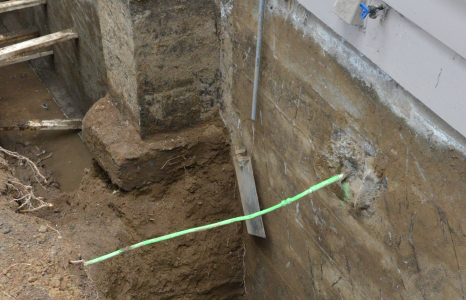
So here's the outside during the perimeter drain replacement. Flex copper to the point where it broke. Transition to PEX 1/2" (OD, not ID). Then through the 11/32" right angle fitting up through more PEX into the ball valve which likely has an ID of 9/32".

All which translates into a drop in shower head pressure when a tap somewhere else is turned on.

Oh and to the left of it is the ground plate for that new 200A panel.

1784323195696.png
 
You're going make me look aren't you. ;-)
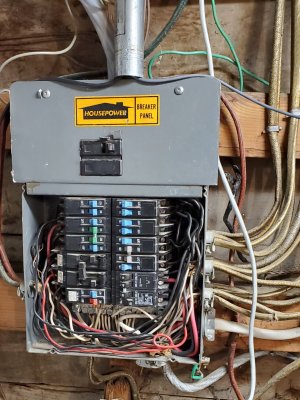
It's too crowded in there to see if there's a direct physical connection between the white Neutral and the green ground(box). However since we had Electricians install the 200A panel and run a new wire over from a 100A breaker to the old panel plus disconnect that earth wire to stake into the concrete I'm going to guess they likely did whatever else was required. But short of shutting off the 100A breaker and tugging at all the wires I don't know if I can see. Plus no guarantee that I'd even recognize some hidden connection underneath the neutral power bar.
 

Attachments

  • OldPowerPanel.jpg
    OldPowerPanel.jpg
    489.3 KB · Views: 6
@jcdammeyer

Yes, probably not a good idea to press or push on wires while the panel is live.

In more modern panels the bonding screw can usually be easily spotted by its vibrant green color.

In older panels like that it might not be a green colored screw, just plain. If you can safely shine a light to the left or right at the bottom of your panel you might see a solitary screw head on the neutral busbar. Or you may see an opening where a screw could go. That is the likely location of the bonding screw. The screw goes through the neutral busbar and into the back of the panel which makes it common to ground.

If in doubt are you able to confirm with the electrician who did the work?
 
Last edited:
Detroit floods all the time, and it's still standing. (Mostly) I think it's harder on the cars than the buildings but I could be wrong.

The buildings are standing but how healthy is it to live in them? It's not just clean water when places get flooded. Even if it was there is still the development of mold if it doesn't get repaired properly.

When I was a maintenance supervisor we had several old buildings that were constantly besieged by sewer back-ups, plumbing leaks, rain roof water leaks, spring run off seeping in...
We called in people to check and repair the damage after we cleaned up. Those were government/public funded buildings so money wasn't a problem.

What about all the privately owned property? I doubt many owners can afford to keep throwing money at it. Insurance, no insurance, expensive insurance...if it keeps happening I suspect some buildings just slowly rot.
 
The buildings are standing but how healthy is it to live in them? It's not just clean water when places get flooded. Even if it was there is still the development of mold if it doesn't get repaired properly.

What about all the privately owned property? I doubt many owners can afford to keep throwing money at it. Insurance, no insurance, expensive insurance...if it keeps happening I suspect some buildings just slowly rot.
https://www.eenews.net/articles/historic-floods-fuel-misery-rage-in-detroit/

I guess it's a myriad of problems, but reading a bit it sounds like Detroit keeps getting hit with "once in a century" storms, 5 or 6 times in a decade.

I was listening to the radio this week and it said Detroit has declined from around 2 million residents to around 650,000. They called it the "great migration", when so many people moved north to Detroit for good paying jobs in the Motor City
 
Back
Top