• Scam Alert. Members are reminded to NOT send money to buy anything. Don't buy things remote and have it shipped - go get it yourself, pay in person, and take your equipment with you. Scammers have burned people on this forum. Urgency, secrecy, excuses, selling for friend, newish members, FUD, are RED FLAGS. A video conference call is not adequate assurance. Face to face interactions are required. Please report suspicions to the forum admins. Stay Safe - anyone can get scammed.

Milling machine (time) needed

Kobusvn

Member
Hi All,

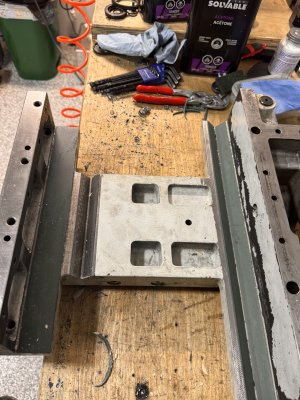
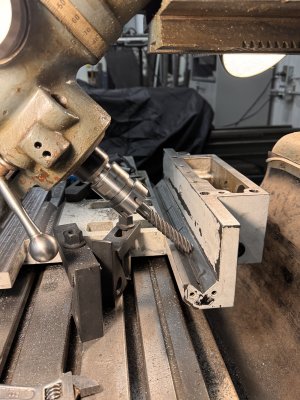
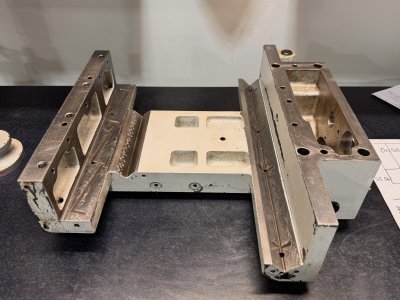
I started rebuilding my lathe saddle and I realized that I will have to do some remedial work that I need to get done on a milling machine that is bigger in capacity than my current milling machine. I am in Regina, SK. If anybody is willing to let me use their mill to get the job done, I would greatly appreciate it. I have severer trust issues in machining shops and the saddle is not something that I will ever be able to replace without gifting potentially two kidneys. I have my own tooling to get the job done. I need to be able to mount a saddle with a footprint of 20"x20" and just mill some surfaces to make way for Turcite or Moglice. The underbelly of the carriage is as the picture depicts, so, I need to get a milling machine head into the cavity.

Appreciate any responses.

Thanks.
 

Attachments

  • Saddle bottom.jpg
    Saddle bottom.jpg
    4.5 MB · Views: 35
Tell us more about what you are planning to do @Kobusvn. What is wrong or otherwise planned with the saddle?
 
Hi all, I have in the meantime had a hand extended for a milling machine, thanks.

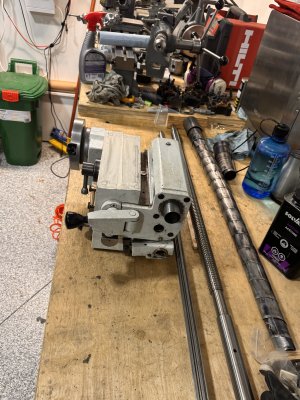
I have taken a lot of the lathe apart, mostly the carriage, apron assembly with its gears, ball screw etcetera. Headstock stays in tact. I am replacing all the bearings, o-rings and oil seals and where a surface is scuffed, it is buffed back to its original (as near as can be) condition.

With regards to the saddle, I need to mill out theV-way and flatly for Turcite fitment and rescraping. I will then also lightly touch the crosslide surfaces to ensure that everything is coplanar and that the dovetails are parallel. The crosslide will then also get a new Turcite surface.

The work is being done on a Schaublin 150, so, I am a bit pedantic on how it is done and prefer to do the work myself as parts are hard to come by and everything costs a fortune.
 
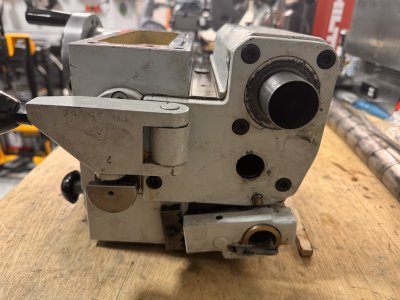
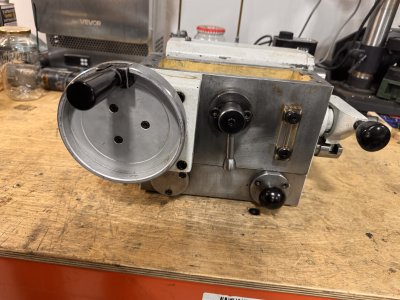
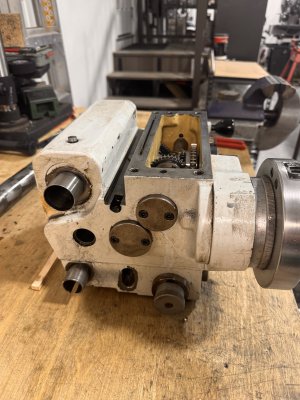
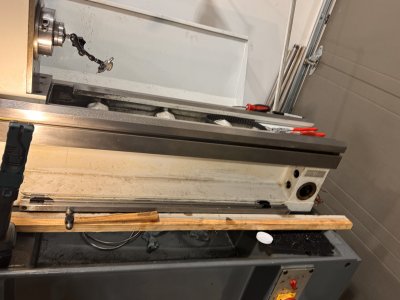
I had some account issues and could not post anything... They are now sorted. Some pics of saddle feedbox removed and bed without it's goodies on it.
 

Attachments

  • IMG_7840.jpeg
    IMG_7840.jpeg
    2.2 MB · Views: 18
  • IMG_7839.jpeg
    IMG_7839.jpeg
    2.6 MB · Views: 17
  • IMG_7836.jpeg
    IMG_7836.jpeg
    2.8 MB · Views: 18
  • IMG_7834.jpeg
    IMG_7834.jpeg
    2.3 MB · Views: 18
  • IMG_7835.jpeg
    IMG_7835.jpeg
    3.1 MB · Views: 18
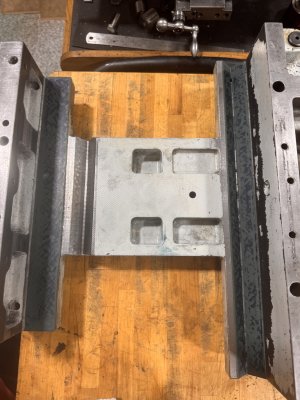
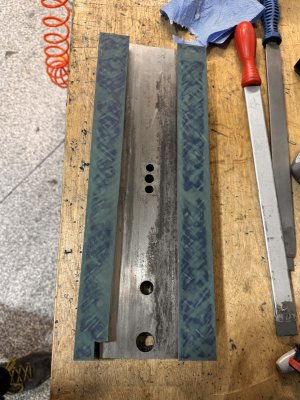
I managed to get some time on Doggggboy's mill and the net result is as follows so far. Turcite fitted and scraped to the bed - picture shows rough scraping done. Was ultimately finish scraped. Crosslide is almost done as well. Will post some more pictures in the weeks to come.
 

Attachments

  • IMG_7989.jpeg
    IMG_7989.jpeg
    3.1 MB · Views: 15
  • IMG_7977.jpeg
    IMG_7977.jpeg
    2.8 MB · Views: 15
  • IMG_8022.jpeg
    IMG_8022.jpeg
    2.6 MB · Views: 14
Turcite fitted and scraped to the bed
Cool! I dont think I've ever seen anyone on the forum actually do a Turcite job. Tell me more about the application. How much metal did you remove & then how thick was the Turcite strip? What is the bonding process? Is scraping much like metal scraping with the transfer blue etc? Is the scraping tool a different edge geometry given softer material etc? How do you handle lubrication? I think I see some weep holes in the original CI surface, do you just cut through the Turcite there?
 
Enjoying this thread. I’ve done some turcite scraping but definitely not on a Schaublin 150! Kudos to you. Machine originally from Moose Jaw? Cross slide need turcite? Tailstock need attention as well? Suggest no to turcite at bed tailstock slide- prefer shimming in between base and top.

Forgive my snooping eyes- is that a 102 in the background?
 
Cool! I dont think I've ever seen anyone on the forum actually do a Turcite job. Tell me more about the application. How much metal did you remove & then how thick was the Turcite strip? What is the bonding process? Is scraping much like metal scraping with the transfer blue etc? Is the scraping tool a different edge geometry given softer material etc? How do you handle lubrication? I think I see some weep holes in the original CI surface, do you just cut through the Turcite there?
I did Turcite on the crosslide as well, did some rough scraping on it - photo attached. Will do the final scraping once I am done with the saddle to ensure that all fits well. There is some math involved when you consider the V way versus the flat way. I used 1.2mm turcite on the saddle surfaces so I had to remove 0.86mm on the flat side and 0.96mm on each of the v-faces to ensure that it remains parallel to the reference surface and maintain the correct height for the bottom gearbox/feedbox. My lathe has a ball screw and two further rods for rapid traverse and slow/fast start, stop and reverse so the height should remain constant. The bonding is simple, rough up the casing, clean the turcite, mix the epoxy and apply. I made a serrated scraper that had just shy of 0.8mm teeth to give me an even fine spread of epoxy and keep the bond line small. Then, apply a lot of pressure. I basically loaded everything heavy that I had on the saddle and left it for a day or two. I used parchment paper on the saddle so that no epoxy bonds on the saddle and also for safety applied a thin layer of mold release.

The scraping process is similar save for you pulling towards you in stead of pushing away. The turcite does not react well to the scraping in a conventional fashion because it gouges the material, so it is best pull scraped. I find that a well ground scraping tool that is sharp works great and I don't change the geometry from conventional scraping in iron.

I have in the meantime transferred the lubrication holes, cleaned the ports and still need to cut the lubrication grooves into the turcite. Future me problem. The turcite is soft so working with it is a breeze in comparison to the casting. I opted for the turcite on the saddle because it had irregular wear and would have been an utter pain to scrape due to the way in which it was made. You have to pull scrape the one side and push scrape the other. With the turcite in it was the same but it was much easier to work with. After the finished scraping the saddle measurements were great, running perfectly parallel to the spindle rotation.

I am looking forward to feel it all come together, I think it will feel great.

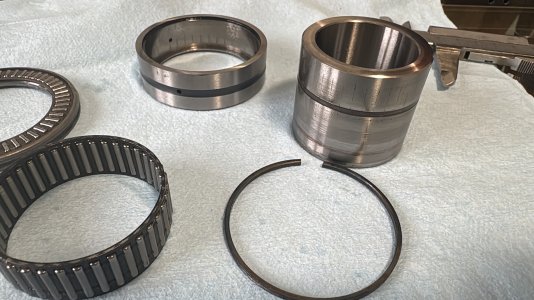
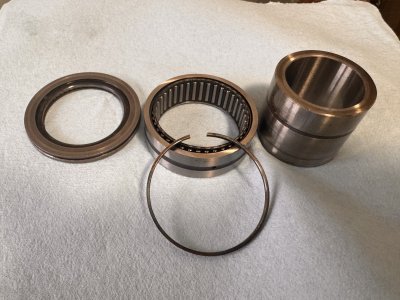
Much has been doneto the other components as well and I am awaiting new ball screw bearings (not the bearings in the ball screw, I have replaced them already) then that assembly can be finalised. It uses a bearing set made by Nadella (RAX445) which is a very slim profile needle roller/trust bearing assembly that is almost like a drawn cup bearing but with a recess, retaining ring and matched thrust bearing. I will add a photo the bearing stack just for interest.
 

Attachments

  • IMG_7987.jpeg
    IMG_7987.jpeg
    3 MB · Views: 6
  • B17FEE33-3861-4A0C-B94A-6131876E512F.jpeg
    B17FEE33-3861-4A0C-B94A-6131876E512F.jpeg
    1.6 MB · Views: 6
  • IMG_7887.jpeg
    IMG_7887.jpeg
    2.5 MB · Views: 6
Enjoying this thread. I’ve done some turcite scraping but definitely not on a Schaublin 150! Kudos to you. Machine originally from Moose Jaw? Cross slide need turcite? Tailstock need attention as well? Suggest no to turcite at bed tailstock slide- prefer shimming in between base and top.

Forgive my snooping eyes- is that a 102 in the background?
No, I bought the machine from Switzerland several years ago.

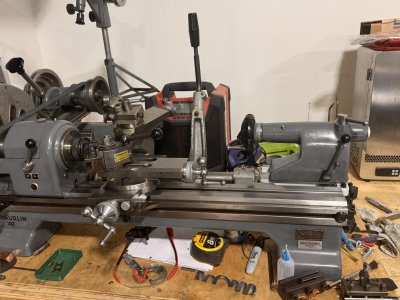
It is a 102, yes... 🙂 Excuse the mess, I am spatially impaired... There she is.
 

Attachments

  • IMG_7802.jpeg
    IMG_7802.jpeg
    3.9 MB · Views: 17
mix the epoxy and apply.
About what kind of depth do you figure you pull with a typical scrape? Like, do you have to be a lot more careful vs typical cast iron scraping or does it work out to something similar? Is the boding epoxy specifically made for Turcite? I thought I read somewhere the adhesion side of Turcite has some special chemical treatment or etch - like you pull off a protection film or something & then directly on the epoxy spread? Where do you buy the Turcite goodies? Nice machines BTW!
 
About what kind of depth do you figure you pull with a typical scrape? Like, do you have to be a lot more careful vs typical cast iron scraping or does it work out to something similar? Is the boding epoxy specifically made for Turcite? I thought I read somewhere the adhesion side of Turcite has some special chemical treatment or etch - like you pull off a protection film or something & then directly on the epoxy spread? Where do you buy the Turcite goodies? Nice machines BTW!
You need to be a bit more careful. The material removal rate wit the turcite is considerably more than removing iron. It does make it a pleasure to work with though. The epoxy is specifically for the material. You are correct the underside of the turcite is a browner shade and looks like it has very slight holes in the back for surface retention. No film, just surface that I cleaned with acetone prior to bonding. I still had material left from previous projects that I used for this. I did email companies in the US, especially to get some moglice because that was my first choice, however, they just never replied to any email which is quite poor. I emailed the US distributor that claimed that they ship to CA. There are turcite replicas in China that seems to have great reviews and ratings and are also more affordable.
 
Back
Top