TEMPERING SPRINGS
It is often necessary to make small springs for special purposes in the model workshop. While the winding or forming of a spring is usually fairly simple, difficulties frequently arise in tempering it to produce the desired elasticity.
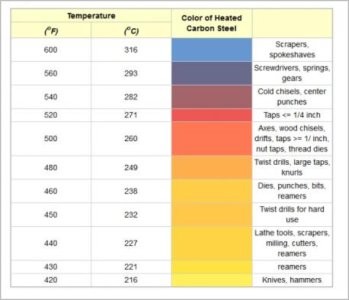
Page 24 of the Model EngineerHandbook gives a table of the temperatures needed to produce various degrees of hardness in carbon steel after preliminary heating and quenching to make it dead hard. Mr G.Brown, of West Bromwich, a professional metallurgist, writes that the temperature of 300 deg.C which is given in this table for tempering springs, is much too low, and will result in leaving the springs too hard and brittle.
Mr Brown continues: “Springs made from plain carbon steel are hardened or stiffened to resist taking permanent set when loaded, in two principal ways. One is to quench the springs from red heat and then temper at an appropriate temperature. If the tempering temperature is too low, the springs will be brittle and will crack when compressed; if too high, the springs will be too soft and will set permanently when compressed. “The second method achieving hardness in spring material is to use suitably work-hardened material to make the springs-hard-drawn wire or cold rolled strip.
“In the first instance, most carbon steel spring materials are heated to 820 deg. C, quenched in oil, and then tempered in the range 400 deg.C to 480 deg.C, the precise figure depending on the material used and the length of time at temperature.
“While springs made from hard drawn or rolled materials can be used in just this state, it has been found that such materials are improved in their elastic properties; permanent set takes place at a higher stress, if the springs are heated to a low temperature in the range 200 deg.C to 300 deg. C for a few minutes-known as 'stoving' in the spring trade.
“While it is possible that your stated tempering temperature of 300 deg. C might refer to the stoving treatment, it is, generally speaking, very high for this, and I have interpreted it as being a tempering temperature after hardening. If this is so, the springs will be outside the optimum hardness range of 400-500 Vickers Pyramid Hardness Number and will most likely be brittle enough to fail when fully loaded.
“A more suitable tempering temperature would be 450 deg. C for five minutes (or slightly less if the temperature were a little higher). Thus you will see that tempering temperatures for springs are outside the range of temperatures that can be determined by reference to tempering colours.
“I feel sure that the contributor of your table on page 24 has confused the tempering of springs with heat blueing of springs. This is often done to previously hardened and tempered springs after they have been cleaned to a bright finish by an abrasive process, followed by heating to 300 deg.C (generally in a rotating metal barrel), this temperature giving a lustrous blue finish. As the 300 deg. C blueing temperature is below the 450 deg. C used for tempering the springs, they are not softened to any noticeable extent.
“One also sees many springs with a straw coloured finish—clock mainsprings, for example. The colour is imparted to the springs, which are of the hard drawn or rolled material variety, by heating to just over 200 deg.C the stoving temperature."
To this Edgar T. Westbury replies:“The information given by our correspondent is undoubtedly based on practical experience, and I have confidence in recommending it to allwho have facilities for exact temperature, measurement and control.These are not commonly available in smallworkshops, and some experiment is usually found necessary before satisfactory results can be obtained with the usual limited equipment.”
19 JANUARY 1961
72
MODEL ENGINEER