
• Scam Alert. Members are reminded to NOT send money to buy anything. Don't buy things remote and have it shipped - go get it yourself, pay in person, and take your equipment with you. Scammers have burned people on this forum. Urgency, secrecy, excuses, selling for friend, newish members, FUD, are RED FLAGS. A video conference call is not adequate assurance. Face to face interactions are required. Please report suspicions to the forum admins. Stay Safe - anyone can get scammed.

Leaking model boiler under construction - lost cause or is there faint hope?

Mike R

Ultra Member
Premium Member
I recently brought home a copper boiler from my dad with the intent of getting it done so the locomotive its for could be moved towards completion as the running gear is basically done and running on air. Its for a 3-1/2" gauge Maisie.
Well, after making up some plugs for the openings I gave it a preliminary pressure test with city water pressure - unknown pressure but maybe 70 psi max - I feel its actually less where I am. Thats against a static test that will be at 200psi+ when (if) the time comes to do a proper hydrostatic test.

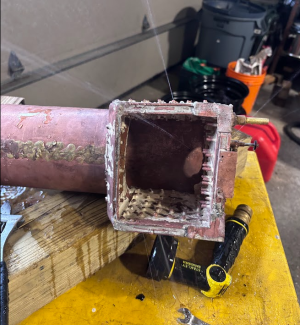
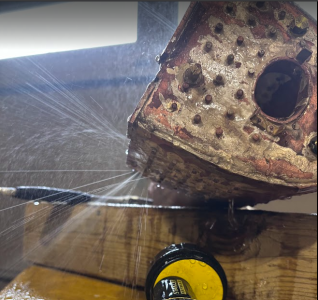
Anyway, we had been chasing a bad leak around the foundation ring that would not even let it fill and it appears that is fixed (see flat plates added to back corners), but now the rest of the boiler resembles a lawn sprinkler more than a pressure vessel.

Looking closely at the (excessive) silver solder, it looks "cold" around the leaking stays. Theres even a leak in the middle top of the firebox where there aren't even any through holes - that one is a real mystery unless it was a through hole for rivetting on something inside the crown?

Just wondering out loud - has anyone recovered a boiler from this state or will I just be fixing one leak and making several new ones as we have already done? Options are give up and start over (just materials alone will be $$), pay ~$3500+ for a prebuilt one from the UK (silver soldered), and there are vendors who Tig weld boilers (special grade of copper and technique to prevent cracking - who knows how much $ for those).
1795899570358.png 1795899711547.png
 
Just musing here. What about using big billets of 4140/1018 etc. round and square stock and mill/turn the vessel from that? I have some 4140 4" round and a lump A36 square 5" x 6" by 5" or so. Tig weld the machined parts into one boiler assembly? Add bolts to be over built? Not as nice as beautiful copper parts - but maybe a layer of copper on top for appearance? Keep in mind I have no idea if this is a desirable or even a safe idea. Boilers scare the crap out of me. And high pressure pipelines too.
 
Even model size boilers have rules that are to be adhered to. Copper is spec'd as its corrosion resistant and you don't need to worry about it wasting away like a steel boiler. Stainless steel is frowned upon as there are conditions that lead to it cracking under heat and pressure and letting go without warning (this is an area I'd like to explore more but not until retirement).
Steel boilers are possible, but at the small size like this they aren't typical as the spec's call for min 1/4" (6mm) thick shell to allow for wasting (corrosion). Gets heavy and cuts into your firebox if its 1/4" on outside, and 1/4" on inside the fire box both sides you loose a full inch of firebox width before adding water space on an already small firebox - on these small boilers the fire grate size is important when firing with coal.
Once you are into the 7-1/4" or 7-1/2" gauge stuff steel boilers make alot of sense and 5" gauge is kind of the start of the break over point - a case can be made for both.

short story - copper has been proven to be a safe material for home builders with less than amazing fabrication skills (looking in the mirror) once it has passed its hydrostatic test at 2x max working pressure.
 
I see. Trickier than first appears. Could you TIG weld with copper rod all those holes?
 
I recently brought home a copper boiler from my dad with the intent of getting it done so the locomotive its for could be moved towards completion as the running gear is basically done and running on air. Its for a 3-1/2" gauge Maisie.
Well, after making up some plugs for the openings I gave it a preliminary pressure test with city water pressure - unknown pressure but maybe 70 psi max - I feel its actually less where I am. Thats against a static test that will be at 200psi+ when (if) the time comes to do a proper hydrostatic test.

Anyway, we had been chasing a bad leak around the foundation ring that would not even let it fill and it appears that is fixed (see flat plates added to back corners), but now the rest of the boiler resembles a lawn sprinkler more than a pressure vessel.

Looking closely at the (excessive) silver solder, it looks "cold" around the leaking stays. Theres even a leak in the middle top of the firebox where there aren't even any through holes - that one is a real mystery unless it was a through hole for rivetting on something inside the crown?

Just wondering out loud - has anyone recovered a boiler from this state or will I just be fixing one leak and making several new ones as we have already done? Options are give up and start over (just materials alone will be $$), pay ~$3500+ for a prebuilt one from the UK (silver soldered), and there are vendors who Tig weld boilers (special grade of copper and technique to prevent cracking - who knows how much $ for those).


View attachment 90141 View attachment 90144
This something I definitely never done, seen, or been a part of, but with as much work that has gone into it, I would definitely attempt repair. Just take your time and fix one at a time, by the time you are done your skills will have improved enough that you'll probably redo the first ones and touch up some areas you hadn't identified yet. Sounds like a fun project. 🙂
 
I see. Trickier than first appears. Could you TIG weld with copper rod all those holes?

Unfortunately no. Welding copper is another rabbit hole, and to do it properly needs the right kind of copper - oxygen free. Otherwise you end up with embeded hydrogen that causes cracking. No ease way out unfortunately. I've gone down a few different paths on my own in search of a viable alternative to silver solderd copper for small boilers and haven't found a good alternative yet.
 
Someone has put a great deal of time and effort into that one already, which is a shame it's such a leaker. I personally would stick that on a shelf and build a new one. If I absolutely HAD to make that one work, I would redo every joint the best that I actually could. Perhaps disassembly, clean up all the joints and resolder the entire thing. If I could. Not sure how far you can actually get that apart.
 
You mention stainless not being great? What about swagelok tube and 316L stainless. We use it in the nuclear industry for much higher pressures then you'll ever use.
 
How about hot dipping a steel version in zinc, maybe multiple times? Would that be corrosion resistant? or some sort of electrolytic treatment?
 
The use of stainless is controversial in the live steam modelling world. Lots of fear (some justified, some not) over stress corrosion cracking as we are boiling water and not simply conveying it along, and there are lots of things that introduce stress in a boiler versus a smooth tube ( a zillion bushes, welded tube plates and localized heating). Plus typically our water is not treated as well as that in a nuclear facility.

I'd love to dive deeper into making stainless steel boilers a viable alternative as that is yet another factor that is killing the hobby (high cost and skill required), but I need to retire to dedicate time to it.
Some Australians have looked into using duplex stainless steel for boilers and published a spec, but they didn't really do it right in my opinion and didn't get any real benefit for the additional cost and effort that they agreed to in the spec (still needs to be 6mm thick at minimum, needs certified welders, etc...).

I hear rumors of stainless steel boilers being used in Europe for models but there is precious little info out there. Maybe I can use AI to do some deep digging for me.
 
How about hot dipping a steel version in zinc, maybe multiple times? Would that be corrosion resistant? or some sort of electrolytic treatment?
I'm no expert but I think the zinc is readily disolved at the temperatures used. Can't use brass in boilers due to "dezincification" so I imagine the galvanizing would go away too quickly. All the fittings (bushes) built into the boiler (i.e. permanently bonded in by soldering) are bronze. Can use brass on external stuff (fittings, valves, etc.) as its replaceable and not considered part of the pressure vessel.
 
Back
Top