Ik wist niet dat je Zweeds sprakDet var inte jag!

Ik wist niet dat je Zweeds sprakDet var inte jag!

Ik niet, maar Google wel.Ik wist niet dat je Zweeds sprak
My old man did exactly that one time only he landed knee cap first on the concrete floor shattered that cap into spinters....he suffered for the rest of his life over that few seconds laps in good judgment.Standing on some wobbly stuff and reaching way past my balance point of course
Yeah when we look back there was always a smarter way to do something.My old man did exactly that one time only he landed knee cap first on the concrete floor shattered that cap into spinters....he suffered for the rest of his life over that few seconds laps in good judgment.

I found out the other day that the ESP32 processor modules have a CAN bus. Apparently it's a clone of the SJA1000 from Philips but they can't call it CAN so they call TWAI (Two Wire Auto Interface).
The ESP32 outputs are 3.3V and need a CAN bus driver so I put together a small board with a 5V driver and resistors to level shift.
Here's the latest project finally working.
View attachment 73870
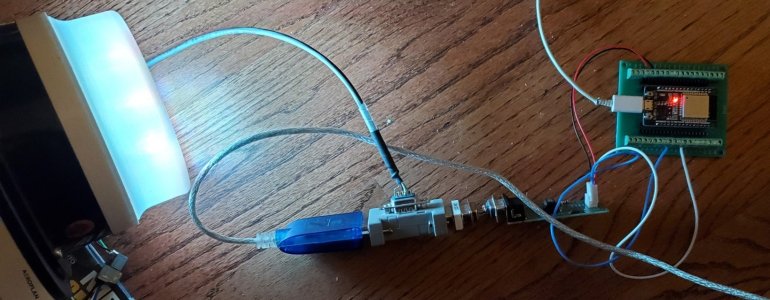
ESP32 DEVKIT1 running pins 4,5 out to a CAN bus level translator and the CAN bus goes out to an Olympic Ring Light #27 (500kbps). The blue thing is a USBCAN dongle to verify the correct messages are being sent.
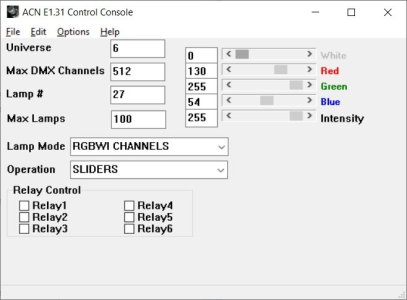
The App, written in Delphi Object Pascal, sends out UDP packets to the ESP32 formatted in ACN1.31 which carries internally the DMX512A 513 bytes of data. It receives that, parses the data and updates the lamps over the CAN bus.
View attachment 73869
And the output from the ESP32 to the PC that shows it's getting the messages.
Received packet from : 192.168.0.137
Size : 638
For Universe #6
DMXPacketLength 513, DMXSlotStart 0, DMXSlotIncrement 1, DMX_RGBWI_CHANNELS Sending CAN Message
Now I can use Vixen Light Show Software to create the ACN1.31 messages. And it turns out DragonFly is delivering my five 3V CAN transceivers today some time.
In the past I've had to use hard wired Ethernet to make this work.
Great fun even if a bit frustrating.
Let's see... metalwork... hmmmmm... Ah. Yes! I soldered the adapter board.


That's alright. Went over my head too. Just luck I got it working.You too huh...... 😳😛😀
Yeah I'm thinking I'll turn the fan around. Even a bit of air circulation creating movement is probably good for the plants too simulating the real world.

I found out the other day that the ESP32 processor modules have a CAN bus

Can you make/buy a "middle finger" light and wire it into your brake lights? Probably just as effective, in the back windowIn my last job I worked with managing, interpreting, reporting and acting on CANBUS messages from a variety of sensors. One of my get-to-it-someday projects is to interpret the CABUS messages in my vehicle, which tells me not just my speed, but the speed limit per the posted signs which the car's camera reads. I want to put a large display in the back window, clearly visible to tailgaters, along the lines of "The speed limit is XX". "My speed is XX" "What's your ^%$#! Problem, %$#!?"
I have a Redboard (Ardunio clone) with a CAN module along with the proper pinout cable and connector for the connector to the car. Was able to monitor messages but found most of them are unknown and finding out what is what is really hard.In my last job I worked with managing, interpreting, reporting and acting on CANBUS messages from a variety of sensors. One of my get-to-it-someday projects is to interpret the CABUS messages in my vehicle, which tells me not just my speed, but the speed limit per the posted signs which the car's camera reads. I want to put a large display in the back window, clearly visible to tailgaters, along the lines of "The speed limit is XX". "My speed is XX" "What's your ^%$#! Problem, %$#!?"
What sort of CANBus stuff did you work on?
Since the company had designed the system from the ground up, I didn't have to reverse engineer CanBus messages, just translate them to human meaningful form and act on them.finding out what is what is really hard.
I mostly did work with industrial control systems starting in The Netherlands before there were CAN bus driver chips.Nothing to do with vehicles. The company made dementia monitoring and nurse call systems for continuing care retirement residences. Fall detection, wander alarms, incontinence sensors, many other things all fed back to a central monitoring system to log and alert nurses and care staff. Also developed a smaller scale system that ran on a Beagle Board under Linux. The last thing I worked on before retiring was porting the Windows based (w/ SQL Server) legacy PC system over to Linux and PostgreSql.
Since the company had designed the system from the ground up, I didn't have to reverse engineer CanBus messages, just translate them to human meaningful form and act on them.
Yeah, the anti-tailgater messaging system.... I like the middle finger idea, easy to implement, but actually reading the legal and actual speed from the CanBus and letting the tailgater know exactly why I'm annoyed at them that has a certain appeal.
We previously had a Nissan Leaf, and someone had either reverse engineered or had access to the CanBus messages and built a blue tooth app ("Leafspy") which allowed you to look at battery life and the things that EV owners mostly care about. I don't know how available that stuff is for the Hyundai Kona we have now. I'd like to think it's in a service manual somewhere. In any case, that project is way down the list.


I decoded the CAN bus messages from the main CPU to an EPS (Electric Power Steering) module so that I could mimic the main CPU to trick the EPS into thinking it was in the original vehicle (I put it in a hot rod).