
-
Scam Alert. Members are reminded to NOT send money to buy anything. Don't buy things remote and have it shipped - go get it yourself, pay in person, and take your equipment with you. Scammers have burned people on this forum. Urgency, secrecy, excuses, selling for friend, newish members, FUD, are RED FLAGS. A video conference call is not adequate assurance. Face to face interactions are required. Please report suspicions to the forum admins. Stay Safe - anyone can get scammed.
You are using an out of date browser. It may not display this or other websites correctly.
You should upgrade or use an alternative browser.
You should upgrade or use an alternative browser.
DIY Bandsawmill build.
- Thread starter Dan Dubeau
- Start date

Ah, if we only knew all the things that are being claimed to be green. Something like carbon credits, but that's like talking poly ticks, ( a type of blood sucker? )
Heard a bad one today, solar panels by the thousands at one of the big projects around here, shipped in on pallets, have 5/8 or 3/4 ply on top to put panels on. Person has the job of getting rid of them, can give them away if can find someone to take them, orrr, has to break them down and burn them. How true? not sure.
As to composting chicken sheist, we were working with digested sheist from a sewage plant. The general public of the town voted in favor of this proven process instead of passing the problem of human waste to others to deal with. This was used for a few different fertilizing things.
Last edited:
Anyway back to the mill, it appears from the drawing, that the saw head has its own frame. Flywheels attached to it, and adjusters, will engine be on this or on carriage frame? Belt drive, hydro drive. Yes am curious, as had collected most all material for one also before leaving B.C. Done some basic drawings, looked at a few different units.
Those little diesels are neat, I think torque is more important then the h.p.
Those little diesels are neat, I think torque is more important then the h.p.
Dan Dubeau
Ultra Member
I have not finished the drawing beyond that 2d scratching. That was mainly to just nail down a size, and scale before I started cutting material to make the base. Not very detailed. Yes, the saw head will be it's own frame, with the flywheels, guide wheels, and engine riding on it. It will travel up and down the carriage by chain/cable. I used a bit of the steel I had earmarked for that to build some beefy jack stands when I replaced the springs on my Dad's travel trailer. Forgot about that..... I might have to go back to the wallet for more, or figure out a different design with what heavy steel I still have. I still have a lot of design and pondering left to do over the details, but should be able to chip away at it in the coming weeks. I've been saving screenshots, and pictures of designs and details I like from other builds both commercial and DIY for about 10 years and making notes. I just need to start pouring over them again, and nail down a plan and start building.
Not exactly sure when that will be as I just got roped into building a deck for a friend, and that will lead me into summer sports season where free time is non existent.
On a side note, my "new" city neighbors are gone. Barely lasted 8 months. Pounded the sign in 2 weekends ago, and sold it this past. I didn't think they'd last long, as they just didn't embrace the country living lifestyle (or cut the grass/shovel snow), but they beat my expectations by a year or so. Sold for less than they bought too. I wonder how much money the show Yellowstone has cost people over the years lol. This was probably about 100k country vacation.
Dan Dubeau
Ultra Member
Good day to powerwash the engine.

Squeaky clean now

Sprayed it down with some wd, and hit all the electrical connections with some contact clean then dielectric grease. Ready to go back in the barn until the fall when I hopefully get some time to get back to it.
Love this time of year. Ran into some traffic coming home from golf the other night.

Now I gotta finish getting the garden in.
Squeaky clean now
Sprayed it down with some wd, and hit all the electrical connections with some contact clean then dielectric grease. Ready to go back in the barn until the fall when I hopefully get some time to get back to it.
Love this time of year. Ran into some traffic coming home from golf the other night.
Now I gotta finish getting the garden in.
Former Member
Guest
One of the dangers particularly with human waste is transfer of illnesses when composted are not perfectly composted! Quick cycle and same said illness is back in the humans.Ah, if we only knew all the things that are being claimed to be green. Something like carbon credits, but that's like talking poly ticks, ( a type of blood sucker? )
Heard a bad one today, solar panels by the thousands at one of the big projects around here, shipped in on pallets, have 5/8 or 3/4 ply on top to put panels on. Person has the job of getting rid of them, can give them away if can find someone to take them, orrr, has to break them down and burn them. How true? not sure.
As to composting chicken sheist, we were working with digested sheist from a sewage plant. The general public of the town voted in favor of this proven process instead of passing the problem of human waste to others to deal with. This was used for a few different fertilizing things.
Hope your town monitors and tests properly.
Yes, there can be problems, mainly from not haveing temputures high enough for the proper length of time or temps dropping before time span is met, it was all graphed during the run. If regulations for run were not met in anyway, run was scrapped and put back into process for remix and a retry, or go to a proper land full.
It could be complex, interesting, frustrating, amazing all in the same day. The finished product had to meet local, provencial, federal, envirermentail rules and regulations, testing, and monitoring.
I retired nearly 2 years ago from there. The biggest change in my life, in hand with selling the farm, and moveing to Alberta.

a smile
Lifelong hobby - cold iron
The green lawn will release your mood, which is the place I yearn forWelding the crossmembers in went pretty good. I clamped them to some beams so they were flush on the top, then tacked them all in. I measured the diagonals, and used a ratchet strap to pull it into square before I burned in the ends.

Had some trouble in the middle and needed the porta power. I purposely ran the slight bend inward because I thought it would be easier to control by spreading vs clamping with what I had to work with. Came out great, and both rails now run parallel.

Some obligatory weld shots. 1/8" 7018


Ran a few vertical welds, but wasn't really happy with them and decided this wasn't the project I wanted to practice getting better on......so I just ran a few good stitches on the verts, and rolled it, so I could complete all the welds in the flat position.

Signed my work, and left myself a reminder which way was "up"

Then hacked together a quick and dirty axle from an old cart so I can move it around.


I sprayed all the joints with some cold galv primer, and finished it just in time for the first snowfall of the year. This was the very next day.

That was fall/winter 2021 and it's sat in the same spot since. Life got in the way.....
Dan Dubeau
Ultra Member
Thank you, yes it's very relaxing out here, and I consider myself very fortunate to have this place, and to have bought when we did. To get out here now on our salaries would be too far out of reach, and it's sad to think our children will probably never have a chance to live in the area in which they grew up.The green lawn will release your mood, which is the place I yearn for
a smile
Lifelong hobby - cold iron
Why you want to leave, you need to know too many Chinese people want to settle down in your place of residence - please cherish the moment, no place is perfect.Thank you, yes it's very relaxing out here, and I consider myself very fortunate to have this place, and to have bought when we did. To get out here now on our salaries would be too far out of reach, and it's sad to think our children will probably never have a chance to live in the area in which they grew up.
Nothing can stop free movement in a free country, it's just that you have to decide if the price is worth paying
Dan Dubeau
Ultra Member
No project really dies around here, they just go to sleep for a while.....
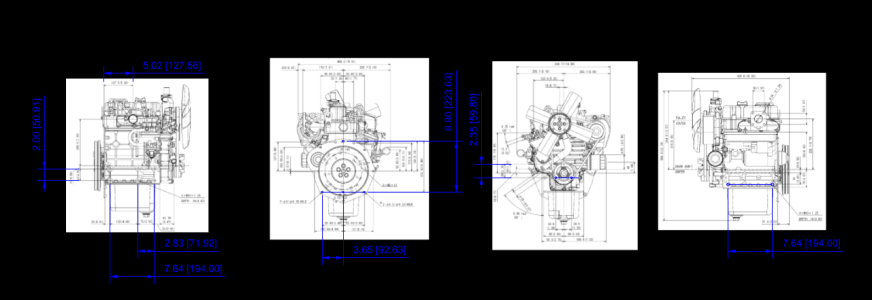
I started chipping away at (re)modeling this again last night. I've been scouring the web to no avail, and cannot find a cad model of the engine like I had last time. I did find 2d dimensioned drawings though, so I just brought those into cad, scaled them appropriately and fixed all 4 sides in position relative to each other. Not as nice as having an actual model, but will more than suffice for my needs here.
I've got the frame modeled to what's built, and started sketching out the important dimensions based on my requirements of being able to cut a 36" diam log, a 24" cant, and being able to cut that cant in half. Those are my critical clearances. I loosely based those on being able to mill the large white pine in the backyard that I wish to remove, but the longer this project goes on, I might have to enlarge that envelope......lol
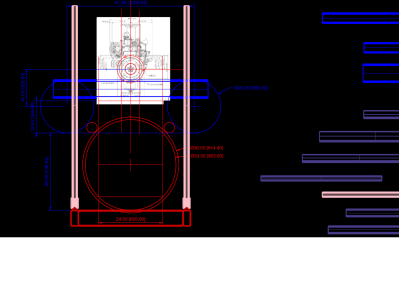
I have a couple of 17.5" cast flywheels I bought years ago I was planning on using for wheels, but think I'm going to roll my own now at 20" diameter. I have some better capabilities to do that now, so I'll give it a shot. Should be better for blade life, and will be a fun/challenging part of the build. If I fail....well, I still have those cast ones to fall back on. the above is drawn with a 158" blade length. But I'm tossing around some ideas on being able to push that out should I ever want to do wider slab milling.....I'll roll that around upstairs for a while. I have a long commute into the city for the next 2 months, and I do some of my best designing/conceptualizing when stuck in traffic lol.
This is one of the fun parts of a project for me. The brainstorming, sketching, digging through the scrap pile to see what I have to work with.... In the above photo you can see my virtual scrap pile that represents all the larger pieces of angle and HSS I have out in the barn. I can sit on the comfort of my couch and iterate through many design ideas quickly and easily compared to the trial and error of cutting, welding etc...
I'm documenting this project a bit different and will update and take you along for the ride as I go. I'll try and do as many short updates as I fumble my way forward through the design, and show the changes I make, and the reasons why. Learning from my mistake on my belt grinder build, I had planned to do all that, but wait until the end and then make a large build post when done..... Losing all that data and design revisions when I dropped my laptop sucked, and has taken the wind out of my sails for making that build post even though the grinder is done, so I'm going to do this one different and post as I go. Which brings discussion and debate about design choices into play, which I always welcome. Anyway, enough rambling. Here's where I'm at right now, I'll keep you posted....There's no timeline here, I may chip away at this for another year or three, or it may light a fire under me and I'll be done in a week. Who knows....
I started chipping away at (re)modeling this again last night. I've been scouring the web to no avail, and cannot find a cad model of the engine like I had last time. I did find 2d dimensioned drawings though, so I just brought those into cad, scaled them appropriately and fixed all 4 sides in position relative to each other. Not as nice as having an actual model, but will more than suffice for my needs here.
I've got the frame modeled to what's built, and started sketching out the important dimensions based on my requirements of being able to cut a 36" diam log, a 24" cant, and being able to cut that cant in half. Those are my critical clearances. I loosely based those on being able to mill the large white pine in the backyard that I wish to remove, but the longer this project goes on, I might have to enlarge that envelope......lol
I have a couple of 17.5" cast flywheels I bought years ago I was planning on using for wheels, but think I'm going to roll my own now at 20" diameter. I have some better capabilities to do that now, so I'll give it a shot. Should be better for blade life, and will be a fun/challenging part of the build. If I fail....well, I still have those cast ones to fall back on. the above is drawn with a 158" blade length. But I'm tossing around some ideas on being able to push that out should I ever want to do wider slab milling.....I'll roll that around upstairs for a while. I have a long commute into the city for the next 2 months, and I do some of my best designing/conceptualizing when stuck in traffic lol.
This is one of the fun parts of a project for me. The brainstorming, sketching, digging through the scrap pile to see what I have to work with.... In the above photo you can see my virtual scrap pile that represents all the larger pieces of angle and HSS I have out in the barn. I can sit on the comfort of my couch and iterate through many design ideas quickly and easily compared to the trial and error of cutting, welding etc...
I'm documenting this project a bit different and will update and take you along for the ride as I go. I'll try and do as many short updates as I fumble my way forward through the design, and show the changes I make, and the reasons why. Learning from my mistake on my belt grinder build, I had planned to do all that, but wait until the end and then make a large build post when done..... Losing all that data and design revisions when I dropped my laptop sucked, and has taken the wind out of my sails for making that build post even though the grinder is done, so I'm going to do this one different and post as I go. Which brings discussion and debate about design choices into play, which I always welcome. Anyway, enough rambling. Here's where I'm at right now, I'll keep you posted....There's no timeline here, I may chip away at this for another year or three, or it may light a fire under me and I'll be done in a week. Who knows....
Dan Dubeau
Ultra Member
Oh, and while digging around out in the barn the other day taking inventory of material, I discovered the engine I have is not a d722, but a d662. Not sure where I made that mistake, but I see it's been repeated from the start of getting it. For the sake of the build it makes no difference, both are the same family of engine and block size, I'm just down a few HP from where I thought I was. And no, I couldn't find a d662 model either lol. Nor did I find dimensioned drawings, so the above are of the d722.

mickeyf
Ultra Member
No project really dies around here, they just go to sleep for a while.....
Some of mine would put Rip Van Winkle to shame.

MashingMetal
Ultra Member
I have some 30” wheels. Maybe a bit big? Lol Good work on the build.
I was wondering if you had priced out blades, might change your mind as to making the mill much bigger. Don’t know how readily available blades are out that way.
Those flywheels will do the 24 inch cant. As to the 36 inch log, you don’t need a full 36 inch between wheels. Slab off, roll 1/4 turn, slab off, suddenly the log is a lot smaller. 3 quarter turns and your making lumber after the slab off, if you want wide boards.
If you’re doing 1/4 sawn lumber, a lot more work and carefull planning of cutting. Much more work.
Live edge sawing on bigger logs, more space needed between wheels and harder to control blade then also.
Always fun to cut a frozen log, NOT, generally not completely frozen, blade go unexpected directions often. Even a head saw will do that.
Build a log roller/turner makes life easier, they don’t need to be powered either.
Most of my experience is on an old head saw, 52 inch blade, could cut 24ft. long when needed, but hard to find good straight logs for timbers if was cutting them. A bit of time with band mill, they can be a bit finicky, but easier to build one.
The head saw took some planning for board sizes when cutting as you lost about 3/8 inch every cut, basically an inch every 3 cuts.
The most “fun” was hitting metal in the log, another NOT, remember the old man cutting a railroad spike nearly length wise. Had to replace every tooth on the blade, good thing they were carbide, some only had a corner knocked off, but that could make the blade wander and over heat. The old White engine just grunted a bit when cutting it, and didn’t realize till blade started wandering near the end of cut.
Anyway, watching and waiting.
Wider boards, hmmm, here's my take. I got my mill at age 35, access to large fir was good. Handling slab wood and large wide boards was back breaking. Framing lumber is rarely 2x12 or 10 anymore and large, wide boards split, check, warp etc quite easily and drying cants for resaw is a pain. In milling a specific size there is a lot of incidental catch you accumulate.
My work bench is three 4x12's and my next top will be the same but I'll mill each down to 2" and then glue the 6 pieces back together, they'll still look like 12's but will behave much better.
All good fun though.
My work bench is three 4x12's and my next top will be the same but I'll mill each down to 2" and then glue the 6 pieces back together, they'll still look like 12's but will behave much better.
All good fun though.
Dan Dubeau
Ultra Member
I was wondering if you had priced out blades, might change your mind as to making the mill much bigger. Don’t know how readily available blades are out that way.
Those flywheels will do the 24 inch cant. As to the 36 inch log, you don’t need a full 36 inch between wheels. Slab off, roll 1/4 turn, slab off, suddenly the log is a lot smaller. 3 quarter turns and your making lumber after the slab off, if you want wide boards.
If you’re doing 1/4 sawn lumber, a lot more work and carefull planning of cutting. Much more work.
Live edge sawing on bigger logs, more space needed between wheels and harder to control blade then also.
Always fun to cut a frozen log, NOT, generally not completely frozen, blade go unexpected directions often. Even a head saw will do that.
Build a log roller/turner makes life easier, they don’t need to be powered either.
Most of my experience is on an old head saw, 52 inch blade, could cut 24ft. long when needed, but hard to find good straight logs for timbers if was cutting them. A bit of time with band mill, they can be a bit finicky, but easier to build one.
The head saw took some planning for board sizes when cutting as you lost about 3/8 inch every cut, basically an inch every 3 cuts.
The most “fun” was hitting metal in the log, another NOT, remember the old man cutting a railroad spike nearly length wise. Had to replace every tooth on the blade, good thing they were carbide, some only had a corner knocked off, but that could make the blade wander and over heat. The old White engine just grunted a bit when cutting it, and didn’t realize till blade started wandering near the end of cut.
Anyway, watching and waiting.
Yep, I don't need 36" between the wheels, just 24" to process a 36" log (want, not a need). This pic below shows that a bit better. As is, it'll fit and let me slab a 36" log into a 24" cant. Not much around here that big aside from a couple white pines. Most of what I'd be milling are scots pines in the 12-16" range. I have a lot of those that need to be thinned out over the next decade or so. A few big cedar and poplar too, but mostly just trying to future proof myself and find the best compromise.
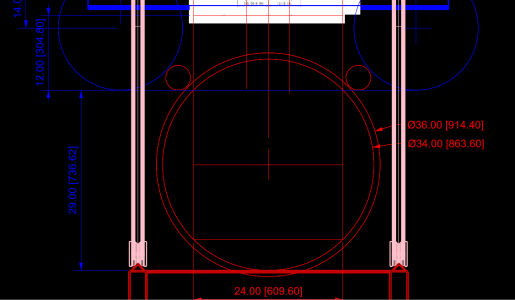
158" blades aren't too bad. I don't want to go bigger for everyday milling, because they do get pricey, but just mulling the idea of having the axles adjustable giving me the option of slabbing larger logs should I ever run into one. Just a possibility for now. This is another reason why things are slow moving. Feature creep.....But what if it can do this, or this.....
I have lots of ideas for stuff between the bunks too. A log turner is a must, but will get built later. Siding and shingle jigs are wants too, as I have a lot of EWC here too. I will plan on slab and material handling too as I have many fond memories of being that bitch while my Grandfather and his brother ran their old frick, and I was the dumb labour on the wrong end. None of that matter suntil I get the actual mill built, but it's fun to day dream about stuff to build for it.
Dan Dubeau
Ultra Member
Yep, smaller laminations are usually the better straighter way to go for square straight building. Large slab handling sucks too, but there's tractors and hydraulics for that 😀.Wider boards, hmmm, here's my take. I got my mill at age 35, access to large fir was good. Handling slab wood and large wide boards was back breaking. Framing lumber is rarely 2x12 or 10 anymore and large, wide boards split, check, warp etc quite easily and drying cants for resaw is a pain. In milling a specific size there is a lot of incidental catch you accumulate.
My work bench is three 4x12's and my next top will be the same but I'll mill each down to 2" and then glue the 6 pieces back together, they'll still look like 12's but will behave much better.
All good fun though.
Yup, in the end the mill is 25% of the cost. 75% for all the ancillary stuff.Yep, smaller laminations are usually the better straighter way to go for square straight building. Large slab handling sucks too, but there's tractors and hydraulics for that 😀.
Advantage of larger wheels, thus longer blades, is less flexing yielding longer blade life.
Dan Dubeau
Ultra Member
Agree. Isn't everything though? Lucky for me, I'm already used to expensive hobbies. Seems like I've collected them all 😀. At this point they all feed off and into each other it's tough to tell where one ends and one begins.Yup, in the end the mill is 25% of the cost. 75% for all the ancillary stuff.
Advantage of larger wheels, thus longer blades, is less flexing yielding longer blade life.
I bought those cast wheel probably 7-8 years ago for pretty cheap. I remember reading somewhere that 18" is generally the minimum recommended for 1.25" bladestock, so at only 17.5" they're borderline acceptable. Aside from that they were perfect. Typing that just reminded me how long this project has been going on..