• Scam Alert. Members are reminded to NOT send money to buy anything. Don't buy things remote and have it shipped - go get it yourself, pay in person, and take your equipment with you. Scammers have burned people on this forum. Urgency, secrecy, excuses, selling for friend, newish members, FUD, are RED FLAGS. A video conference call is not adequate assurance. Face to face interactions are required. Please report suspicions to the forum admins. Stay Safe - anyone can get scammed.
  • The 2026 Calgary Area Meetup is set for Saturday May 30th at 10am. The signup thread is here! Robinhood has graciously offered to host the meetup again this year. Please note that you MUST RSVP to the notice linked above if you wish to come.

Cutting radius on lathe

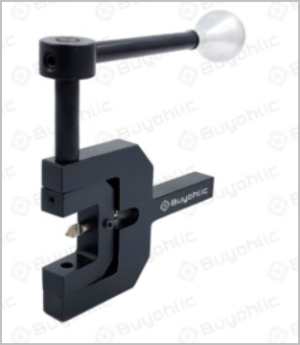
I’m also guilty of misunderstanding your requirements. I was thinking of convex cutting, like ball handles. Yes, the Amazon cutter will work but it’s fiddly and chatters.

Ten minutes with a chunk of HSS and a grinder. Set your lathe feed to a suitable coarse thread, take shallow cuts because form cutters have to absorb a lot of energy to perform a cut.
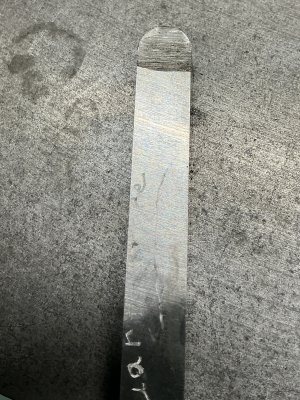
IMG_0436.jpeg
 
. . . but I don't have a DRO or a dial gauge yet, nor the files I'd need for concave cuts. So while this is really good as a "no special tools required" approach, it still requires tools I don't have (though I know I need to get), making a cheap radius cutter seem more attractive.
If you don't have the tools to follow the procedure that is outined, you most likely will not have the necessary tooling/tools to "make" a radius cutter. Also, a dial indicator or DRO is helpful when using a radius cutter as well.


I also misunderstood. Seems like a radiused form tool might be good then.
A radius form tool for making concave surfaces would general a lot of tool pressure, even on Delrin/Acetal.
 
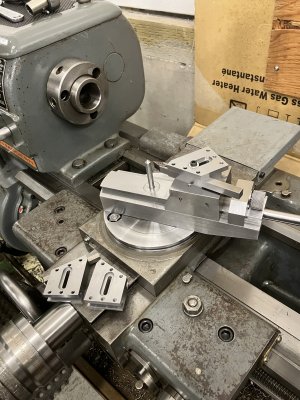
It depends on how deep, relative to the radius - some of the ball turning attachments. For example the Stefan Gotteswinter setup based on a boring head (held in the tool post with a lift arrangement). Also the Hemingway kit (couple pictures of what I built), the tool can be displaced either side of the centre pivot - it would be hard to sweep the tool through 180 for a small groove.
 

Attachments

  • IMG_2444.jpeg
    IMG_2444.jpeg
    2 MB · Views: 6
  • IMG_2448.jpeg
    IMG_2448.jpeg
    2.3 MB · Views: 6
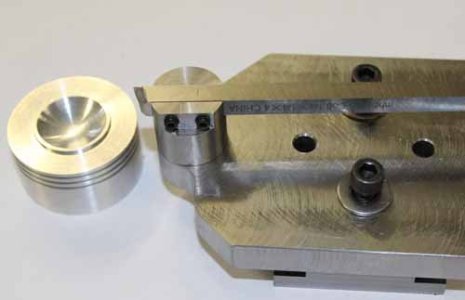
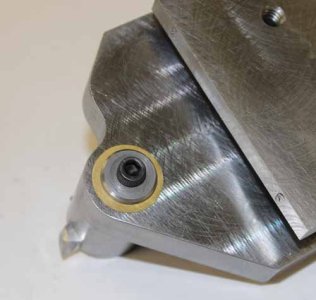
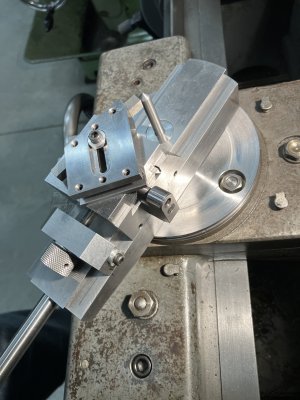
Not the best pictures but here is a simple intenal radii turner I made using 1/4" HSS cutter held it a pivoting block. Pretty simple but the radius of your groove dictates the geometry of the pivot block. If the radius is realtively small, you likely need a different gadget that facilitates that particular pivot center to cutter tip distance. there are lots of ways to accomplish this, just a matter of tool making vs tool purchase. Not all ball turning mechanisms can make internal profiles or may have dimensioal limitations.

Now depending on how many grooves you have make & how precisie it has to be, there is also the straight-in grooving tool method where you make a series of stepwise incrementing steps, precalculated DOC & smooth the steps with a file.

1792985195805.png
 

Attachments

  • IMG_0624_edited-1.jpg
    IMG_0624_edited-1.jpg
    14.7 KB · Views: 3
  • IMG_0625_edited-1.jpg
    IMG_0625_edited-1.jpg
    24.1 KB · Views: 3
I’m also guilty of misunderstanding your requirements. I was thinking of convex cutting, like ball handles. Yes, the Amazon cutter will work but it’s fiddly and chatters.

Ten minutes with a chunk of HSS and a grinder. Set your lathe feed to a suitable coarse thread, take shallow cuts because form cutters have to absorb a lot of energy to perform a cut.

View attachment 88455

I supposed I'm going to have to start learning to grind cutters sooner or later, so this is probably a good, noncritical place to start.

Where does a brother find 1/4" HSS stock?
 
Not the best pictures but here is a simple intenal radii turner I made using 1/4" HSS cutter held it a pivoting block. Pretty simple but the radius of your groove dictates the geometry of the pivot block. If the radius is realtively small, you likely need a different gadget that facilitates that particular pivot center to cutter tip distance. there are lots of ways to accomplish this, just a matter of tool making vs tool purchase. Not all ball turning mechanisms can make internal profiles or may have dimensioal limitations.

I'm going to have to stare at this for a few minutes to get the implications.

Now depending on how many grooves you have make & how precisie it has to be, there is also the straight-in grooving tool method where you make a series of stepwise incrementing steps, precalculated DOC & smooth the steps with a file.

Yes, that was described in blondihacks' video, linked to by @ChazzC in his first reply to me in this thread. Other than my not having any kind of readout (DRO, dial gauge, etc.), it's certainly easy enough i.e. within my ability. But I think I'd be better served tooling+learning to actually cut the radius rather than "cheating" with the stepwise+file approach.
 
Yes, that was described in blondihacks' video, linked to by @ChazzC in his first reply to me in this thread. Other than my not having any kind of readout (DRO, dial gauge, etc.), it's certainly easy enough i.e. within my ability. But I think I'd be better served tooling+learning to actually cut the radius rather than "cheating" with the stepwise+file approach.

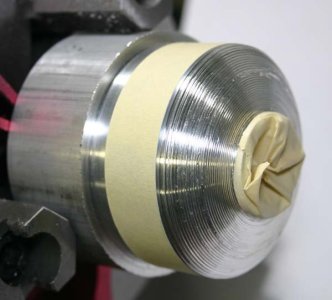
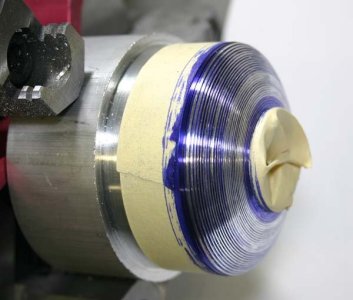
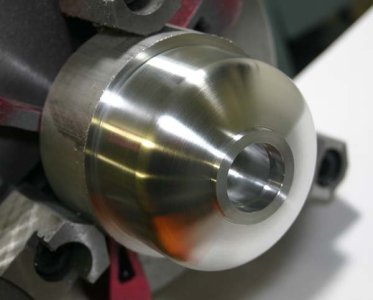
I didnt watch the video but this stepover method has been around for as long as lathes themselves. You dont need a DRO, its just more convenient. Some guys set their compound parallel to the bed & that eliminates the coarser increments of carriage wheel (assuming tailstock support does not interfere). Or just slap a mag base indicator on the bed. For onsey-twosey type jobs its actually very fast because its essentially a roughing job. After that, cover in marker dye & away you go. It does take some hand work to finish the profile & thats where the end use requirements dictate method. Are we making a precision bearing seat or a much more forgiving shape.

For circular profiles you cant beat a rotating single point tool IMO which means some kind of gadget. OTOH, if the next job is an eliptical section or any other kind of non-simple arc swervy-curvy profile, you are SOL with a ball turner. Saaaay a nose case for a radial engine LOL. Of course you need to make your increment table beforehand, CAD comes in handy here. I also prefer to use a circular profile grooving tool (just a different insert in a parting tool) because it corresponds to tangent points of cutter vs profile. Otherwise with a rectangular parting tool you need to mindfull that the tool corners are not over-cutting on certain portions of the curve
 

Attachments

  • IMG_7155_edited-1.jpg
    IMG_7155_edited-1.jpg
    33.9 KB · Views: 1
  • IMG_7158_edited-1.jpg
    IMG_7158_edited-1.jpg
    38.9 KB · Views: 1
  • IMG_7162_edited-1.jpg
    IMG_7162_edited-1.jpg
    24.8 KB · Views: 1
Last edited:
I'm in the not-unfamiliar situation of not having enough cash at the moment for necessary tools, of which one is a dial indicator. Broad interests (especially involving electronics) sometimes means having to spend limited funds on things that aren't urgently needed, but might not surface again for a very long time. Present case is the hundred bucks I just dropped on a couple of PLCC test adapters (Emulation Technology Bug Katchers) that popped up on ebay and I've been waiting for more than a month for the price on them to drop enough. Do I need a dial indicator more, and right now, and should have popped right over to PA to get one? Yes. But I'll soon need these adapters and if I don't grab these ones it might be a couple of years before any more come up - they haven't been made in 20 years. Same problem with boat parts that I certainly won't be able to use until May, but come up for sale used less than once a year.

So... yeah... shit.
 
Back
Top