• Scam Alert. Members are reminded to NOT send money to buy anything. Don't buy things remote and have it shipped - go get it yourself, pay in person, and take your equipment with you. Scammers have burned people on this forum. Urgency, secrecy, excuses, selling for friend, newish members, FUD, are RED FLAGS. A video conference call is not adequate assurance. Face to face interactions are required. Please report suspicions to the forum admins. Stay Safe - anyone can get scammed.
  • The 2026 Calgary Area Meetup is set for Saturday May 30th at 10am. The signup thread is here! Robinhood has graciously offered to host the meetup again this year. Please note that you MUST RSVP to the notice linked above if you wish to come.

Contact Cement Storage

Perry

Ultra Member
How are you guys storing contact cement? (Or any other solvent based adhesive )

Went to use a tin of contact cement and it had gassed off and gone to goo. Same with my rubber cement. I do not use a lot of it, but nice to have some around.

Went to grab a new tin today and it is $25 for a 236 ml. Crazy. The small tin is $15 for 118ml.

For the amount I use , this will be another expensive batch of goo in short order.

On another note, I miss the small rectangle cans that use to have the bush attached to the lid. They had a small screw on lid and I found storing them upside down seemed to make them last longer.


Cheers, P.
 
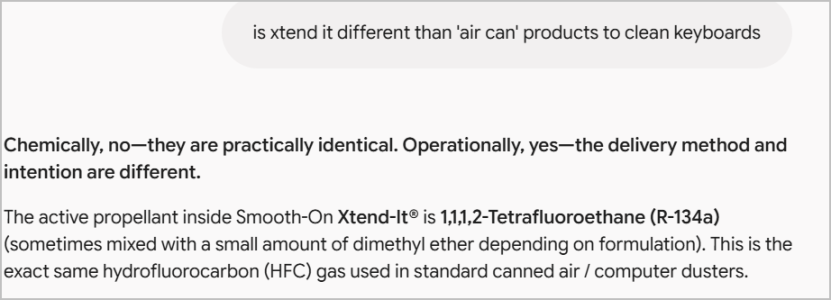
I'f its mostly related to exposure to air (oxygen) inside the can, there are gas blanket products. I use one called XTend it by Smooth On for their urethane resins but its crazy expensive. I must have deleted my AI query but there is a range of other products that could work. Apparently even some of the contents of 'canned air' inside those keyboard blasters contain something useful. Argon & some inert welding gasses work but less chance you have it kicking around. Do some Googling. Now if its like certain resins that just start forming long chains on their own due to age thats a different issue. Until recently I didnt know my 10 year old can of TremClad tar can be diluted with common paint thinner & away we go again. Kind of depends on the product.
 
Last edited:
Any glues of any kind I try to store in a freezer grade Ziploc bag.

Sometimes, if it's a large can I will use a layer of Saran wrap between the lid and the can. Sometimes I do that with paint, too. Not sure if it helps the seal but it doesn't seem to hurt.
 
Sometimes just reducing the air volume within the container can go a long ways to preservation. I have some smaller volume HDPE bottles I've standardized on & just fill them full vs storing a can 1/2 or 1/3 full, so thats one way. The inert gas way is squirt a bit in the can & close the lid. It doesnt take much but it has a higher density so sits on top of the liquid product & blocks oxygen within air which is now above but no longer in contact. But just do a check, seems to me some kinds of product do not get along as well with some kinds of gas, maybe the gas permeates certain products... things like that. A lot of plastic containers even like HDPE are somewhat permeable. I have certain epoxies that are sweating out of the container over a couple years & air is getting in, so I change them out every so often. Some products are adersely affected by UV so you need the right kind of plastic that blocks it. But there are many products that just have a shelf life for whatever chemical reason & thats it. I've gotten burned on certain stores that have old product on time sensitive product so check the label if its relevent.

1789703148278.png
 
How are you guys storing contact cement? (Or any other solvent based adhesive ).
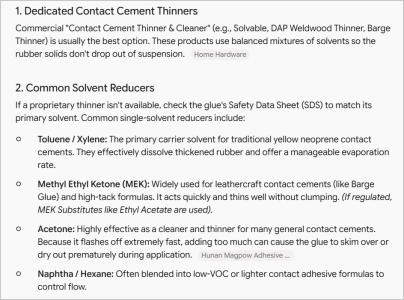
I might be thinking about something else where a guy thinned his product for whatever reason, but if you have any of these reducers kicking around, you could do a small sample test. Assuming its not already too far gone. Just add it in small % & make notes.

1789703737814.png
 
There used to be a product that you could put in paint cans that would stop the paint from skinning over. Some inert gasses. I wonder if that would would be effective.
 
I think the chemical products world has gotten more complex, especially with so many water based carrier products. I've read that simple dry gases like argon or nitrogen can actually pull moisture out of the paint, causing a thin skin to form faster. Even a close cousin solvent in a hydrocarbon product can muck it & cause weird things to happen.
 
I had the same problem with the assortment of different gunstock finishing products and was given the advise to just put clean stones or marbles in the container to bring the level of fluid back up to container lid...worked very well. i have had True-oil keep usable for 5 yrs.
 
I might be thinking about something else where a guy thinned his product for whatever reason, but if you have any of these reducers kicking around, you could do a small sample test. Assuming its not already too far gone. Just add it in small % & make notes.

View attachment 87078
I was thinking the contact cement might be Acetone based and it was escaping somehow. I have a couple of small decanter bottles on my desk. One with 99% isopropyl alcohol, the other with acetone. Over time the acetone one always drops down in level.

With this in mind I was thinking that after I use the contact cement I could add a little acetone to the glue surface in the tin. The idea is it might prevent the glue from "losing" the acetone in it as fast. The skimming over comment above makes me think I might be wrong. Toluene might work better?

I think I might send Lepage an email today and see what they say. Searching the web comes up with a lot of different answers.
 
THIS!!! 100%
I've been doing this for years, with contact cement and paint cans as well as anything else that can be spoiled by evaporation.
This infers a micro leaking lip seal then because a volume of air is still present no matter how you orient the can. This can be a headache if the typical tin can lip seal gets gummed up with product. Bad for sealing & bad for dried crud to drop into the product. My old-tymey method of popping a few peripheral nail holes around the lip gutter allowing any product to be squeezed down as you tap the lid shut ran into an unwelcome surprise on water based clear. Turns out they use some kind of plastic coating liner on these cans because of the water base, popping a hole compromising the coating, exposes a tiny bit of metal , resulting in a bit of rust showing in the lip which can mess up the clear.

A lot of otherwise decent solvent proof 'plastic' bottles have threads that just dont seal as well. I've put a patch of plastic over the mouth before screwing it down, it gets squished between the threads & seals better. Some guys go through the effort of PTFE tape. Just be aware typical household cling wrap may not be up to the task chemically depending on the product.

Yes the magic trick of acetone or similar solvents reducing volume in the bottle just sitting there over time is the classic evaporation though the container and/or lid. Plastic has permeability, it ssmall but its there. Some plastics more than others. Even nylon swelling in the presence of water or air moisture can be an issue in certain applications.
 
This infers a micro leaking lip seal then because a volume of air is still present no matter how you orient the can. This can be a headache if the typical tin can lip seal gets gummed up with product. Bad for sealing & bad for dried crud to drop into the product. My old-tymey method of popping a few peripheral nail holes around the lip gutter allowing any product to be squeezed down as you tap the lid shut ran into an unwelcome surprise on water based clear. Turns out they use some kind of plastic coating liner on these cans because of the water base, popping a hole compromising the coating, exposes a tiny bit of metal , resulting in a bit of rust showing in the lip which can mess up the clear.

A lot of otherwise decent solvent proof 'plastic' bottles have threads that just dont seal as well. I've put a patch of plastic over the mouth before screwing it down, it gets squished between the threads & seals better. Some guys go through the effort of PTFE tape. Just be aware typical household cling wrap may not be up to the task chemically depending on the product.

Yes the magic trick of acetone or similar solvents reducing volume in the bottle just sitting there over time is the classic evaporation though the container and/or lid. Plastic has permeability, it ssmall but its there. Some plastics more than others. Even nylon swelling in the presence of water or air moisture can be an issue in certain applications.
The "seal" that keeps the paint or glue contained doesn't necessarily stop the much smaller molecule of the vapour from the volatile solvent. With the can stored upside down, the evaporation through the joint in the lid will take much longer.
I've been storing my cans of various stuff upside down for years. It works for me.
 
Then there's also the chemical change of the paint or glue or whatever.

People here might recall that I pulled out the 3/4 full can of paint that was custom tinted to match the mill. I had used it to paint the CNC computer cabinet. Now I wanted to paint the 3D printed pulley covers and it took 3 days for the paint to not accept a finger print and a week to dry to a reasonable hardness.

Now I'm faced with a similar scenario. MG Chemicals Conformal Coating. Needed at least one more spray can. A friend gave me his two old spray cans and a can of liquid. The light almost empty spray can that theoretically still had some liquid had lost the propellant. Useless. The other one was heavy but instead of a spray coming out it's more like a liquid stream. Does seem to dry though even thought the application is thick.

Finally the can of liquid. After owning it for many years I get to try out my PA HVLP mini spray gun.

Although it says minimum pressure 40PSI in reality at that level it blows the PC boards across the spray booth. So I've had to do some tweaking. Now waiting to see if they dry properly. Don't want to screw up the main boards if the conformal coating has degraded.
 
Send an email off to Lepage Canada. Fast reply.

"
Dear Perry,


Thank you for e-mailing Henkel Corporation. We're sorry to learn you've had some trouble with our LePage contact cement.

We don't recommend thinning or diluting any of our products. For optimal shelf life, store the product at room temperature between 16°C (60°F) and 27°C (80°F). Close lid tightly to prevent drying and contamination. Do not transfer to other metal containers or leave objects that may rust (e.g. brushes) sitting in the adhesive.

We will be sure to share your feedback regarding packaging format with our marketing and product development teams.


For questions, comments or suggestions, please feel free to call us at (800) 624-7767, Monday through Friday, between the hours of 9:00 a.m. and 4:00 p.m. Eastern Time; or visit us on the Web at www.lepage.ca.


Thank you for your inquiry. I hope you find this information helpful.


Sincerely,

Consumer Relations Representative
Henkel Corporation - Consumer & Craftsmen Adhesive Group
"


I went and picked up a new can. Noticed a small white sticker on the can with a 5 digit number. Mine is 26016. There were some cans with 25xxx on the self. This is most likely a date code. 16th week of 2026?

So another email off to Lepage asking if they can decode the 5 digit number. Also, I would like to know what they consider an expected shelf life for this product. No use buying spoiled milk.


In my past life we had a strict shelf life on all products. The items would be time-X'd and placed in a quarantine cage. Not to be used. I never really paid attention to how it worked. It just happened. Should have paid more attention. 🙂
 
Although it says minimum pressure 40PSI in reality at that level it blows the PC boards across the spray booth.
Hmmm that sounds off somehow. Ive sprayed lots of lightweight + wide area things. I think 40 psi means the air inlet pressure ~compresssor regulator pressure factoring line/filter loss. On an HVLP that probably equates to ~10 psi at the nozzle tip. But this is dynamic pressure, which rapidly dissipates by the time paint hits the surface some distance away. HVLP is the right weapon of choice but anyway if its enough to pressure to blow delicate parts around then ya, you need to attach or hang them somehow. Old school 'fog maker' guns are more like 50-60 inlet, 30-40 at nozzle, way worse from that standpoint. But the great thing was everything in the room also gets a paint job LOL. Even an airbrush could be 15-20 psi at the nozzle.
 
Well I have to say Lepage is on the ball with the customer support. Already got a reply back from them on my second email.
Hopefully someone else can use this information.

"
Dear Perry,


Thank you for your reply. We can't speak to the estimated shelf life of opened product as there are many factors that influence how a product ages. The product's shelf life is 24 months from the date of manufacture when unopened.

The date code provided indicates that this was manufactured on January 16, 2026. The first two digits are the year of manufacture (2026), and the last three are the day of the year out of 265 days (the 16th day of the year, January 16).

Please let us know if you have any further questions.

Sincerely,"
 
Well I have to say Lepage is on the ball with the customer support. Already got a reply back from them on my second email.
Hopefully someone else can use this information.

"
Dear Perry,


Thank you for your reply. We can't speak to the estimated shelf life of opened product as there are many factors that influence how a product ages. The product's shelf life is 24 months from the date of manufacture when unopened.

The date code provided indicates that this was manufactured on January 16, 2026. The first two digits are the year of manufacture (2026), and the last three are the day of the year out of 265 days (the 16th day of the year, January 16).

Please let us know if you have any further questions.

Sincerely,"
Well. Without doubt these folks are going to have troubles with the millennium bug again in 74 years. Is that can from 2126 or 2026? The 26016 date code doesn't tell you that. So 75 years from now when I'm over 150 years old and that tin has been sitting there unopened can I still use it?
I'm so confused...
 
I'm very fond of the single-use CA glue from the dollar store. I really wish things like pvc cement and contact cement were available in some sort of similar format.
 
After owning it for many years I get to try out my PA HVLP mini spray gun.

Although it says minimum pressure 40PSI in reality at that level it blows the PC boards across the spray booth. So I've had to do some tweaking. Now waiting to see if they dry properly. Don't want to screw up the main boards if the conformal coating has degraded.

I have one of those, great little gun. I don’t use it for conformal but it is my go to for small jobs and touch ups. I just did three wheels with it a couple of days ago, didn’t blow them around lol!

Don’t pay list, they go on sale all the time.

D 😎
 
Back
Top