• Scam Alert. Members are reminded to NOT send money to buy anything. Don't buy things remote and have it shipped - go get it yourself, pay in person, and take your equipment with you. Scammers have burned people on this forum. Urgency, secrecy, excuses, selling for friend, newish members, FUD, are RED FLAGS. A video conference call is not adequate assurance. Face to face interactions are required. Please report suspicions to the forum admins. Stay Safe - anyone can get scammed.
  • The 2026 Calgary Area Meetup is set for Saturday May 30th at 10am. The signup thread is here! Robinhood has graciously offered to host the meetup again this year. Please note that you MUST RSVP to the notice linked above if you wish to come.

Contact Cement Storage

Perry

Ultra Member
How are you guys storing contact cement? (Or any other solvent based adhesive )

Went to use a tin of contact cement and it had gassed off and gone to goo. Same with my rubber cement. I do not use a lot of it, but nice to have some around.

Went to grab a new tin today and it is $25 for a 236 ml. Crazy. The small tin is $15 for 118ml.

For the amount I use , this will be another expensive batch of goo in short order.

On another note, I miss the small rectangle cans that use to have the bush attached to the lid. They had a small screw on lid and I found storing them upside down seemed to make them last longer.


Cheers, P.
 
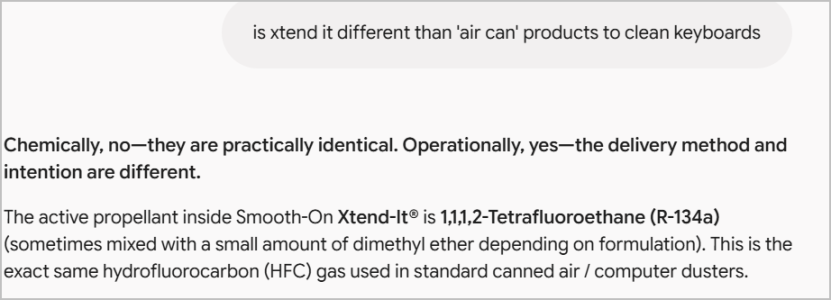
I'f its mostly related to exposure to air (oxygen) inside the can, there are gas blanket products. I use one called XTend it by Smooth On for their urethane resins but its crazy expensive. I must have deleted my AI query but there is a range of other products that could work. Apparently even some of the contents of 'canned air' inside those keyboard blasters contain something useful. Argon & some inert welding gasses work but less chance you have it kicking around. Do some Googling. Now if its like certain resins that just start forming long chains on their own due to age thats a different issue. Until recently I didnt know my 10 year old can of TremClad tar can be diluted with common paint thinner & away we go again. Kind of depends on the product.
 
Last edited:
Any glues of any kind I try to store in a freezer grade Ziploc bag.

Sometimes, if it's a large can I will use a layer of Saran wrap between the lid and the can. Sometimes I do that with paint, too. Not sure if it helps the seal but it doesn't seem to hurt.
 
Sometimes just reducing the air volume within the container can go a long ways to preservation. I have some smaller volume HDPE bottles I've standardized on & just fill them full vs storing a can 1/2 or 1/3 full, so thats one way. The inert gas way is squirt a bit in the can & close the lid. It doesnt take much but it has a higher density so sits on top of the liquid product & blocks oxygen within air which is now above but no longer in contact. But just do a check, seems to me some kinds of product do not get along as well with some kinds of gas, maybe the gas permeates certain products... things like that. A lot of plastic containers even like HDPE are somewhat permeable. I have certain epoxies that are sweating out of the container over a couple years & air is getting in, so I change them out every so often. Some products are adersely affected by UV so you need the right kind of plastic that blocks it. But there are many products that just have a shelf life for whatever chemical reason & thats it. I've gotten burned on certain stores that have old product on time sensitive product so check the label if its relevent.

1789703148278.png
 
How are you guys storing contact cement? (Or any other solvent based adhesive ).
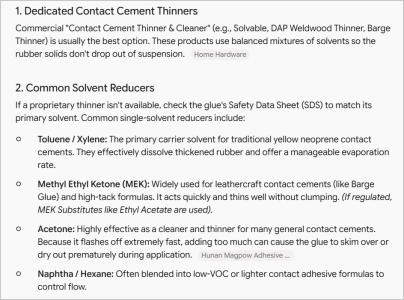
I might be thinking about something else where a guy thinned his product for whatever reason, but if you have any of these reducers kicking around, you could do a small sample test. Assuming its not already too far gone. Just add it in small % & make notes.

1789703737814.png
 
There used to be a product that you could put in paint cans that would stop the paint from skinning over. Some inert gasses. I wonder if that would would be effective.
 
I think the chemical products world has gotten more complex, especially with so many water based carrier products. I've read that simple dry gases like argon or nitrogen can actually pull moisture out of the paint, causing a thin skin to form faster. Even a close cousin solvent in a hydrocarbon product can muck it & cause weird things to happen.
 
Back
Top