• Scam Alert. Members are reminded to NOT send money to buy anything. Don't buy things remote and have it shipped - go get it yourself, pay in person, and take your equipment with you. Scammers have burned people on this forum. Urgency, secrecy, excuses, selling for friend, newish members, FUD, are RED FLAGS. A video conference call is not adequate assurance. Face to face interactions are required. Please report suspicions to the forum admins. Stay Safe - anyone can get scammed.
  • The 2026 Calgary Area Meetup is set for Saturday May 30th at 10am. The signup thread is here! Robinhood has graciously offered to host the meetup again this year. Please note that you MUST RSVP to the notice linked above if you wish to come.

Machine Busy Bee DF-1237G tail stock question? help?

Machine
Here you go.

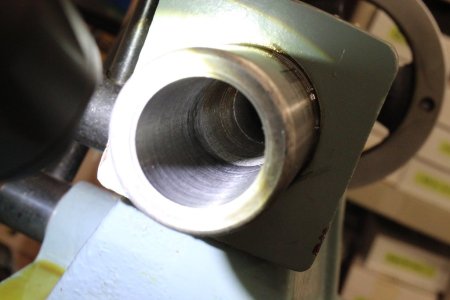
View attachment 84672View attachment 84673View attachment 84674

Here is the parts breakout.

View attachment 84678

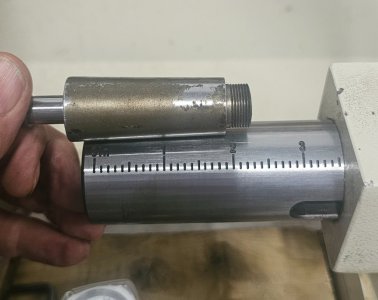
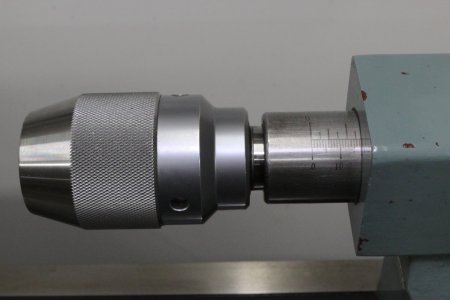
I also took several pictures of the total quill movement with different types of tapers. The taper tang style limits the full retract of the tailstock quill. I don't really like that, but it hasn't been a hard barrier yet..... If it ever was, I'd prolly make a shorter custom taper for that particular task.

View attachment 84675View attachment 84676View attachment 84677
I like the slot for removal, that would be an easy enough addition to most quills I would think.
The first time I got one stuck in my tailstock, I clamped it down tight to the bed, retracted it, and used a "pickle fork" for splitting ball joints..... I didn't like that at all, but, it worked.
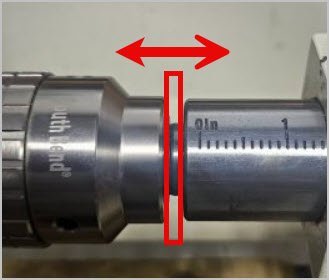
 
The first time I got one stuck in my tailstock, I clamped it down tight to the bed, retracted it, and used a "pickle fork" for splitting ball joints..... I didn't like that at all, but, it worked.

I dont understand - are you talking about removing the chuck from teh arbor or removing the arbor from the quill barrel?
 
Out of the tailstock barre

Why I was asking (if I understand correct) Anything you wedge between the chuck & end of quill, you hav enno control which comes off first - the arbor with chuck, or the chuck itself pops off leaving the arbor only in the quill. The chuck taper might be steeper & less surface area, so I'd bet on the chuck coming off first. But anyway thats what I wasn't undestnading.
 

Attachments

  • EDT-23-07-2026 8.33.28 PM.jpg
    EDT-23-07-2026 8.33.28 PM.jpg
    14.4 KB · Views: 0
Why I was asking (if I understand correct) Anything you wedge between the chuck & end of quill, you hav enno control which comes off first - the arbor with chuck, or the chuck itself pops off leaving the arbor only in the quill. The chuck taper might be steeper & less surface area, so I'd bet on the chuck coming off first. But anyway thats what I wasn't undestnading.

That was my concern too. I've both made and purchased MT pickle forks to separate chucks from arbours. If they properly fit the neck between the chuck and the arbour, it will do what is expected. If they don't, then it's a crap shoot. I like the wedge in the quill and the proper fork in the arbour because you almost always get the result that you want.

This thread has caused me to think about the minor irritance of losing some of my quill range to the shape and size of my MT taper tang. It just seems wrong to have a 4" quill and only be able to use 2-1/2 inches of it.

It's a simple problem to define and describe but I don't think the solutions are practical at all!
 
Also like to hear more about the Cummins convert, are you using a distributor pump or have you found a Bosch inline pump?
May need to run a new post.
 
That was my concern too. I've both made and purchased MT pickle forks to separate chucks from arbours. If they properly fit the neck between the chuck and the arbour, it will do what is expected. If they don't, then it's a crap shoot. I like the wedge in the quill and the proper fork in the arbour because you almost always get the result that you want.

This thread has caused me to think about the minor irritance of losing some of my quill range to the shape and size of my MT taper tang. It just seems wrong to have a 4" quill and only be able to use 2-1/2 inches of it.

It's a simple problem to define and describe but I don't think the solutions are practical at all!
I was thinking about this problem because my 12x37 has the issue

Is it the end of the leadscrew that pushes out the tooling? If so then one approach would be to shorten the leadscrew. That way the ram can retract more without ejecting the tooling
 
Is it the end of the leadscrew that pushes out the tooling? If so then one approach would be to shorten the leadscrew. That way the ram can retract more without ejecting the tooling

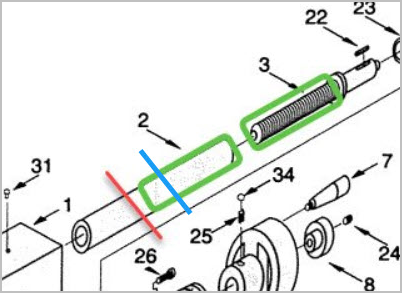
No, shortening the lead screw makes the problem worse. The key distance is overlap difference between end of arbor & end of leadscrew when fully retracted. Red = short arbor, the screw cant reach the end when quill fully retracted. Blue = longer arbor or added cap screw to the end, now the screw can push it out. If the leadscrew end had an extension boss it would work. But now its more difficult to accomodate different MT shanks. I think the issue is using shanks intended for other machines. It meets the MT criteria but not the length criteria. Once you know the required length, just check before inserting tool & facing consequences.

1784903451099.png
 
Here you go.

View attachment 84672View attachment 84673View attachment 84674

Here is the parts breakout.

View attachment 84678

I also took several pictures of the total quill movement with different types of tapers. The taper tang style limits the full retract of the tailstock quill. I don't really like that, but it hasn't been a hard barrier yet..... If it ever was, I'd prolly make a shorter custom taper for that particular task.

View attachment 84675View attachment 84676View attachment 84677
Interesting. My lathe, a Harrison M300 also has that slot. Until now I didn't know what it was for because I never had to use it.
 
No, shortening the lead screw makes the problem worse. The key distance is overlap difference between end of arbor & end of leadscrew when fully retracted. Red = short arbor, the screw cant reach the end when quill fully retracted. Blue = longer arbor or added cap screw to the end, now the screw can push it out. If the leadscrew end had an extension boss it would work. But now its more difficult to accomodate different MT shanks. I think the issue is using shanks intended for other machines. It meets the MT criteria but not the length criteria. Once you know the required length, just check before inserting tool & facing consequences.

View attachment 84697
Right but @Susquatch and I both have the same problem which is that the ram cannot retract to the zero mark without ejecting the tooling.
So if the leadscrew were shortened and all tooling made to eject at when the ram is retracted to less than zero then wouldn't we have the the best of both worlds; a ram where we don't have to try and remember which hash mark we started at and tooling that ejects.
 
Right but @Susquatch and I both have the same problem

Ah, I see what you mean now. Thats a PITA. Maybe the factory presumed a specific length of MT shank & that dictated the engraved scale positioing? I guess if you absolutely knew you would always be using particular MT shanks you could reduce the lead screw length. Then I would go one step further & drill/tap a hole to accomodate an extension insert just in case.
 
I'll have to measure mine just out of interest. Seems to me I looked this up before & even found discrepancy amongst published MT tables for the effective length of taper & big end diameter, nevermind tang or no tang. If you happen to see an MT arbor with no tang but a threaded end, guessing its meant for a drawbar & intended for another machine like a mini mill? It lends itself to adding a lengthening screw but there is no reason it has to be short or a certain length to begin with. Could be whatever the offshore manufacturers cooked up & standards be damned.


1784907998874.png
 
Ah, I see what you mean now. Thats a PITA. Maybe the factory presumed a specific length of MT shank & that dictated the engraved scale positioing? I guess if you absolutely knew you would always be using particular MT shanks you could reduce the lead screw length. Then I would go one step further & drill/tap a hole to accomodate an extension insert just in case.

And @DavidR8

I think the solution is a shorter MT3 taper. I don't know how much shorter. But it shouldn't be hard to figure out.

As shown in the photos above, my different tapers have different ejection points.
 
No, shortening the lead screw makes the problem worse. The key distance is overlap difference between end of arbor & end of leadscrew when fully retracted.

I think I agree with that.

I did a few measurements. When the quill is retracted to the zero mark on the quill scale, the taper length from the from of the quill to the internal face of the leadscrew is approximately 2-3/8 inches.

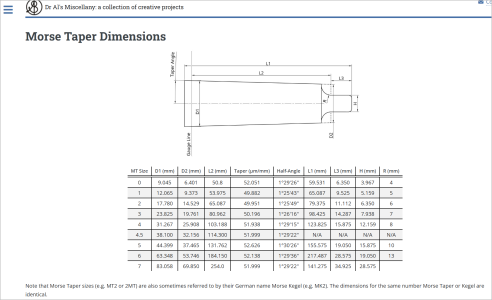
The length of the smallest MT3 arbour I can insert and still get full scale travel of the quill is also 2-3/8 inches. This was found by grinding the small end of the taper off until it would fit. I did this with a taper I got in the junk box at a Kijiji buy. This leaves the big end diameter at about 0.93 which is just 10 thou short of the D1 diameter in the chart above and a fair bit shorter than the length in the chart above.

20260724_145312.jpg

20260724_145257.jpg

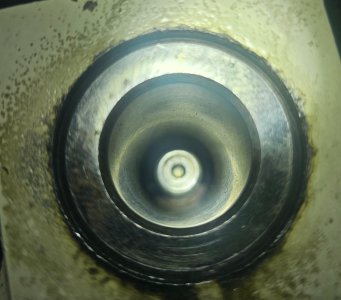
Looking into the quill, it might be possible to shorten the leadscrew but I doubt thats a good idea. Certainly not something I will do on a whim. I'd much rather shorten all my MT3 Arbours - or maybe even just those where I could use the quill travel.

20260724_150608.jpg

Edit - The other issue is that a short MT3 taper cannot be ejected using the wedge slot. That leaves only the fork or the leadscrew to do any ejecting. Neither one is a great scenario.

20260724_155155.jpg
 
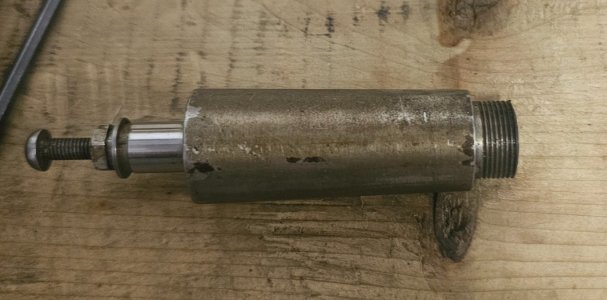
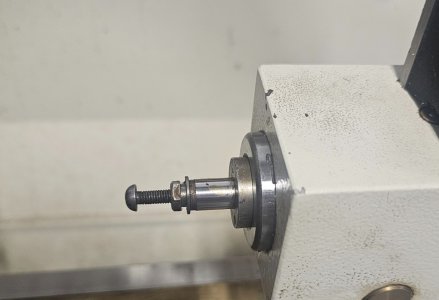
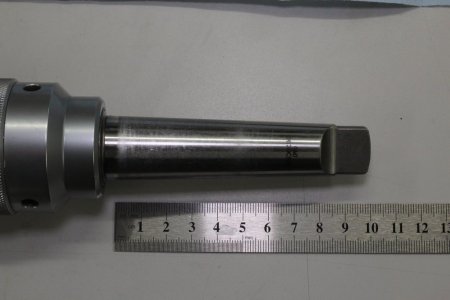
Brain fart. Turns out I have the exact same issue, losing ~0.75" of travel before extraction starts on my tanged MT3 drill chuck arbor. I've been 'zeroing' on my 1.0" mark for so long I totally forgot. Here is the length of that same arbor. Interestingly the key chuck that came with the lathe originally is also tanged & exact same dimensions. Eyeballing distance if I lopped off the tang from start if of mill radius that would probably get me to 0.0 on the graduations. Usually if I run out of quill travel with a deeper bore, I advance the whole TS into the bore & pick up drilling from there. Don't do this under power for safety reasons. I've done ~6" bores that way so the extra inch would not have mattered. So the mismatch graduations is a nuisance, but not sure if sufficiently motivated to a) cut off arbor & dress it cleanly without some fixturing b) shorthen the lead screw as discussed.

BTW, the actual surface length contacting the tapered surface only extends ~50mm on my lathe, so for this particular application, the rest of the taper aft of that to towards the skinny diameter does nothing, just along for the ride.
 

Attachments

  • 07-24-2026-001.jpg
    07-24-2026-001.jpg
    74.7 KB · Views: 1
  • 07-24-2026-002.jpg
    07-24-2026-002.jpg
    82.8 KB · Views: 2
  • 07-24-2026-003.jpg
    07-24-2026-003.jpg
    79 KB · Views: 1
BTW, the actual surface length contacting the tapered surface only extends ~50mm on my lathe, so for this particular application, the rest of the taper aft of that to towards the skinny diameter does nothing, just along for the ride.

Mine doesn't go full length either. Only about 2.5". Not even far enough to reach the taper slot.

It appears to have been back bored from the leadscrew end.

That suggests that it might be possible to make a longer MT3 taper that fits around the outside of the leadscrew that could be released using the taper slot.

But I don't think I'll even bother trying it. I do wish I could use the entire 4" scale on the quill though.
 
Back
Top