• Scam Alert. Members are reminded to NOT send money to buy anything. Don't buy things remote and have it shipped - go get it yourself, pay in person, and take your equipment with you. Scammers have burned people on this forum. Urgency, secrecy, excuses, selling for friend, newish members, FUD, are RED FLAGS. A video conference call is not adequate assurance. Face to face interactions are required. Please report suspicions to the forum admins. Stay Safe - anyone can get scammed.
  • The 2026 Calgary Area Meetup is set for Saturday May 30th at 10am. The signup thread is here! Robinhood has graciously offered to host the meetup again this year. Please note that you MUST RSVP to the notice linked above if you wish to come.

Working on my South Bend 9C

I'm not really sure how to adjust the balance then.

I did a pass with a different cutter as well - less pronounced, but same core issue.

Didn't happen with my tests the other week. But that was shorter stock. And before I adjusted the lathe placement - maybe that's pitched the weight on the base in a negative way.
 
Last edited:
Hi Michael,

Lots of reasons why you have that problem ! Not obvious but belt slap could cause problems, you have had the pulleys shifted, did the belt get turned round, running in the other direction. That lathe tool is not right for cutting brass, its not sharp enough, too much nose. Feed and speed could be wrong, I use high speeds and slow feed for brasses. As far as balance is concerned, if the weight is at the bottom any counter weight should be at the top. An easy test for balance is to use a dial test indicator on the edge of the spindle, the needle bobbing about will give you some idea. Since you are turning a straight shaft check the diameter at each end the readings should be the same. The final cut for me would be a "Shear" tool ! Allow a thou over size, then use shear tool to remove that last bit.
 
Longer stock is always worse.

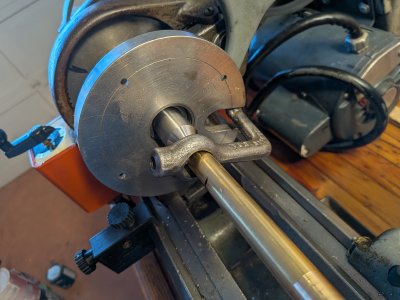
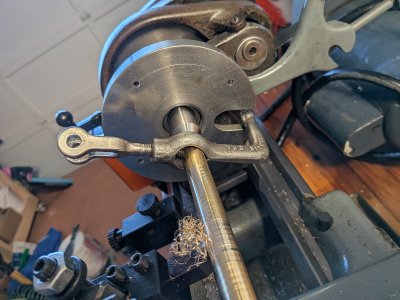
Put a shorter or longer bolt in the drive dog to balance it, or make bigger heavier lock nuts. Lots and lots of ways to do it.

Balance it on a sharp edge.
 
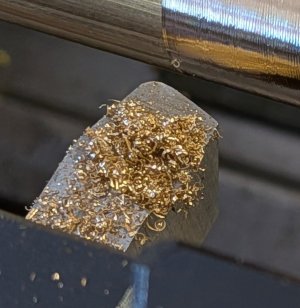
I've cropped the tool bit from the picture posted:

brass tool cropped.jpg

As shown, it really doesn't look ready to cut. (Forgive me if it is just the picture.)

Rather than write a tonne, I very much like the write up on steves-workshop.co.uk for grinding HSS lathe tool cutters:


I use either a coarse grit grinding wheel, deglazed, or a coarse sanding belt to shape the HSS quickly. Then I use medium and fine diamond 'credit card' sharpeners to get a decently polished edge right at the cutting corner. Set up your grinding rest at the desired angles at least for your first few times. Free-handing can come later. Start with a small radius (say 1/16"); you can always make it bigger but you have to grind a fair amount of metal to make it smaller.

Also, is it possible that:
a) there isn't enough clearance on the front of the tool and it is therefore rubbing? and/or
b) the cutting edge is above centre and therefore rubbing?

HTH,

Craig
 
I can switch the cutter, and as noted I did and still had the same pattern and chatter, just less so.

I'll work on balancing the drive dog first. Will figure out a different bolt to start and iterate from there.
 

Attachments

  • PXL_20260531_143842228.jpg
    PXL_20260531_143842228.jpg
    1.3 MB · Views: 4
Last edited:
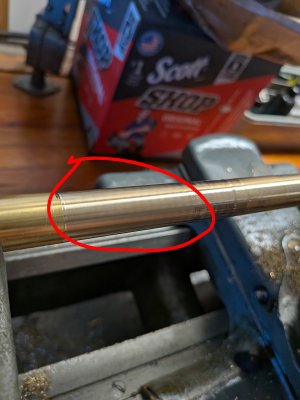
But I AM getting this very regular slightly wavy/striped finish. Almost like it's in sync with the lead screw or something?
 

Attachments

  • PXL_20260531_153625836~2.jpg
    PXL_20260531_153625836~2.jpg
    1.7 MB · Views: 14
Glad to hear you clobbered the main vibration.

Sometimes, those waves are mostly optical effects that don't affect the work.

I like @trlvn's advice regarding the tool tip geometry. If you look at his photo, you can see the surface cuts are tiny compared to the tool tip curvature. The nose is way too big and the edge is not ground correctly.

You should try a shear tool to see what it does for that surface effect.
 
They are tactile, I can't definitely feel them. Though whether they affect the work, can't say yet. Again, they are present when using my carbide inserts as well.

That is a hand me down HSS bit, so I know nothing about it's geometry. I did finally get some belts in though so I can start grinding my own now (er, once I make room for the grinder). I will absolutely take all the great advice shared about grinding when I start.
 
Hi Michael,

Looking at Craig's picture, the feed looks to be far too fast, not helped by the large nose on the lathe tool.
 
Yes the waviness you see is in sync with the lead screw because that is what is moving the carage/ tool bit. Try slowing the feed rate down abit, while maintaining turning speed. There should be a feed rate that does not leave very much if any microscopic ridges, the bit nose radius is part of this. Think of it like threading, the slower the feed rate, the finer the thread. Watch your bit rake angles, the wrong ones may cause grabbing/self feeding of the bit. It is possible to have bit that pulls slightly into the work, then releases and springs back a wee bit. Looseness of components can cause waviness/rippling of surface all so. Check looseness of compound and cross slide on their dovetails, may need a slight tightening adjustment.
You will get it figured.
 
Yes the waviness you see is in sync with the lead screw because that is what is moving the carage/ tool bit. Try slowing the feed rate down abit, while maintaining turning speed. There should be a feed rate that does not leave very much if any microscopic ridges, the bit nose radius is part of this. Think of it like threading, the slower the feed rate, the finer the thread. Watch your bit rake angles, the wrong ones may cause grabbing/self feeding of the bit. It is possible to have bit that pulls slightly into the work, then releases and springs back a wee bit. Looseness of components can cause waviness/rippling of surface all so. Check looseness of compound and cross slide on their dovetails, may need a slight tightening adjustment.
You will get it figured.
A few things!

I think I'm already running as low of a feedrate as possible (at least per the standard documentation).

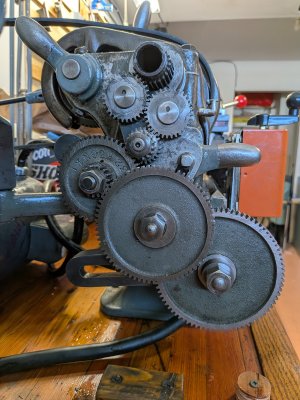
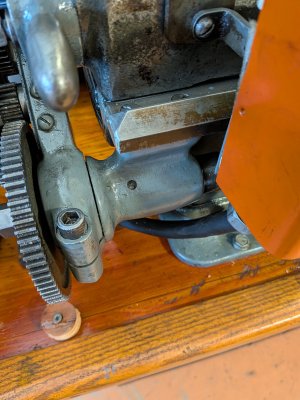
But, I was poking around and it turns out the lead screw support bracket had developed a slight rock from the holding screws backing out. I suspect that is exactly what is causing the surface wave. Have tightened those back down and will test again when family allows.
 

Attachments

  • PXL_20260531_181935473.jpg
    PXL_20260531_181935473.jpg
    2 MB · Views: 3
  • PXL_20260531_182143617.jpg
    PXL_20260531_182143617.jpg
    1.6 MB · Views: 3
A few things!

I think I'm already running as low of a feedrate as possible (at least per the standard documentation).

But, I was poking around and it turns out the lead screw support bracket had developed a slight rock from the holding screws backing out. I suspect that is exactly what is causing the surface wave. Have tightened those back down and will test again when family allows.
What sort of family doesn't prioritize chatter elimination ?
Jeesh.
 
With a "c" model southbend the only power feeds are accomplished thru the half nuts and leadscrew, so I don't think you will ever eliminate that entirely. The "a & b" models have a keyway that runs the length of the leadscrew and powers the feeds thru a feather key and worm and wheel arraignment, giving true power feeds vrs different pitches of threads offered in the c......
 
With a "c" model southbend the only power feeds are accomplished thru the half nuts and leadscrew, so I don't think you will ever eliminate that entirely. The "a & b" models have a keyway that runs the length of the leadscrew and powers the feeds thru a feather key and worm and wheel arraignment, giving true power feeds vrs different pitches of threads offered in the c......
Yeah, would be a nice upgrade haha. I was getting better finishes before though, so I do think it was the play in the bracket that was giving the cyclical waves. The spiral cut effect is separate and as y'all have said, somewhat inherent.
 
With a "c" model southbend the only power feeds are accomplished thru the half nuts

The pictured finish looks pretty darn good to me! There is no shame in polishing with abrasives if you want/need a mirror finish.

However, you might want to inspect the half-nuts. I know on Atlas lathes, the half-nuts are made of a much softer material than the lead screw so that most of the wear occurs on them rather than the more-expensive to replace screw. They can be a pretty loose fit on the lead screw and still 'work' but will vibrate more which leads to poorer surface finishes. I presume the Southbend 9-series are similar. Replacements will be available if needed.

Craig
 
Back
Top