• Scam Alert. Members are reminded to NOT send money to buy anything. Don't buy things remote and have it shipped - go get it yourself, pay in person, and take your equipment with you. Scammers have burned people on this forum. Urgency, secrecy, excuses, selling for friend, newish members, FUD, are RED FLAGS. A video conference call is not adequate assurance. Face to face interactions are required. Please report suspicions to the forum admins. Stay Safe - anyone can get scammed.
  • The 2026 Calgary Area Meetup is set for Saturday May 30th at 10am. The signup thread is here! Robinhood has graciously offered to host the meetup again this year. Please note that you MUST RSVP to the notice linked above if you wish to come.

Working on my South Bend 9C

Hi Michael,

a few more pictures.

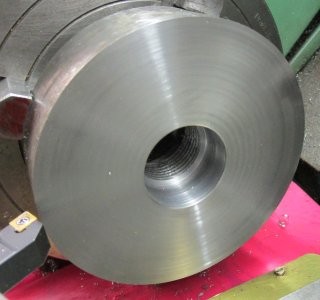
06-12-2024-011.jpg

At this point the backplate has been threaded and the register for the spindle has been machined. Note that it has never left the four jaw chuck up to this point.
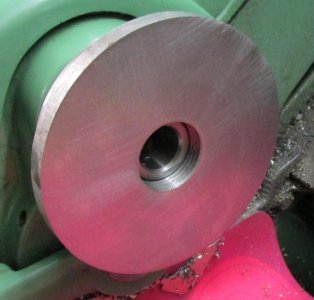
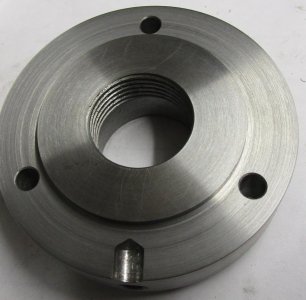
09-12-2024-16.jpg

In this picture the backplate has been taken out of the four jaw chuck and reversed so that it can be screwed onto the lathe spindle. You can see the threads in the backplate. At this point the backplate has been thinned down to about 15 mm thick.
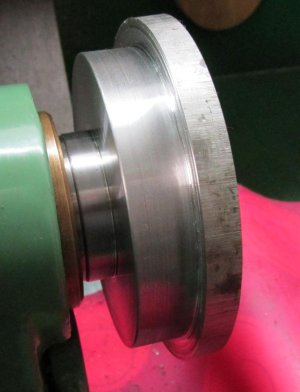
09-12-2024-15.jpg

It turned out that I needed to take another couple of thou off the register so that it would fit properly on the spindle.
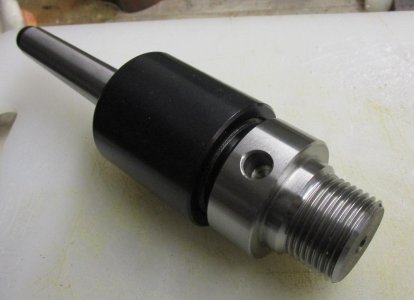
09-12-2024-14.jpg

This is the dummy spindle that I used to measure the finished threads. Its actually an MT2 tailstock live spindle for mounting a chuck on the tailstock.
 
To be a little less cryptic, with a dial test indicator and mag base that conveniently arrived moments before, David sussed out the following:

1) The spindle itself doesn't seem to be warped, and the actual runout on it is actually quite respectable, given it's age and wear.

2) There is more deflection than ideal using the beam deflection test, but as already explored, I've probably got that as optimal as it can reasonably be, and I don't think it will be a major concern.

3) A closer assessment with the backing plate from my 3-jaw chuck showed that yes there is some wobble, but not really much runout at all. Likely the plate wasn't machined on this lathe and doing so would probably bring it well within acceptable tolerances.

4) The fit on my collet chuck is no good. The actual thread engagement on the spindle is extremely sloppy - likely one reason I couldn't repeatedly shim adjust it. It's probably not worth trying to use.

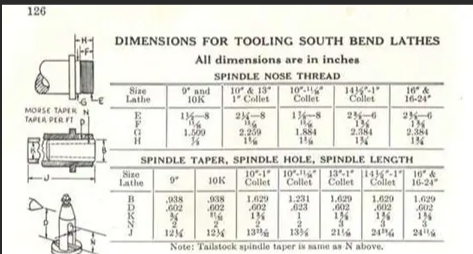
On to the test with David's known-very-good Bison 3 jaw. It didn't fit properly! Specifically, the portion of the spindle behind the threads has a slight step up in diameter about 1/8" from the registration face. While my two chucks had more clearance in that area, the Bison stopped on that step and couldn't thread on fully.

We came to two decent solutions:

A) Get a good 4-jaw chuck and a collet block. However I would want to keep that relatively low profile for my stuff (not a long bed on the lathe), which would likely mean one with integrated threads. The issue there is if it didn't have that extra spindle clearance, modifying it would be a big deal.

B) Go with a two-piece back plate and collet chuck. Probably this https://bmpartstech.com/product/south-bend-9-light-10-er32-chuck-collets-with-1-1-2-8-adapter/ since if the back plate need additional clearance someone should be able to help me with that at least.

If I KNEW the 4-jaw would work without modification I would probably go that route. But for now I am most likely going to go with the second option (especially since they'll knock the price down without collets, and I have plenty).

Phew. Progress.
 
I have been thinking on this...... once the 3 jaw is back on, can you chuck up a piece roughly 5/8" leaving about 2-2 1/2" sticking out, then turn it down to 1/2"? After that, put a 1/2 collet in your chuck and install that on your freshly turned stub so it is facing backwards to the lathe....... now check it again with the dial indicator. If it still shows runout, take a skim cut on all exposed surfaces. Hopefully then when it comes up on the register it will pull it straight.....
Now is a good time for the smart people in the room to set me straight and remind me that my role is lifting heavy things...... 😉
 
Hi Michael,

A couple more pictures !

Remembering that the new backplate now screws on to the spindle and having rechecked that everything runs true, I did a couple of thou skim right across the face. I did this to ensure that any new runout due to now having the new backplate screwed tightly in place was removed.

Now is the time to machine the register for the new collet chuck. The register is a good push by hand on to the 5 mm deep register. The actual depth is not critical, just that it is a good fit.

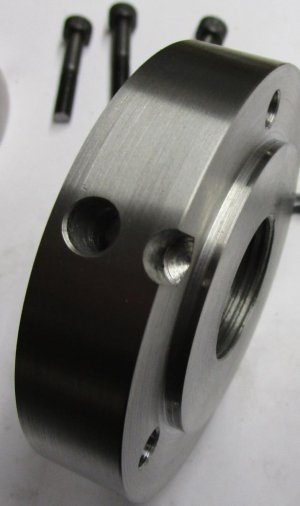
13-12-2024-026.jpg

Here you can see that there is a few thou of undercut on the register this is because the HSS lathe tool was very slightly pointing inwards. You can also see the result of and error here ! The backplate got turned round the wrong way when drilling the Tommy bar hole. The correct hole can be seen below.

After making sure that the collet chuck fits properly on the register it was used to mark the position of the mounting holes. They were drilled for M6 clearance and Hex cap screws were used to secure the collet chuck.

13-12-2024-027.jpg

The Tommy bar hole was drilled 8mm 15 mm deep. The cap screws were cut to length before being used to secure the collet chuck. You can see them in the background.

I have pictures of that if you want them.
 
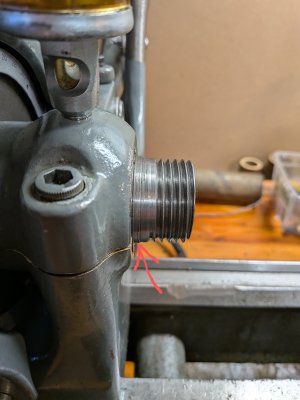
On to the test with David's known-very-good Bison 3 jaw. It didn't fit properly! Specifically, the portion of the spindle behind the threads has a slight step up in diameter about 1/8" from the registration face. While my two chucks had more clearance in that area, the Bison stopped on that step and couldn't thread on fully.

Did you or @DavidR8 take a photo of this? If not, could you do a napkin drawing for us? Doing so won't likely result in a solution, but it would help us understand what is going on.

If it still shows runout, take a skim cut on all exposed surfaces.

That is certainly an approach I would consider on my lathe. But I'm not sure this little guy with babbit bearings could handle the cantilever weight without significant distortion.

Maybe if somebody who can lift heavy stuff was holding it......

Seriously, I mean someone with a lathe that can lift heavy stuff! Doesn't have to be this lathe after all! I'd also make the pin as big as the biggest collet and long enough to engage the full bearing surface of the collet.
 
LMS has backplates are a decent price: https://littlemachineshop.com/products/chuck-adapter-1-1-2-8-thread-4-diameter-3-holes

With regard to the original subject of the collet chuck (the woodworker one?) it is highly unlikely to work out because it wasn't finish machined on your lathe. If it butts fully against the rear shoulder of the spindle then it will thread on the same way repeatedly so you 'might' get away with a skim of the ER32 inside taper.
I say this because there were a lot of efforts in the past to get screw on collet chucks made for Unimat DB200's, and none worked out for the above reason. Same with the Sherline ER16 screw on chuck (the one without a backplate), nice but not good enough. You need a backplate and then a chuck to mount on it. The backplate will repeatedly mount the same, and when the surface is machined you can centre the collet chuck on the plate. (a short version of BaronJ's description)
1768055831915.png
 
LMS has backplates are a decent price: https://littlemachineshop.com/products/chuck-adapter-1-1-2-8-thread-4-diameter-3-holes

With regard to the original subject of the collet chuck (the woodworker one?) it is highly unlikely to work out because it wasn't finish machined on your lathe. If it butts fully against the rear shoulder of the spindle then it will thread on the same way repeatedly so you 'might' get away with a skim of the ER32 inside taper.
I say this because there were a lot of efforts in the past to get screw on collet chucks made for Unimat DB200's, and none worked out for the above reason. Same with the Sherline ER16 screw on chuck (the one without a backplate), nice but not good enough. You need a backplate and then a chuck to mount on it. The backplate will repeatedly mount the same, and when the surface is machined you can centre the collet chuck on the plate. (a short version of BaronJ's description)
View attachment 76274
Ah that LMS unit is a good find, thanks!
 
Did you or @DavidR8 take a photo of this? If not, could you do a napkin drawing for us? Doing so won't likely result in a solution, but it would help us understand what is going on.

Not with his chuck mounted. It bottoms out here where the spindle diameter steps up.
 

Attachments

  • PXL_20260110_001233357~2.jpg
    PXL_20260110_001233357~2.jpg
    1.8 MB · Views: 4
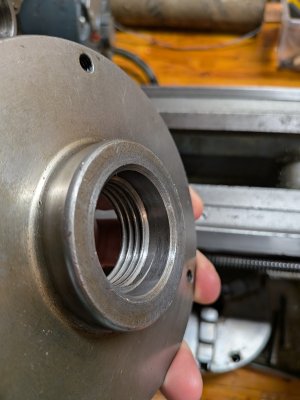
My two chucks have a large enough recess there. David's had a smaller ID.

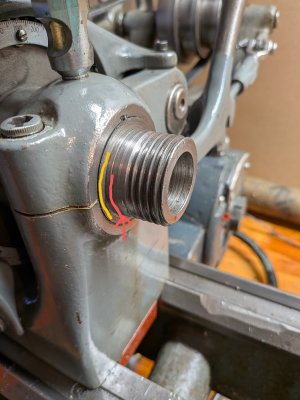
Those are mine.
 

Attachments

  • PXL_20260110_154358308.jpg
    PXL_20260110_154358308.jpg
    1.4 MB · Views: 1
  • PXL_20260110_154414719.jpg
    PXL_20260110_154414719.jpg
    1.2 MB · Views: 1
I know a lot of those were bought by members, including myself, but IDK if anyone local has one. If someone local did buy one maybe they would be willing to help out if you are interested in getting one.

The company bought a pallet load of each back in the 80's hoping to corner the hobby market and they still have a bunch left. The 3jaw Bison is a screaming deal with the backing plate, even if a guy had to open up the backing plate to for your spindle.
 
Back
Top