• Scam Alert. Members are reminded to NOT send money to buy anything. Don't buy things remote and have it shipped - go get it yourself, pay in person, and take your equipment with you. Scammers have burned people on this forum. Urgency, secrecy, excuses, selling for friend, newish members, FUD, are RED FLAGS. A video conference call is not adequate assurance. Face to face interactions are required. Please report suspicions to the forum admins. Stay Safe - anyone can get scammed.

Tips/Techniques What are you printing today?

Tips/Techniques
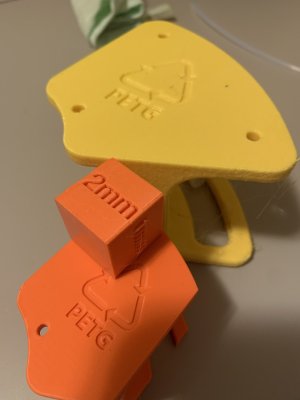
@Janger AFAIK neither PETG nor PLA are accepted in blue box recycling programs in Canada because in the case of PLA it is not a true plastic. PETG has glycol which contaminates true PET.
No, they are not ok in blue bins you are right. But! If all 3D parts were labeled then interested people could then start making filament from it or melting it to cast into new parts. The first thing though is knowing what the scrap is made of. I was talking to a filament manufacturer and he says even when people tell him what scrap is made of sometimes they are wrong and it contaminates and ruins the whole batch.

The other thing I would like is the part version v1 v2 v3, the part name, the date put on every part I print.
 

Attachments
  • image.jpg
    image.jpg
    794.1 KB · Views: 2
Last edited:
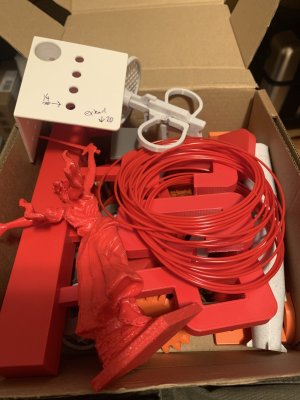
I print a lot. Mainly things I’m designing and usually several iterations are needed before it’s even ok. Or just stupid trinkets I get bored of and chuck. That makes a LOT of waste. I hate just putting it in the trash. Here’s just some. I have another big box in the basement. What are other people doing?
 

Attachments

  • image.jpg
    image.jpg
    1.8 MB · Views: 4
What are other people doing?
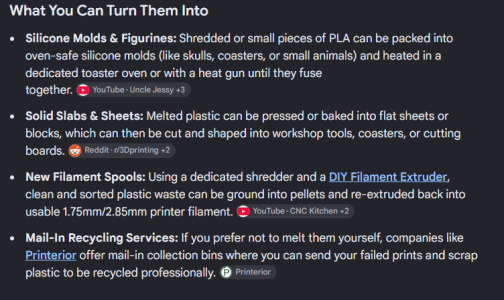
I was thinking about that the other day. I keep a box of 3DP scraps to try different adhesives, paint whatever but I'm kind of beyond that now. If one had some kind of a female mold for a useful object, say like a cutting board or plant pot something. Every so often you go on a melt-a-thon. Bake the 3DP parts to melt temp & just press it into mold, until one day its a complete object. Essentially it would be close to solid plastic. Even more fun if it was crazy swirly colors from varied scraps. You could sell them to granola heads on Etzy along with hemp underwear. Of course USING the cutting board might incur ingesting microplastics & lead to premature death. Christmas gift for an inlaw maybe?
 
Melt them down and make them in to cutting boards. Or blocks to machine. That's what I am going to work towards. I don't like dumping totes of failed prints in the land fill.
 
I print a lot. Mainly things I’m designing and usually several iterations are needed before it’s even ok. Or just stupid trinkets I get bored of and chuck. That makes a LOT of waste. I hate just putting it in the trash. Here’s just some. I have another big box in the basement. What are other people doing?
UVic accepts PLA and PETG for recycling. Maybe check your local Makerspaces etc?
 
Blocks to machine. Melt into molds. Good ideas. Cutting boards? Not worth health risks. New filament from old is a great idea and this my point - you need clean and identified material. Throw some PETG into a batch of PLA and you ruin it. Worse- you’ll jam someone’s expensive nozzle with a rock of crap in a spool of recycled filament. If that happens even once you’ll never use recycled filament again.

So even if you use a different slicer than Prusa if you would upvote the feature request for auto labeling then that feature will spread to other slicers.

Here is the link
https://github.com/prusa3d/PrusaSlicer/discussions/15772
 
Last edited:
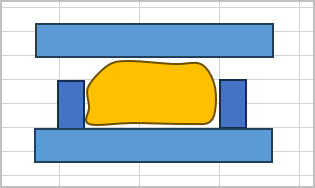
The panini press is a good idea because it povides constant heat & makes it flat-ish. But a) you need one b) doesnt really solve if you have large prints or varied size or different infill unles you spend time cutting them into manageable chunks? Maybe thats a prerequisite in any case? An oven might be more controlled but asking for domestic beating. I have tested softening in my shop mini toaster oven, even there had to be careful. One could make a rudimentary press just using scraps of whatever. The trick is to melt what you are adding but also the base material otherwise it wont bond

1793723096087.png
 
The Panini press is a good idea because it provides constant heat & makes it flat-ish. But a) you need one b) doesn't really solve if you have large prints or varied size or different infill unless you spend time cutting them into manageable chunks? Maybe that's a prerequisite in any case? An oven might be more controlled but asking for domestic beating. I have tested softening in my shop mini toaster oven, even there had to be careful. One could make a rudimentary press just using scraps of whatever. The trick is to melt what you are adding but also the base material otherwise it wont bond

View attachment 88851
One of their earlier videos shows how they combine multiple colours and how they use silicone oven mitts to grab and mush together the melted plastic. So the different size isn't as big an issue. Interesting idea though.
 
Back
Top