
• Scam Alert. Members are reminded to NOT send money to buy anything. Don't buy things remote and have it shipped - go get it yourself, pay in person, and take your equipment with you. Scammers have burned people on this forum. Urgency, secrecy, excuses, selling for friend, newish members, FUD, are RED FLAGS. A video conference call is not adequate assurance. Face to face interactions are required. Please report suspicions to the forum admins. Stay Safe - anyone can get scammed.

Unravelling the USB mess...

Arbutus

Ultra Member
Premium Member
USB was designed by committee. What an effing mess.

My new MAC only has Thunderbolt 5 (backward compatible with USB-C 4.0) and USB-C 3.0, but there's still a desk full of older gadgets with all kinds of connectors. In addition to the MAC, a USB-C HUB is needed to connect with anything with legacy USB-A type connectors.

Finding the right cable is a real pita, but perhaps this image may help others in distress. (from: https://facilities.doc.gold.ac.uk/connectorcheatsheet/ <-- lots of useful info)
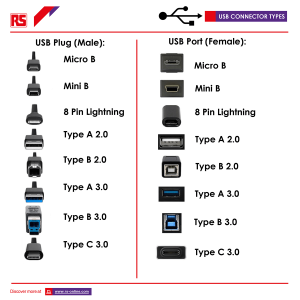
1794987425053.png
 
I've found this website very useful too. It helps define the 3-way information for the data, the connectors, and the power specs.


Gemini creates a similar 3-way set of definitions with some additional info. Here is a link to that chat that I created just now for others:


I keep these two sources in my info library because I have the same difficulty keeping it all straight as @Arbutus does even though I don't use the apple ecosystem at all.

I recently shattered the screen on my cell phone. To recover the data, I linked the phone to a USB powered monitor screen and a USB mouse. Unraveling the data and power requirements of the different USB systems was a dog's breakfast. A standalone solution didn't appear to exist. With those cheatsheets and a cobbled together kit of hardware I was in and fixing it a day later. I was fully up to speed in two days and I'm using the new phone to type this post now.
 
going forwards, thanks to legislation from the European Union, USB C style connectors are expected to be upwards compatible for a long time.

Apple invented their own deliberately incompatible connectors, but those have mostly been superseded by USB C (they were forced)

B style connectors are widely used with printers, but not much else.

both A and B connectors started with USB 1.0 and were also used with 1.1 before the 2.0 standard and will probably never go completely away
 
Gemini creates
... a Share Link! Good way to save Q&A information without copy pasting.

In all fairness to the seemingless needless changes in USB/plug/cable standards, like most electronic things, the amount of data/speed/hardware specifics has also changed by orders of magnitude. Your old plug may simply not be up to the task. This doesnt absolve certain manufactures with their sales tactics though.

I finally caved & got a new smart TV over a perfectly functioning 15 year old TV. Perfect as in functioning, but not able to keep up with what was coming down a current pipeline. I thought it might be a new artistic filming style where everyone is in a dark room with stuttering/time lag speech. The good news is you get a hell of a picture for less $ than decades ago. Its 2" thick & 1/3 the weight. But (I checked) the 15 year old HDMI cable is not up to snuff even though the plug fits. And apparently Netflix on 5G direct from the WiFi box is better than going through the Rogers box via HDMI. I feel like a Neanderthal. Hopefully I can last another 15 years. By that time it will be socket into one of my human orfices.
 
I just built a CNC router using a parallel port on a PC running DOS, so screw all of this. I know explicitly what each individual wire does. You’ll have to pry that DB25 connector from my cold, dead hands.
 
And your new tv will be able to listen to your conversations and monitor traffic on your wifi and feed you personalized ads based on your viewing habits and and and.........
Yup. OTOH they were probably fully aware of content & viewing habits when PVRs came into the scene, so what +25 years or so now. Supposedly CDN laws are a bit stricter in terms of selling data outside the telecom sandbox. Voice snooping from everyday appliances & kids toys is just another level of creepy. Supposedly a Hey Siri stays inside AppleCo but I dont believe in Santa Claus either. Every app on your phone is spewing metrics to every corner of the world. I think MarketPlace just did a show on that (YouTube). Your donut purchase at the local Tims ends up in 15 different data centers as far away as Africa or some such wierdness.
 
I just built a CNC router using a parallel port on a PC running DOS, so screw all of this. I know explicitly what each individual wire does. You’ll have to pry that DB25 connector from my cold, dead hands.

Do you? Which version of the PC parallel port are you using?
 
People might not know but the wifi router and your connected devices do not just show those device usages. They can show where you are in the house and even break down to showing specific tasks. As in they can tell if your standing or sitting. There is even data that shows what your doing at that time. Now connect all that together that many devices are listening to you, as well as listening to each other. If device A has a signal strength of 4.3 and then goes to 4.2 and an interpretable sound like someone using the bathroom, breathing rate changes such as sleeping, other key signifiers. Can be mapped out. This actually started to pop up about 10 years ago. Now with pretty much everything connected and listening it is likely not just a lab experiment its likely very doable. Having said that we also want to live in the modern world and have connectivity. If guys really want to see how far things have gone, do a bit of dive in to smart homes.

Back to the origin of the thread. USB-C is looking to be the best of all worlds as far as power and data connectivity. It can handle a decent amount of current and is still a small form factor.
 
As long as we're doing I'm-an-older-fart-than-you-are, here's a problem I deal with: When I started using programmable logic (initially just PALs) in 1989, I couldn't afford all the modules for doing it with my first Data I/O programmer (Model 29), and I was traveling a lot, so I bought a PC-driven programmer from a Bay Area company called Advin. Runs from a parallel port under DOS (like @whydontu's CNC router), but... the driver software borks once the CPU clock gets up above 50MHz (or something in that neighborhood). At the time I was using Compaq's Portable III, then Portable 386, then SLT - all slower than that. Now it's a giant PITA to keep a old, slow-enough PC running to support it - which sucks, because the UI is terrific. DOS, so no mouse. They cribbed the UI from the original Lotus 123, so all of the menu selections (ascending, descending, executing) are single keystrokes. And though I now have a room full of device programming equipment (mostly Data I/O, since I run the online user's group), I still love using the Advin for lots of work because that UI is so damn fast to use.
 
Last edited:
Back
Top