• Scam Alert. Members are reminded to NOT send money to buy anything. Don't buy things remote and have it shipped - go get it yourself, pay in person, and take your equipment with you. Scammers have burned people on this forum. Urgency, secrecy, excuses, selling for friend, newish members, FUD, are RED FLAGS. A video conference call is not adequate assurance. Face to face interactions are required. Please report suspicions to the forum admins. Stay Safe - anyone can get scammed.
  • The 2026 Calgary Area Meetup is set for Saturday May 30th at 10am. The signup thread is here! Robinhood has graciously offered to host the meetup again this year. Please note that you MUST RSVP to the notice linked above if you wish to come.

Show us your shops!

Conduit (EMT) has a few benefits:

1) Its visible. Any damage done is plainly apparent and there is no mystery hidden in a wall.
2) If you upsize the conduit (cheap if running conduit anyway) you can pull more circuits in later and add plugs/equipment as you need it.
3) Its basically rodent / damaging pest proof. A properly installed conduit system will never suffer pest or rodent damage.
4) Its durable. It takes a lot to damage conduit.

And a few downsides:

1) Its significantly more expensive when compared to running NMD in the walls before drywall/tin. Depending on the setup, probably 1.5x the price for the same number of devices. This includes labor and materials. Its slower to install, and the parts cost more.
2) Its visible. Some people(s wives) don't like the look of visible conduit as it definitely has a "commercial" appearance.
3) Most people are not comfortable DIY'ing conduit. There is more code to be aware of and the skill is definitely something that doesn't come naturally.


If I were wiring a shop for myself I would do it. But I'm a licensed sparky who is well practiced and my labor is free for me. It really depends on who you are and what you want. Alot of farm/industrial shops do it because of the benefits. Rodents wrecking wires in walls absolutely does happen and it really really sucks. It is super nice to be able to slap another couple wires in an existing pipe when the customer buys a new air compressor. That saves money / time in the long run.
 
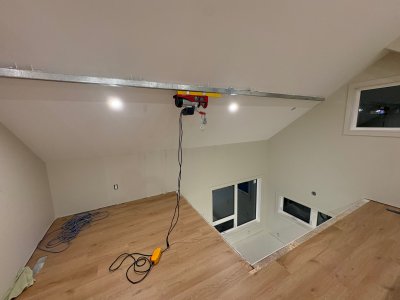
I installed the first overhead crane trolly in my nearly finished shop / garage.
This is in the shop upper floor that one day will be finished as a two bedroom apartment. The upper loft is partially open to the main level where my machinery and workspace is. The barn door crane rail and crane is to lift motorcycles and other large items up to the loft.
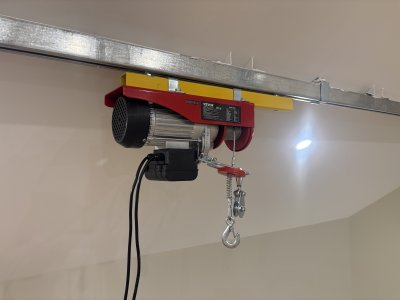
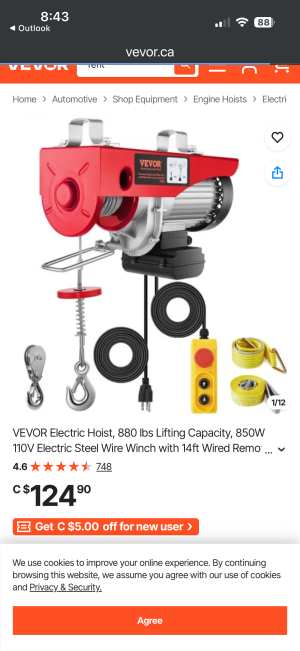
I bought the 120 volt 400 lb/800lb hoist from Vevor and it arrived in three days. I added a 24” long piece of 1-3/4” square tube that is suspended from the barn door trolly carriages (2). The Vevor hoist comes with two brackets that wrap around the square tube.
My roof trusses were designed for minimum 600 lb point load. The limit on the barn door trolleys is also 600 lbs. I don’t plan on lifting more than 500 lbs.
I am adding an eye loop to the end of the yellow square tube that will let me grab the trolley with a long steel rod / hook to push and pull the trolley out over the open to below.
The Vevor hoist is so cheap I am buying another for the crane rail that runs above the vehicle stalls in the garage area.
I am so looking forward to finally finishing the shop / garage and getting all my tools and motorcycles moved over for winter.
 

Attachments

  • IMG_5967.png
    IMG_5967.png
    869.8 KB · Views: 12
  • IMG_5962.jpeg
    IMG_5962.jpeg
    2.7 MB · Views: 12
  • IMG_5961.jpeg
    IMG_5961.jpeg
    3.5 MB · Views: 12
  • IMG_5963.jpeg
    IMG_5963.jpeg
    1.6 MB · Views: 12
I just checked ‘Google’ and . . .

Standard Factors of Safety by Equipment Type :
  • Wire Rope Slings: Typically 5:1 (or up to 6:1 depending on application)
** You may want to double check your lifting capacities **
 
I just checked ‘Google’ and . . .

Standard Factors of Safety by Equipment Type :
  • Wire Rope Slings: Typically 5:1 (or up to 6:1 depending on application)
** You may want to double check your lifting capacities **
Except a wire rope sling is generally used as a static load. A winch is generally dynamic

In other words, a crane main line is usually a larger diameter than any of the accessory rigging
 
I question why Princess Auto and Vevor would list these winches at 409/800 lbs capacity if the wire was not up to spec for the listed rating.
In my existing shop I have a very heavy overhead crane made from 24” deep wide flange rails and 8”deep cross beam. The winch is a Princess Auto 800/1600 and I have lifted 1200 pounds without drama. The cable on the 400/800 doesn’t look different than the heavier winch I have.
 
Trust, but load test?

And not while underneath.

PA engine hoist failed that for me years ago and was returned. No were near rated capacity…

Not an engineer, but understand wire is more difficult to inspect than chain. If you want to see an inadvertent test, suggest watching Brian Block’s radial drill lifting youtube.
 
I installed the first overhead crane trolly in my nearly finished shop / garage.
This is in the shop upper floor that one day will be finished as a two bedroom apartment. The upper loft is partially open to the main level where my machinery and workspace is. The barn door crane rail and crane is to lift motorcycles and other large items up to the loft.
I bought the 120 volt 400 lb/800lb hoist from Vevor and it arrived in three days. I added a 24” long piece of 1-3/4” square tube that is suspended from the barn door trolly carriages (2). The Vevor hoist comes with two brackets that wrap around the square tube.
My roof trusses were designed for minimum 600 lb point load. The limit on the barn door trolleys is also 600 lbs. I don’t plan on lifting more than 500 lbs.
I am adding an eye loop to the end of the yellow square tube that will let me grab the trolley with a long steel rod / hook to push and pull the trolley out over the open to below.
The Vevor hoist is so cheap I am buying another for the crane rail that runs above the vehicle stalls in the garage area.
I am so looking forward to finally finishing the shop / garage and getting all my tools and motorcycles moved over for winter.

Awesome planning to do something similar in my upcoming workshop too. I'll putting some LVL beams in there so maybe I'll attach a tubing onto it to create a sort of track for a hoist.
 
You won’t be disappointed!
Attaching to LVL beams would be simpler than reinforcing the web and TJI joists I am contending with. I had my truss and joist supplier carry out the engineering for the loads I want to lift, attachment locations etc.
A couple buddies have installed these barn door overhead cranes before. I was going to install wide flange beams but on second thought I don’t need the heavy lifting capacity that my current place conveniently has.
Getting things in and out of the pickup without breaking my back is the main concern and getting motorcycles up to the second floor. Only small bikes will go upstairs, probably 500cc and smaller, up to 400lbs. My bigger bikes will stay downstairs.
 
I question why Princess Auto and Vevor would list these winches at 409/800 lbs capacity if the wire was not up to spec for the listed rating.

I've got one and it seems ok .... but I think you'd be challenged to find someone at Vevor or Princes auto who has done or could do the calculations. They have no QC and just take the manufacturers word for it. imo there no reason to think something like load rating is accurate just because it is for sale there.

this is old news, but still a major factor ..... It is a different manufacturing culture there (been there done that). Here the customer is king, there the manufacturer is. Here a contract manufactures would not change the design /cutting corners without customer consultation, there it is constant and what matters is not getting caught. This is the root cause of the China/quality issue .... in traditional North American supply chains, a manufacturer has QC and the retailer relied on this. With Low cost manufacturer -> low price retailing, there isn't that function of if there is at the manufacturer, it cannot be trusted. A great book on this is "Poorly Made in China - written by an America who's lived there for decades as consultant to NA firms buying products from Chinese manufactures... explains this dynamic better than i can.

We are seeing products where they are stakeholders in the brand and quality is amazing, e.g. DGI, Bambu , however in contract supply to low cost retailers where it is price price price, I'd bet it is still the wild east as bad as it ever was.

We stand behind our hoists but never under them 🙂
 
Last edited:
I was thinking of lifting entire sportbikes (~500lb) up with these cheapo hoists but maybe that's a bad idea? I'll restrict it to engines and parts then. Has anyone tried mounting them on track system?
 
I was thinking of lifting entire sportbikes (~500lb) up with these cheapo hoists but maybe that's a bad idea? I'll restrict it to engines and parts then. Has anyone tried mounting them on track system?
Princess Auto has this one for $100 off and has a capacity that far exceeds 500lb:


There is a high number of positive reviews, so that's a minor but decent indicator.

If it's for home use by one person and the user occassionally inspects it, maintains it, and operates it with the same safety precautions that you would with the best of equipment it should serve the purpose well.

If it were in a shared shop or business then I would prefer something that is made to a documented standard. It will likely get used more often and some people aren't as careful with how they handle tools. The term "treated like a rented mule" comes to mind. Maybe a Powerfist hoist wouldn't do as well with so many different people using it. I have seen them used in professional workshops.

Oh nice thanks! I'll grab these higher capacity ones for the headroom. Yeah definitely home solo use with maybe the occasional time my partner wants to do some pottery, but I won't be hoisting anything while she's in there. I don't imaging using it daily or anything like that. I just emailed the builder/structural engineer and mentioned this hoist so they can get a better sense and figure out the LVLs for me.
 
I have been using a Princess Auto 800/1600 lb electric hoist for the past 8 years, it’s mounted to a heavy wide flange beam overhead travelling crane in my current shop area that I rent.
I have lifted both a Honda GL1800 GoldWing and BMW K1600 GTL several times, both are 800 lb bikes with no issues.
The heaviest load I have lifted is my knee mill, similar to a BusyBee CX603, about 1000 lbs, using the double cable pulley, it does seem to work harder at this weight but it gets the job done.
My new shop crane lift capacity is limited by the roof/floor structure and not the crane. I purposely set the load limit at 600 lbs, most of my motorcycles are in the 300-500 lb range. I won’t be craning the heavy bikes in my shop
Regardless, I don’t stand under anything I lift with my current crane, I will follow the same principles in my new shop.
 
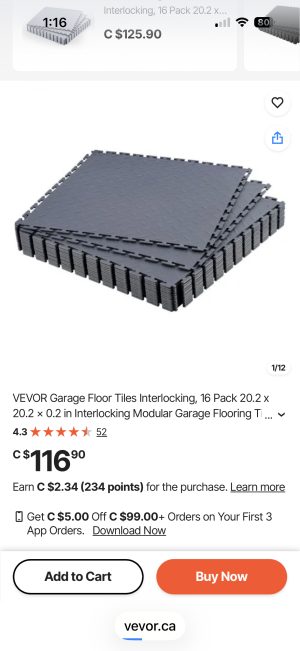
I ended up purchasing Vevor interlocking pvc floor tiles, 20” x 20”. The area where my lathe, mill, bike lift will go is about 300 square feet. The floor is not 100% water proof but it’s going to be ok for damp mopping. The tiles will supposedly handle the loads of my mill and lathe. I read that if I glue the tiles down, the floor will be watertight but I have decided against that. Tiles should arrive Monday, hopefully the trades working in the garage will be done their work next week and I can finish off this space.
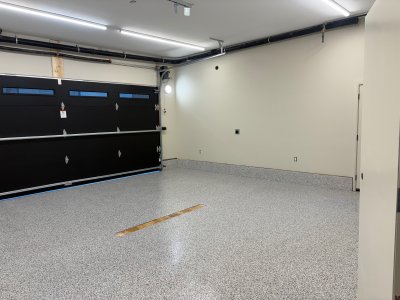
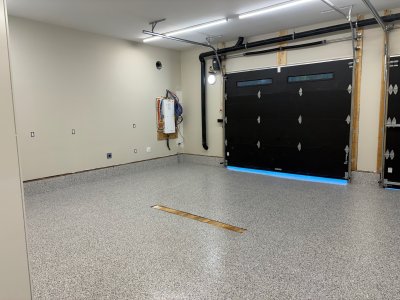
Yesterday I had the vehicle parking side of my shop/garage slab professionally coated with epoxy / polyaspartic coating with the pvc flakes. I didn’t want the epoxy in my shop, I find it chips too easy in my current shop from dropping tools.
My welding area is on one side of my 39’x23’ garage area, I am going to make up an aluminum checker plate floor around the welding area laid over the epoxy floor.
 

Attachments

  • IMG_5987.png
    IMG_5987.png
    1.7 MB · Views: 8
  • IMG_5980.jpeg
    IMG_5980.jpeg
    3.4 MB · Views: 8
  • IMG_5979.jpeg
    IMG_5979.jpeg
    3.3 MB · Views: 8
My welding area is on one side of my 39’x23’ garage area, I am going to make up an aluminum checker plate floor around the welding area laid over the epoxy floor.

Do you plan on protecting the walls too? I am planning the same small welding area but will have concrete with densifier so want to lay down some protection all around. Someone else in the tread recommended some corrugated siding I believe so that's what I'm leaning towards.
 
What type of welding are you guys doing that you are concerned about the floor? Or the walls for that matter? Unless you do welding right on the floor or using a cutting torch aimed at the floor.
 
Do you plan on protecting the walls too? I am planning the same small welding area but will have concrete with densifier so want to lay down some protection all around. Someone else in the tread recommended some corrugated siding I believe so that's what I'm leaning towards.
For the welding corner I am adding thin checker plate aluminum sheet to the wall, 4 feet above the epoxy floor base, I get the checker plate from Metal Supermarket.
I had the same checker plate on some of the walls in my previous shop. I will probably apply the checker plate wall protection to some of my front shop area, mostly where cutting oil can splash onto the walls from the lathe and mill.
 
What type of welding are you guys doing that you are concerned about the floor? Or the walls for that matter? Unless you do welding right on the floor or using a
I managed to get weld splatter onto my fresh epoxy floor in my old shop. I use Mig with shielding gas but I probably had some contaminants that blew off the weld.

I weld on a metal bench, it’s not the best setup for welding being a bit too tall at 42”. I have the table that high to park my Mig and Oxy-Acetylene carts under the work top. I have the bench up against a wall and that limits what I can comfortably weld. A better setup will be a rolling table that I can pull out from the wall. I need to put some thought into how I can make a welding floor that might be a skirt on the welding table that is hinged to drop 90 degrees snd form a floor platform.
 
Back
Top