• Scam Alert. Members are reminded to NOT send money to buy anything. Don't buy things remote and have it shipped - go get it yourself, pay in person, and take your equipment with you. Scammers have burned people on this forum. Urgency, secrecy, excuses, selling for friend, newish members, FUD, are RED FLAGS. A video conference call is not adequate assurance. Face to face interactions are required. Please report suspicions to the forum admins. Stay Safe - anyone can get scammed.
  • The 2026 Calgary Area Meetup is set for Saturday May 30th at 10am. The signup thread is here! Robinhood has graciously offered to host the meetup again this year. Please note that you MUST RSVP to the notice linked above if you wish to come.

Oxy fuel brazing brass

Chris Cramer

Ultra Member
Premium Member
I'm really struggling in just brazing heavy brass. It's said that the process is just the same as soldering with a torch. I tried using flux paste, as well as flux coated bronze brazing rods; and it's easy enough to bind the solder as that is all that melts; but unlike silver soldering it does not bind to the base material even when it is very clean without managing to melt the surface of the base material and fuse it with the pool of solder. If you ask me that is more like welding, but brazing and soldering should still hold without fusing the metal.
 
Ah, I figured it must have been because of the lower temperature of the base brass. I was brazing the parts of the hilt and guard of my fantasy sword that were recently cast. They are all about half an inch thick so it was very difficult to bring both parts to a high enough temperature by how much heat dissipation brass has. I got the welding to work by using much more gas with the torch. I lost a lot of gas as I struggled to get the solder to bond to the brass.
 
Why not just silver solder? right stuff for the job imo. Bronze rod melting temp is too close the brass's melting temp (1600 and 1700F). Silver soldering is brazing btw. (brazing is technically defined as when the stuff melts at over 850F). SS has very high tensile strength, 8-10 that of soft soldering. Typical SS melts at like 1300F so you don't end up with that expensive brass turning into a puff of zinc and puddle on the floor.

Once you get things clean, get used use lots of the right flux and avoid direct flame, SS is fairly easy and gives great results with brass
 
There is a big difference between brazing copper pipe or thin brass stock, and brazing heavy brass or copper. You need to heat almost the entire peice of brass to bring it to the right temperature, and the amount off heat that is built up in the stock is much higher than any flux will melt. Soldering thin stock is easy, because you basically apply the flux and solder and heat the stock a distance from the joint and allow the heat to travel to melt the solder and flux. In that case the solder will follow the flux.
When crafting something with cast brass or bronze, I would always avoid using silver solder because it would stand out from the rest of the peice which I want to look as good as possible after it is polished.
 
After filling my Argon tank, I spent a lot of time tig welding, or in some cases, tig brazing the brass with silicon bronze filler metal. It's difficult to apply the filler metal as the brass melts before the zink starts to boil. If the filler is built up along the joint it will bond to the edges once the brass gets hot enough. The tig torch does a much better job of heating the brass IMO because it is more hot, and even if the rest of the metal is still absorbing heat, a close arc will deliver enough heat as an extremely concentrated source.
 
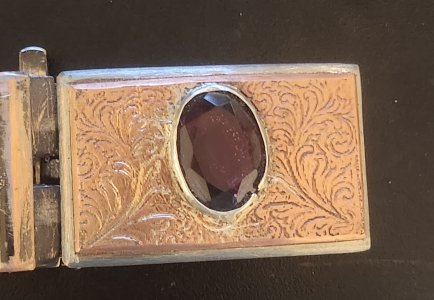
After going to the stampede this year, I decided to try making my own belt buckle instead of purchasing one since I have all the equipment. I used my fiber laser to engrave a small plate of copper, and I wanted to try setting a stone into it. Some of the center is cut out of the plate where it isn't engraved, and I went for a simple bezel setting with silver bezel wire and solder; but I made a big mistake by soldering after I engraved it because some of the solder found it's way into the engraving. The plate was then mounted on the face of an old mechanical belt buckle.1000003559.jpg
 
Do you mean you used the laser to map out the design & then you did hand engraving, or is it entirely laser? Some of the stems almost have a V-look to it but I know digital photos can make things look different to the real thing.

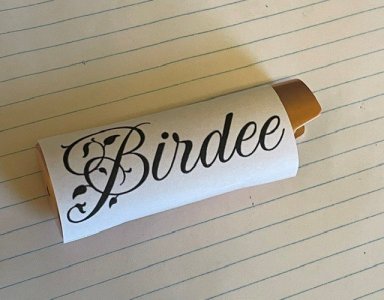
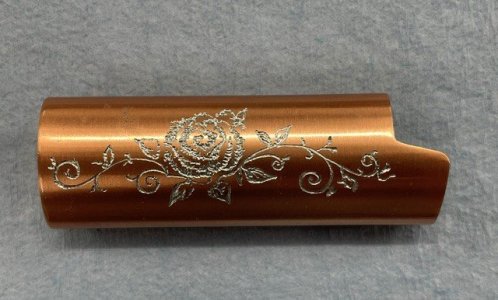
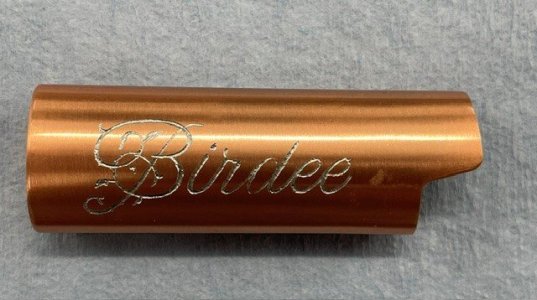
Sorry to photo drop on your post but I did this el-cheapo lighter case gift by spray gluing a print from a downloaded font then going at it with my Dremel burr. It grinds through the electroplating layer exposing the silver base color. Its never going to look like laser or a more cnc controlled motion, so it is what it is.
 

Attachments

  • lighter 1.jpg
    lighter 1.jpg
    65.3 KB · Views: 4
  • lighter 2.jpg
    lighter 2.jpg
    60.9 KB · Views: 4
  • lighter 3.jpg
    lighter 3.jpg
    56.6 KB · Views: 4
I used the fiber laser with 3d slice on an image that I modified so the jem could fit nicely into the design. After I soldered the solder bezel wire I tried removing some of the misguided solder in the engraving with a hand graver. I'm thinking of going over it again with the laser again with a few adjustments on the image to clean things up.
 
Brazing brass is tricky since the melting temp and the brazing temp are so close. I usually melt a tiny bit of rod onto the joint, not how you are suppose to normally braze, and watch to see when it starts to melt. That is when you start brazing. If you are to slow then you will be welding whether you want to or not.
 
Does it have to be bronze brazing? Silver solder is brazing... I too usually think of brazing as being with the bronze rod, but SS is technically brazing >450C and both are the same strength range, higher than the base material, when done properly (gap, flux etc). SS can be very clean, close to invisible with the brass if do the Kozo trick of tiny pieces places at the joint that wick in. Propane/air and a corner of three IFB's is my SOP, O/A if the parts are large, but work more to keep the heat indirect
 
Back
Top