
-
Scam Alert. Members are reminded to NOT send money to buy anything. Don't buy things remote and have it shipped - go get it yourself, pay in person, and take your equipment with you. Scammers have burned people on this forum. Urgency, secrecy, excuses, selling for friend, newish members, FUD, are RED FLAGS. A video conference call is not adequate assurance. Face to face interactions are required. Please report suspicions to the forum admins. Stay Safe - anyone can get scammed.
-
The 2026 Calgary Area Meetup is set for Saturday May 30th at 10am. The signup thread is here! Robinhood has graciously offered to host the meetup again this year. Please note that you MUST RSVP to the notice linked above if you wish to come.
You are using an out of date browser. It may not display this or other websites correctly.
You should upgrade or use an alternative browser.
You should upgrade or use an alternative browser.
New Water Heater
- Thread starter jcdammeyer
- Start date


I wondered why my skin was thinner. Thought it was just old age.Definitely recommend a pressure reducing valve. 100 PSI is pushing it for domestic plumbing fixtures. Does your shower head remove tans?
Does explain why over the years the over pressure/temperature valve on the Sears water heater started leaking more and more once the municipality put in a back flow preventer. Have to have a shower and then see how much the pressure goes to once the heater is warming up the replacement water.

Doggggboy
Ultra Member
100 PSI? 😱I wondered why my skin was thinner. Thought it was just old age.
Does explain why over the years the over pressure/temperature valve on the Sears water heater started leaking more and more once the municipality put in a back flow preventer. Have to have a shower and then see how much the pressure goes to once the heater is warming up the replacement water.
I hope you don't have a bidet!

Means @jcdammeyer has to bring stuff into the bathroom to be pressure washed. Makes one helluva mess I'm sure 😀
Shush... Don't tell my wife...Means @jcdammeyer has to bring stuff into the bathroom to be pressure washed. Makes one helluva mess I'm sure 😀
Drops to 100 when the hot water tap is on. With two taps and a toilet refilling the pressure drops to 75 PSI.100 PSI? 😱
I hope you don't have a bidet!

Drops to 100 when the hot water tap is on. With two taps and a toilet refilling the pressure drops to 75 PSI.
What's the toilet got to do with the hot water tank?

Just picture John sitting on the john with water spraying out of his ears. LOL100 PSI?
I hope you don't have a bidet!
It's the cold water pressure into the tank that is being measured.What's the toilet got to do with the hot water tank?
But wait...
There's more...
Years ago we thought we heard water running where the pipe came into the house. Sure enough the 1/2" copper pipe had split about 2' from the house. The plumbers that came and found the problem used the brilliant (said sarcastically) solution to couple PEX to the copper pipe underground and then transition from the PEX shut-off valve back to 1/2" copper.
The idiots thought it was perfectly alright to use 1/2" PEX. Except that the tubing and connectors have a much smaller ID than copper. Ever since then running the kitchen taps affects the shower pressure.
When I put the Sears tank in years ago, along with kitchen renovations I used 1/2" PEX for that too mostly because we really don't use full flow 60C water without mixing it with cold. So I didn't care much. But now I have to install a Pressure Regulating Valve (PRV) and although they can be mounted vertically it's recommended that they go horizontal.
So it comes into the house now, right angle connector with an even smaller ID than 1/2" copper pipe. Through a teensy ball valve and then onto the internal house 1/2" copper.
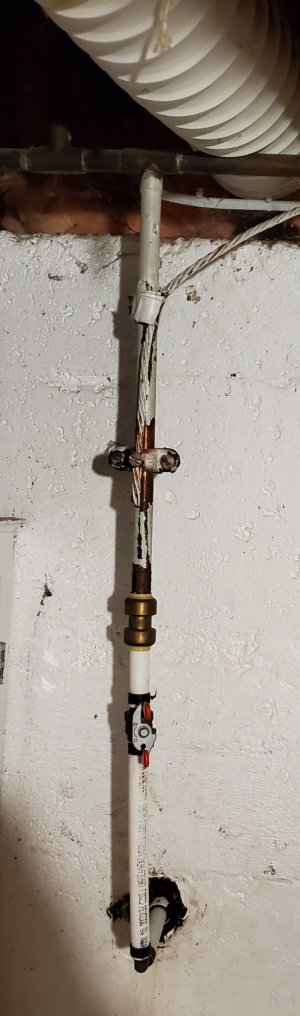
The question is where to install the PRV. And I'm really tempted to dig back up the repair joint now and fix it with larger ID pipe.
Now if you look closely at the T fitting at the top of the entry pipe you can see another T fitting just to the left. That goes to the outside tap. Ideally I'd rather have that on the non pressure regulated side so watering the garden, at least at the back of the house doesn't drop internal house pressure.
If I do reconstruct the entry pipe I could come out, go right first into the shutoff valve then into the PRV and then up and tie into the upper horizontal feed to the rest of the house.
So many decisions...
Doggggboy
Ultra Member
Why have the water heater set for 60 if you have to add cold later to make it useable?It's the cold water pressure into the tank that is being measured.
But wait...
There's more...
Years ago we thought we heard water running where the pipe came into the house. Sure enough the 1/2" copper pipe had split about 2' from the house. The plumbers that came and found the problem used the brilliant (said sarcastically) solution to couple PEX to the copper pipe underground and then transition from the PEX shut-off valve back to 1/2" copper.
The idiots thought it was perfectly alright to use 1/2" PEX. Except that the tubing and connectors have a much smaller ID than copper. Ever since then running the kitchen taps affects the shower pressure.
When I put the Sears tank in years ago, along with kitchen renovations I used 1/2" PEX for that too mostly because we really don't use full flow 60C water without mixing it with cold. So I didn't care much. But now I have to install a Pressure Regulating Valve (PRV) and although they can be mounted vertically it's recommended that they go horizontal.
View attachment 84407
So it comes into the house now, right angle connector with an even smaller ID than 1/2" copper pipe. Through a teensy ball valve and then onto the internal house 1/2" copper.
View attachment 84408
The question is where to install the PRV. And I'm really tempted to dig back up the repair joint now and fix it with larger ID pipe.
Now if you look closely at the T fitting at the top of the entry pipe you can see another T fitting just to the left. That goes to the outside tap. Ideally I'd rather have that on the non pressure regulated side so watering the garden, at least at the back of the house doesn't drop internal house pressure.
If I do reconstruct the entry pipe I could come out, go right first into the shutoff valve then into the PRV and then up and tie into the upper horizontal feed to the rest of the house.
So many decisions...
Seems vaguely ineffecient? Why heat it to more than you need? Seems like turning the furnace up and then opening a window.
I set mine to have 40 C at the farthest from the heater, the bathtub, so now I just turn on the hot and let it rip.
It's recommended to set water heaters between 40 and 60C. Lower temperatures risk to formation of Legionnaires diseaseWhy have the water heater set for 60 if you have to add cold later to make it useable?
Seems vaguely ineffecient? Why heat it to more than you need? Seems like turning the furnace up and then opening a window.
I set mine to have 40 C at the farthest from the heater, the bathtub, so now I just turn on the hot and let it rip.
Doggggboy
Ultra Member
I'm safe then because the heater is set to 46C, the water looses 6C on the way to the bathroom tub. All my piping is buried in the concrete floor.It's recommended to set water heaters between 40 and 60C. Lower temperatures risk to formation of Legionnaires disease
It's also an on demand heater as part of the boiler that heats the house.
50C is the recommended temperatureI'm safe then because the heater is set to 46C, the water looses 6C on the way to the bathroom tub. All my piping is buried in the concrete floor.
It's also an on demand heater as part of the boiler that heats the house.
That's the default setting and was on the old one too. When you mix the hot with cold it goes further. Remember, as soon as you take out some water from the tank it's replaced with cold so the overall temperature of the water drops. It means if the washing machine is using hot water your shower may not see 40C water.Why have the water heater set for 60 if you have to add cold later to make it useable?
Seems vaguely ineffecient? Why heat it to more than you need? Seems like turning the furnace up and then opening a window.
I set mine to have 40 C at the farthest from the heater, the bathtub, so now I just turn on the hot and let it rip.
Plus I've set our shower heads to restrict max hot water so one can't really get scalded by the water.
Last edited:
Doggggboy
Ultra Member
I'll bump it to 50.50C is the recommended temperature
Thanks for the info.
Just switched power back onto the heater. It's been off for a while. I want to see if the pressure now increases while it's heating. The pressure tank should prevent that but then OTOH, the overall pressure is to high to begin with.I'll bump it to 50.
Thanks for the info.
With respect to temperature, in our house in Arnhem the water tank was 'op zolder' in the attic. Beside it was a washroom with a shower and one floor down was the bathroom with a tub/shower. None of the toilets had a hot water tap. Only cold. Don't remember what the water tank temperature was set at.
This big tank was on a timer and only turned on after midnight until 6AM. Lower energy costs during that time. The kitchen was not even connected to this tank. Only cold pipes came to the kitchen and laundry area. Under the kitchen sink was a small 10L tank and a switch on the wall. Took about 10 minutes to heat the tank up. Enough for washing up dishes.
Yesterday I turned down the tank from 60C but a shower this morning showed I'd gone too low. The mix was lukewarm by the time I was done. So now I've cracked it up a tad. I'll measure the temperature when the tank heater shuts off.
Elektrishun
Ultra Member
@jcdammeyer
Question #1:
In post #30, the image showing the PEX repair, is that your water main coming into the house?
Question #2:
If yes to question #1, is that the elctrical panel ground connected to it?
Question #1:
In post #30, the image showing the PEX repair, is that your water main coming into the house?
Question #2:
If yes to question #1, is that the elctrical panel ground connected to it?
Yes and yes.@jcdammeyer
Question #1:
In post #30, the image showing the PEX repair, is that your water main coming into the house?
Question #2:
If yes to question #1, is that the elctrical panel ground connected to it?
OK.
Original panel 100A service with ground to a post in the concrete by the copper drain pipe. Also copper wire running from a second ground post (under the breaker panel) to the water pipe which was copper going through the wall before PEX. For all we know there's a connection along that wall under the concrete between the two.
Now we have a brand new 200A service which included new wires from the pole. I buried one of those large ground plates into the earth as per code. That plate wire connects to the wire you see above the PEX valve but also runs parallel to the wire that went to the original post.
However that new ground terminates inside the 200A service box again as per code.
The 200A service box supplies, through a 100A breaker, power to the original 100A panel and now provides the ground to it too. The connection to the original post in the concrete floor by the copper drain pipe was disconnected as there was no evidence that it was even useful.
The one thing I did not photograph when the perimeter drain tile was redone is what they did with the plate. It was hanging from the wire but whether they buried it horizontally or vertically I don't know.
Does that all make sense?