• Scam Alert. Members are reminded to NOT send money to buy anything. Don't buy things remote and have it shipped - go get it yourself, pay in person, and take your equipment with you. Scammers have burned people on this forum. Urgency, secrecy, excuses, selling for friend, newish members, FUD, are RED FLAGS. A video conference call is not adequate assurance. Face to face interactions are required. Please report suspicions to the forum admins. Stay Safe - anyone can get scammed.
  • The 2026 Calgary Area Meetup is set for Saturday May 30th at 10am. The signup thread is here! Robinhood has graciously offered to host the meetup again this year. Please note that you MUST RSVP to the notice linked above if you wish to come.

New "FREE" CAD program

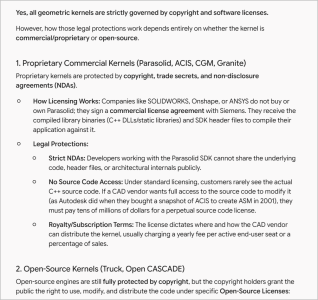
The 3D CAD apps are a bit unique in that they rely on powerful kernals in order to function. Its not just standalone code. Kernals can either be held inhouse under lock & key or essentially licenced. But there are also open source versions as summarized. How they functionally compare to the so called big league ones is above my pay grade.
1792369390291.png
 
Last edited:
In a year it won't be an unknown capability.

It seems that the point of this is really good programs for FREE for hobbyists and small operators. How many big corporations are going to use Fusion anyway. Would you risk having proprietary designs and info out in the cloud. More likely it is locked down on an internal server and that doesn't fit with Fusion..
More corporations than you might think. The cloud noise is only an issue for some. And it is likely/possible that a big enough customer gets to use their own cloud. Distributed teams need a cloud of some sort to operate.
 
Only mid tier orgs use Fusion. High end orgs use quasi-perpetual license (paid updates etc) non cloud version of Solidworks, MasterCAM etc that allow local only installs.
 
Last edited:
Anything in the cloud, or a corporate online network, is at risk for being hacked and stolen no matter how safe the "owners" claim it is. The only truly safe place to store something, assuming somebody wants it bad enough, is to air gap it from the web.
 
Anything in the cloud, or a corporate online network, is at risk for being hacked and stolen no matter how safe the "owners" claim it is. The only truly safe place to store something, assuming somebody wants it bad enough, is to air gap it from the web.

Quite right. I'm unclear, though, on whether you're referring to the distribution/object/executables/etc. or the kernel sources.
 
And your teams will get nothing done.
No one has ever reported a hack on Autodesk servers to my knowledge. And if it had happened you can be sure it would have made the news. Autodesk, Microsoft, Adobe et al are extremely moticvated to keep those servers secure.

There is a difference between fear and being cautious. Being overly cautious results in getting nothing done. I use OneDrive and Fusion's cloud to work seamlessly between my office and workshop computers as well as sharing/cooperating with friends who use some of my designs or ask me to design things.
 
I'm unclear, though, on whether you're referring to
Proprietary files, design data, accounting etc. AKA: secret stuff that a company doesn't want stolen
And your teams will get nothing done.
Autodesk, Microsoft, Adobe et al are extremely moticvated to keep those servers secure.
Large companies get hacked all the time credit card data, personal data, passwords. If someone wants it bad enough they can get in. Places like Russia have hacker factories just for that. There is big money in data theft.
 
There's already problems with the AI-coded 2d photocraft suite that is supposedly the answer against Adobe. There's a discussion on the legal ramification of "reverse engineering" patented software:


In short, these AI projects are not David vs Goliath but one party of opportunists trying to cash-in on the well deserved hatred on Adobe/Autodesk. There are many FOSS (free open source software) that contends in the space that is worth supporting. The AI-coded photocraft is seamingly powerful but looking through the github issues you can find a long list of comical bugs: from not being able to open more than one photo at a time, or corrupted the files that can no longer be opened by official Adobe software again. I follow this closely because I am eager for an alternative but cannot risk my TBs of professional work for a wild west solution.

My previous full service architecture/engineering multi-national company subscribed to Revit cloud services and put all their projects there for ease of collaborating with other consultants. They are now locked in with absurd costs after getting comfortable. I heard from my old colleague and director of technology that they are partnering with local Canadian software companies and academia to develop alternative softwares in order to get out of this shake down.
 
Last edited:
That reddit bit is interesting and entertaining (notwithstanding some factual errors), but I find all the discussion of patents to be kind of stupid, because you can't meaningfully talk about them without referencing the actual patent texts. I'm certainly not a patent lawyer, but I've earned a few in my time; one has been broadly cited in its field (which I guess will have to do as far as validation goes, 'cause the company crashed and burned), and another was infringed upon. But time spent talking about patents in vague generalities is time wasted, because you have to be absolutely unambiguous about which specific patent claims are being infringed upon, and how. Wanna talk about Photoshop? Then dig out the documentation and the license and the "About" screens and everything else that lists a patent number, then keep digging through the countless thousands of patents filed by Adobe over the decades that aren't listed and read every single one for a wisp of a reference to any function that might ever conceivably apply to that piece of software, and then evaluate every single one of those claims against what the new implementation does, and how.

Another part of that conversation that doesn't make much sense is the notion of whether or not a generative-AI-created version is (or can be) a "clean room implementation". All this shit's brand new, and I'm pretty sure that with the present US congress absolutely stuck in place, standing on its own dick, there hasn't been any legislation passed (let alone proposed or introduced) regarding these problems. Yes, there have been copyright suits brought, particularly in the music field, but it's still the wild west and there aren't a lot of rules. The problem is that nobody on the outside (of the AI companies, that is) knows a damn thing about what the LLM training hoovered up over the years, so a complainant will have a hard time proving that his copyrighted work was tapped. But when you're a company the size of Adobe (to pursue just this example), that doesn't really matter shit, because all you have to do is push a few mil in the direction of some choice legislators and make sure that if and when a bill appears, it stipulates a reverse-onus, which is to say that instead of Adobe (the plaintiff) having to prove that there was (for example, copyrighted source code) infringement - via the AI and its training - on the part of the slopbros (I love these new terms), it's up to the slopbros to prove there wasn't, which is pretty much impossible, since they're not privy to all of accumulated training to date.

So while it's fun to speculate about the bunfights to come, this is all way premature.

 
I am in no way a fan of AI or all the fear mongering that goes with it but I am a big fan of free open source programs. And if AI can help bring that to the masses and give people a chance to experience different programs that they otherwise could never afford to use then I am all for it. Lots of people have learned to use programs over the years and don't want to have to learn a different one but are being forced to since you can not longer just buy a program and pay once now you have to rent it.
 
with the present US congress absolutely stuck in place
Don't forget that outside the US the 'merican courts can go suck an egg, more so now then ever considering how the US is behaving towards the rest of the world! Adobe/Autodesk might have to fight a lot more international court battles than just the US
AI or all the fear mongering that goes with it
It's not fear mongering Skynet is on the way. Be afraid, be very afraid.😱😵
 
It should be noted that in the last few weeks there have been a lot more new CAD packages available beside Solidcraft. A couple of improved Sketchup , some that are something between Sketchup and Fusion, two Autocad replacements. All of these are in early beta test form and are being developed some more, Solidcraft appears to be the best of the lot. With so many new programs out there they will swamp the market and make it hard for the old guard to deal with them. Better for us.
 
I spent years using Autocad. Got my start with R12 and then mostly Autocad 2007 and some Autocad 2012. I need something that is set up the same and uses the same commands. I still use keyboard commands for most things. I have no interest in trying to start over learning something new. I found fusion difficult to use because I had to change how I thought about drawing things. I started when using cad was just manual drafting on a screen so that is how I have always drawn. But when I started trying to learn to use fusion 360 years ago it was more like start with a shape then start giving it dimensions and change it until it is what you want instrad of drawing it line by line. Basically I need someone to do the Adobe thing with AI but on autocad.
 
Don't forget that outside the US the 'merican courts can go suck an egg, more so now then ever considering how the US is behaving towards the rest of the world! Adobe/Autodesk might have to fight a lot more international court battles than just the US

Sure, but don't assume that's any kind of obstacle for a company with pockets as deep as theirs. The other factor, though, is that when you're filing for a patent - even in Canada - you generally get the U.S. one first because (for the most part) other countries look to the USPTO as a standard of reference, as historically the U.S. has been the world's greatest technical innovator. So once we got our US patent, we'd submit to the Canadian patent office and it'd pretty much be a rubber-stamp because they respect the USPTO's competence in evaluating and granting. So the U.S. patent really does matter more.
 
Back
Top