• Scam Alert. Members are reminded to NOT send money to buy anything. Don't buy things remote and have it shipped - go get it yourself, pay in person, and take your equipment with you. Scammers have burned people on this forum. Urgency, secrecy, excuses, selling for friend, newish members, FUD, are RED FLAGS. A video conference call is not adequate assurance. Face to face interactions are required. Please report suspicions to the forum admins. Stay Safe - anyone can get scammed.
  • The 2026 Calgary Area Meetup is set for Saturday May 30th at 10am. The signup thread is here! Robinhood has graciously offered to host the meetup again this year. Please note that you MUST RSVP to the notice linked above if you wish to come.

Mycology

Doggggboy

Ultra Member
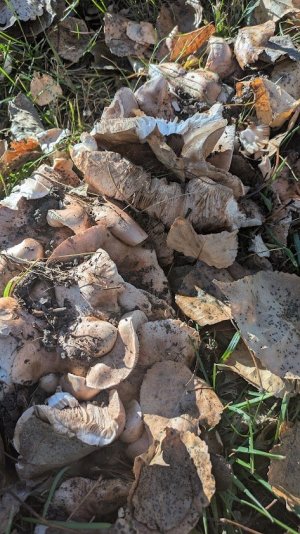
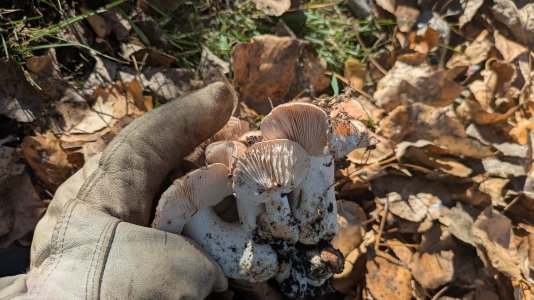
Any amateur mycologists out there?
I am having a massive outbreak of mushrooms on my yard grass.
Not the cute little fairy rings but massive eruptions that get 10 or 12 inches high and leave a 4 inch hole when you pull them out.
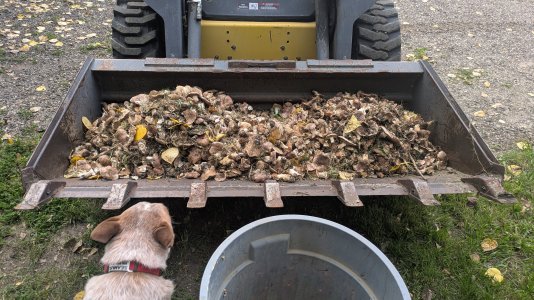
My wife and I picked 140 gallons of these things busting out of the front lawn.
We had some last fall and the dogs spent a lot of the winter trying to root them out of the snowbanks.
I'm hoping they're not toxic but google has been no help.
I'm in Saskatchewan 40km southeast of Regina.
 

Attachments
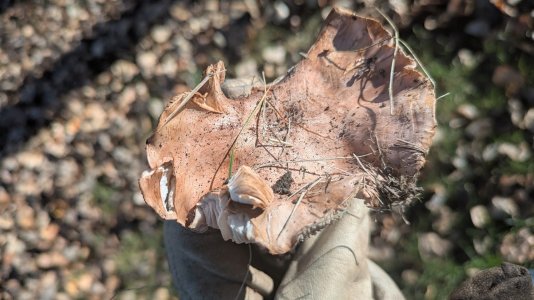
  • shrrom3.jpg
    shrrom3.jpg
    230.5 KB · Views: 30
  • shrrom2.jpg
    shrrom2.jpg
    154.8 KB · Views: 31
  • shroom 1.jpg
    shroom 1.jpg
    306.8 KB · Views: 32
Last edited:
Did you have an old tree that was removed near where they are growing?
Those big ones usually are growing on dead roots that are rotting.
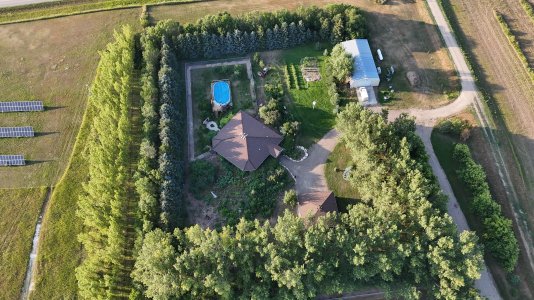
No, and that's what has me a bit worried. The shelterbelt poplars are all at least 40 years old and that is getting up there for most varietals of poplar.
They still look pretty healthy but I read that a fungus outbreak like this can be a result of rotting root systems.
When we moved here in 2002 we planted close to 10 thousand new trees and shrubs knowing that someday the existing shelterbelt would start to fail and that it is a bad idea to wait for one tree to die before you plant a replacement.
Come spring I'll do a better job of removing loose organic matter in the area and see if a little more sunshine and less dampness has an effect.

DJI_20240731191041_0071_D.JPG
 
Maybe reach out to the University of Saskatchewan Biology Department? I have contacted UofS Departments on a couple of occasions and they have always been very helpful. Local gardening stores like Early's or Dutch Growers (Saskatoon) can be good if you get the right person.
 
No, and that's what has me a bit worried. The shelterbelt poplars are all at least 40 years old and that is getting up there for most varietals of poplar.
They still look pretty healthy but I read that a fungus outbreak like this can be a result of rotting root systems.
When we moved here in 2002 we planted close to 10 thousand new trees and shrubs knowing that someday the existing shelterbelt would start to fail and that it is a bad idea to wait for one tree to die before you plant a replacement.
Come spring I'll do a better job of removing loose organic matter in the area and see if a little more sunshine and less dampness has an effect.

View attachment 71882
Awesome looking place.🙂
 
With all those trees surrounding property, you must have your own microclimate in that space. Love it, well planned. It is amazing how beneficial trees can be when planted in a strategic location. Shade, wind break, breeze corridor, erosion protection, wildlife habitat........

Back in the early 90, I used to be a member of a mushroom foraging group. We, 8-16 of us would gather at pre-designate site, forest, farm land. We would all go about individually and forage for mushroom and then we were asked to all regroup in the same spot. Each of us would lay our find on the table and identify them ourselves, 30 minutes later a mycologist would come and judge our mushroom identification. One time on a farm land I found a small panaeolus " dung mushroom and the mycologist identified has a hallucinogenic one, for some reason without even asking he put it in is basket why? I did ask.
I only participated with that group for one year, I was about 30 years plus younger than most of the participant, I didn't really fitted in , but I should of kept it up.
I would of like to try identifying your particular mushrooms, but I can't view the full image, I can only see the thumbnail.

When I moved in my first house, it was a project of about 42 carriage link home about15 years old. Most house only had the city required tree on the front lawn and some houses had really large city lots. The city was promoting tree planting in the city and giving out 2 per household 6-8 footers lilac, red maples, linden, locust, elderberry, service berry........ to name a few. I went door to door meeting a few of my new neighbor and volunteer to plant some free trees on there property. I ended planting about 25 ish trees and now 29 years later it puts a big smile on my face driving through my old neighborhood.
 
I am not going to eat anything mushroomlike that I have picked. Everytime I look up a mushroom to see what it is, they say "it looks like this one and they are tasty but it could be this one and they are deadly" F... that. I'll have what comes out of the can and live to tell the tale.
 
I pick very few types but my main picks are Morels in the spring and giant Puffballs in the fall.

...any other type's I'm with someone who knows a LOT more about them than I do, so sorry I cant help with the ones you have there on your beautiful property
 
Last edited:
With all those trees surrounding property, you must have your own microclimate in that space. Love it, well planned. It is amazing how beneficial trees can be when planted in a strategic location. Shade, wind break, breeze corridor, erosion protection, wildlife habitat........
It's pretty cool.
When we bought it in 2002 there was an existing shelterbelt on 3 sides, North, West and South.
The trees were still small enough to drive the mower between them. In the winter the drifts would form between the trees into the yard like waves.
Now you can barely walk between them and while the sow will still sift into the yard, it mostly just falls straight down and the wind isn't an issue.
We are always surprised when we leave the yard and realize it's windy out there.
 
A couple of ways you can help experts identify the mushrooms, so that you might at least worry less about dogs getting into them:
1. Do a spore print. Take a mushroom that is relatively young and put the cap on a piece of white paper, and leave it for a few hours. Then look at the colour of the ring it leaves
2. Take good photos of the parts of the mushroom - the spore face under the cap, the stem.
3. Identify whether they are growing out of dead or dying wood.
I agree that at least one of your photos resembles some variety of oyster mushroom. More data could help.
 
I spent a good part of my wasted youth collecting and attempting to identify wild mushrooms, my best friend was a mycology major at UC Davis.

My experience with oyster mushrooms (Pleurotus ostreatus) is they grow as a shelf fungus on rotting logs and stumps. They frequently don't have a stipe (stem), but when they do it is short and off-center. My dad had a secret location where he collected them, some as big as a dinner plate. https://www.mushroom-appreciation.com/oyster-mushroom.html

Those pictures are not much help, the specimens being quite old. A spore print would help, but the spores are probably white. Other details of the gills, stipe etc. would be helpful, but even with those details it can be challenging. I can tell you that they are not any of the most deadly varieties, which are few and distinctive in appearance. My friend's Russian wife would have those brined in 5 gal buckets with heavy stones on top. "Mushrooms love stones" she told me.
 
In either "The Secret Life of Plants" or the more recent "The Hidden Life of Trees" something of the complex symbiotic relationship between trees and subterranean fungi was explained.

Both are fascinating reads, especially the first one which is earlier. In general the presence of fungi is considered a positive sign of soil health I believe.
 
In either "The Secret Life of Plants" or the more recent "The Hidden Life of Trees" something of the complex symbiotic relationship between trees and subterranean fungi was explained.

Both are fascinating reads, especially the first one which is earlier. In general the presence of fungi is considered a positive sign of soil health I believe.
Interesting. When I initially started looking into this I had read that quite often a large bloom of mushrooms is indicative a rotting root system, which makes me worried about my shelterbelt health.
But I guess soil health and tree health aren't necessarily the same thing. I am sure trees require healthy soil to make healthy roots but healthy soil also probably requires rotting roots and other decaying matter.
 
Perhaps the fungi came in on the soil attached to the root balls? The experts could say best what if anything such a bloom indicates; sometimes it's just weather I believe.

If your trees look healthy they probably are, but if this fungus is a problem for them there's probably very little that can be done about it unfortunately except to fertilize and water them so as to strengthen their natural defences as much as possible?
 
Back
Top