• Scam Alert. Members are reminded to NOT send money to buy anything. Don't buy things remote and have it shipped - go get it yourself, pay in person, and take your equipment with you. Scammers have burned people on this forum. Urgency, secrecy, excuses, selling for friend, newish members, FUD, are RED FLAGS. A video conference call is not adequate assurance. Face to face interactions are required. Please report suspicions to the forum admins. Stay Safe - anyone can get scammed.
  • The 2026 Calgary Area Meetup is set for Saturday May 30th at 10am. The signup thread is here! Robinhood has graciously offered to host the meetup again this year. Please note that you MUST RSVP to the notice linked above if you wish to come.

my project(s) 1968 Mercury M100 and a 1970 F250 and a deere

grease monkey

just another day!
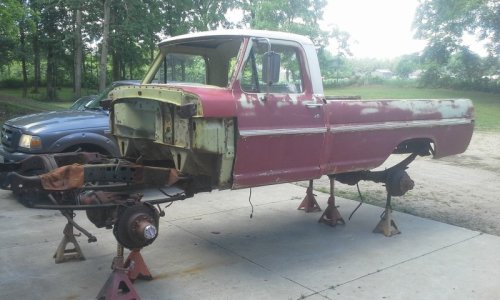
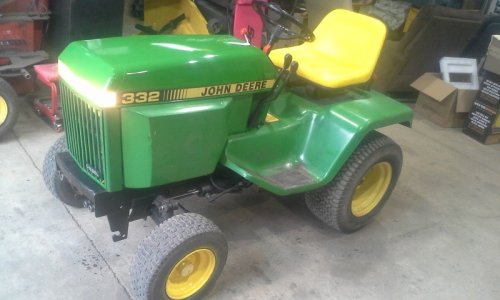
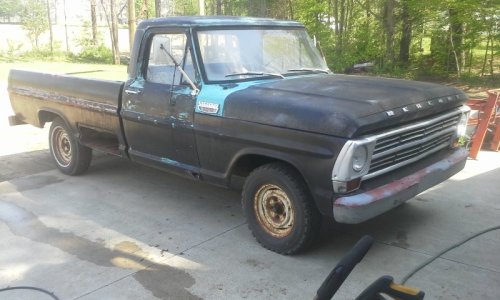
so I did a thing, and its morphed into 2 things, on the hunt for a new daily driver trailer puller, and wanted something unique, I bought a 1968 Mercury M100 1/3t truck, mainly for the body and badging to swap onto a 1979 F250 4x4 frame that will be getting a 24v Cummins 5.9l engine swap, but after some google university, I find out that Ford cancelled the Mercury truck program in April of 1968, and the quick search also showed this Merc as being built in April, so this very well could be one of the last survivors of only 334 trucks built in '68 model year, the rest of the trucks they built were 3/4t and 1t trucks... I have a cab and box for the 1979 build that are from a 1970 F250, so its going to be the correct era of truck, on what I consider the best frame to have from back then, a 1979 F250 4x4 that currently has the same vintage dana 60 1 ton axles front and back, this truck also wants to be a Mercury just for choice, but find the badging is proving difficult. 1st pic is the Merc in its current running and driving state, needing some floor and door rust repair to make it road worthy again, second pic is my preferred build in its current state, the F250 is slated to receive a 1999 Cummins 24v engine thats been converted to full mechanical (because I'm so done with computers and want fuel mileage, not hp) which has a NV4500 5 spd manual trans bolted to it with a new clutch, and a NP4100 T case behind that to do the 4x4 duties. going to try my hand at using an adapter to siphon dry baking soda through my pressure washer wand to remove the primer paint and reveal the original pant on both trucks, reading good reviews about that process. also just finished a project with my son in rebuilding a rare John Deere 332 factory diesel awn tractor, which is for sale now, (if anyone is looking??) and currently have the engine out of a 2009 Mini Cooper, to hopefully be rebuilt. also had the opportunity to machine an adapter pto shaft to bolt o the crank output of a Kubota D482 2 cyl diesel to go into a John Deere 317 tractor Dad is working on, turned out very well! my machining center is becoming more and more useful, so thats good news in my books!
 

Attachments

  • 20260518_160402.jpg
    20260518_160402.jpg
    88.3 KB · Views: 10
  • 20260615_163410.jpg
    20260615_163410.jpg
    89 KB · Views: 10
  • 20260622_155343.jpg
    20260622_155343.jpg
    66.5 KB · Views: 9
converted to full mechanical (because I'm so done with computers and want fuel mileage, not hp)
I had the exact opposite result going from mechanical to computer fired DD Series 60. My 400 hp mechanical delivery Cummins would give me max of 4.5 MPG ( 15-over, 3:90 gears, 2 axle trailer) ...I upgraded to the computer run series 60 (430 hp with identical trans, gearing ) 3 axle trailer and instantly went to over 7 MPG.
A later, bigger (550 hp) computer run Cummins gave me 9 mpg.
 
Should be an interesting project. My neighbor has done a few of these including one in which he put in a Cummins and auto transmission out of a Dodge. As I recall the electrical in the tranny was a nightmare.
Curious about the Kubota, what is the power rating and source of the engine ?
In my experience fuel mileage with a big engine loafing is better than a smaller one grinding away.
 
sounds like some fun projects, would love to get into doing this sort of thing, soon, just need to move to a bigger place.
 
Should be an interesting project. My neighbor has done a few of these including one in which he put in a Cummins and auto transmission out of a Dodge. As I recall the electrical in the tranny was a nightmare.
Curious about the Kubota, what is the power rating and source of the engine ?
In my experience fuel mileage with a big engine loafing is better than a smaller one grinding away.
the Z482 comes from a T1600 kubota lawn mower, its rated at 13.5 hp, nice running little twin.
the Cummins 5.9l is actually a small motor, its only 3" longer than the original Ford 300 cid 4.9l that came in the F250, so it shouldn't be to much of a swallow for that old Ford to accept that Cummins, everyone I talk to thinks I'm crazy for changing to full mechanical using the VE rotary pump, when thay ALL change to the P pump, but they all want the bigger hp, which obviously drives the mileage down, I know guys who have an old 12v Cummins and are getting 23 mpg give or take, and the 1999 gen 24v ecm engine is also getting that, but when they change to the VE style pump, they are getting almost 25mpg, so thats where I'm headed, I had zero desire to crank out serious power with this, as if the stock trim 24v needed any help anyway, the stock 300 Ford made a whopping 170hp, so the 260ish the 24v will have in the configuration I'm aiming for will be worlds ahead of that 300, plus the fact I'm using a NV4500 bull geared 5spd, it should be awesome! thats the goal anyway!
 
In my experience fuel mileage with a big engine loafing is better than a smaller one grinding away.

My experience and knowledge is quite the opposite. I'm thinking your small engine wasn't properly tuned or some such similar explanation. All the OEM's are going to smaller engines with high performance additions ( vvt, turbos, etc) to meet the power needs while also reducing fuel consumption to meet the fuel consumption regulations via smaller engines.

Perhaps the easiest way to see it is to consider pumping losses. Bigger engines have bigger pumping losses because they operate at lower throttle openings for a given load and have bigger displacements trying to breathe through a straw.

The same applies to hybrids. They don't need a big engine for cruising. The electric drive provides the acceleration and temporary power demands. The smaller engine provides better fuel economy cruising on the highway.
 
the Z482 comes from a T1600 kubota lawn mower, its rated at 13.5 hp, nice running little twin.
the Cummins 5.9l is actually a small motor, its only 3" longer than the original Ford 300 cid 4.9l that came in the F250, so it shouldn't be to much of a swallow for that old Ford to accept that Cummins, everyone I talk to thinks I'm crazy for changing to full mechanical using the VE rotary pump, when thay ALL change to the P pump, but they all want the bigger hp, which obviously drives the mileage down, I know guys who have an old 12v Cummins and are getting 23 mpg give or take, and the 1999 gen 24v ecm engine is also getting that, but when they change to the VE style pump, they are getting almost 25mpg, so thats where I'm headed, I had zero desire to crank out serious power with this, as if the stock trim 24v needed any help anyway, the stock 300 Ford made a whopping 170hp, so the 260ish the 24v will have in the configuration I'm aiming for will be worlds ahead of that 300, plus the fact I'm using a NV4500 bull geared 5spd, it should be awesome! thats the goal anyway!
If you can get the dodge t-case output shaft and yoke from the cummins np205, it was either 32 or 35 spline and just that much stronger. Assuming you'd be staying with an np205 in the older iron. Gives you a larger yoke and ujoint for mischief
 
@Susquatch , you obviously have more experience, but these newer engines are also designed to fail, far too early in my opinion, as the OEM's dont want these lasting 300,000k like they used to, so they are not built to the same spec as the older engines, you will also have to admit that these new engines produce higher hp numbers because they are rung out to a higher stress level than the older stuff (turbos & super chargers), kinda like a nascar engine which only last 1 race maybe, and then they need to be completely rebuilt for the next round, and these newer engines, when they fail, its bad, so much so that its almost to the point of writing off the vehicle because they've engineered them so difficult to work on that the time alone to replace an engine doesnt warrant being worked on, just replace the whole vehicle! and the fuel efficiency? I'm sure You can also testify that there were engines back in your day getting 35 to 40 mpg, (I had one) those numbers are STILL a struggle to this day, so if tech these days is choice, then this should be a non issue.(obviously only talking about regular engines, not hybrids) but the big issue here is, I'm not fetching groceries, I'm hauling tractors, equipment, cars that are broke etc, which is where I need reliable power for years, not just till the next oil change, I'd be more than willing to install a 7.3l power stroke (the best diesel Ford has imo) but even these only get 18 at best, myself having 3 of them, thats the best I ever got, which is ok, but at the fuel prices these days, I need better, so if I'm doing this, we're going for best I can get, which is the 5.9. I've worked on auto's for the last 45yrs and that's my consensus. Ford & GM had others design their big diesels, (Ford = International, GM = Isuzu) they just manufactured them themselves, where Dodge tried that and Cummins told them NO, this is how WE will build them, take it or leave it, which proved to be a great choice, Cummins upheld their good name, while Ford and GM are struggling bigtime because they want their stuff soo difficult to fix small shops are starting to shy away just because of shear time to fix, and the newer diesels are still struggling to get 24mpg, which Cummins has been doing that since the 5.9l first came out, isnt that what Your truck gets on average?
@Chicken lights the trans I have is the NV4500 out of a GM rig with the input shaft swapped out for the Dodge variant, so this also has the NP4100 out of the GM, You are right in me wanting the big gear driven case, so if this 4100 even flinches once on me, it will end up on the chopping block real quick, the 4100 is also the case Ford used in their 1 ton trucks, so I have faith in it for now. finding a divorced case is also proving difficult, just keeping my eye open for one.
 
.Bigger engines have bigger pumping losses because they operate at lower throttle openings for a given load and have bigger displacements trying to breathe through a straw.

@Susquatch you're forgetting that @grease monkey is talking diesels, which don't have throttle bodies and therefore are not creating pumping losses through restricted airflow.
 
@Susquatch you're forgetting that @grease monkey is talking diesels, which don't have throttle bodies and therefore are not creating pumping losses through restricted airflow.

No, I'm not forgetting. It was a generic statement about bigger and smaller engines. If we stick to diesels, you are correct that pumping losses are minimal. But we still have friction and rotating mass working against us.

I glossed over something even more important because it was difficult to explain. My bad. I'll try to do better this time.

Everyone is familiar with sweet spots for engines and gearing. The efficiency and power of any engine has a sweet spot in the operating curve. Usually, this spot is higher in its rpm range. Not just because of pumping losses in gasoline engines, but also because of intake and exhaust tuning, port design, valve configuration, combustion characteristics, and a whole multitude of other factors. Engineers try to design these characteristics to serve a range of needs, so compromises are inevitable. For a given power need, this always means that a smaller engine can align its output power most efficiently at a higher point in its power output curve than a larger engine can.

All other things being equal in terms of efficiency, that means a smaller engine can always be optimized for more efficiency than a bigger engine can.

Of course, that totally ignores the fact that most smaller engines can't produce the power that most bigger engines can even assuming equal technology. And so the tradeoffs and compromises begin.
 
well the '68 Mercury is officially for sale as I have found all the Mercury specific bling I need to fit onto my F250, to make it a full Mercury M250, albeit the title will still show F250, but who looks at that?? even found an original really rusty mercury tailgate wall hanger to fill a void on my wall!

truck is progressing, not fast enough for my liking but jobs are required to fund this, cab is almost done and frame is stripped and painted and ready, springs are ready, now rebuilding axles as I can't begin installing body with the frame is sitting on a rickety 30gal drum that seems to be slowly caving in. aiming to have the cab and box sitting back on the frame this week, need to get measurements under the hood to see how/what needs to be addressed to fit the 24v under the hood!

332 is off to a new home, got my space back in the shop
 
Should be an interesting project. My neighbor has done a few of these including one in which he put in a Cummins and auto transmission out of a Dodge. As I recall the electrical in the tranny was a nightmare.
Curious about the Kubota, what is the power rating and source of the engine ?
In my experience fuel mileage with a big engine loafing is better than a smaller one grinding away.
the 482 is rated at 11hp I believe, bunch of torque in this little guy though
 
Back
Top