
-
Scam Alert. Members are reminded to NOT send money to buy anything. Don't buy things remote and have it shipped - go get it yourself, pay in person, and take your equipment with you. Scammers have burned people on this forum. Urgency, secrecy, excuses, selling for friend, newish members, FUD, are RED FLAGS. A video conference call is not adequate assurance. Face to face interactions are required. Please report suspicions to the forum admins. Stay Safe - anyone can get scammed.
You are using an out of date browser. It may not display this or other websites correctly.
You should upgrade or use an alternative browser.
You should upgrade or use an alternative browser.
Tool Maybe Beyond My Skill Set And Needs
- Thread starter whydontu
- Start date
Tool


Loosenut
Member
Apparently it is just loosing molecules on it's own. It is a slow process but the "powers that be" are getting worried about it.
I suppose if it gets to bad it would invalidate the metric system, then we might have to adopt something else. Better dust off the old yardstick. he, he, he.😎
I suppose if it gets to bad it would invalidate the metric system, then we might have to adopt something else. Better dust off the old yardstick. he, he, he.😎

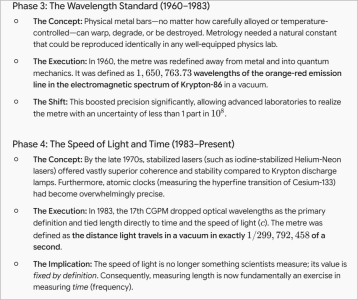
I believe that the meter is a constant precise length that is (by definition) directly related to the speed of light in a vacuum. Also - speed is a distance and time relationship. The time portion of that relationship is defined using cesium-133 (atomic physics defines a second).So it looks like the meter isn't a meter anymore
Last edited:

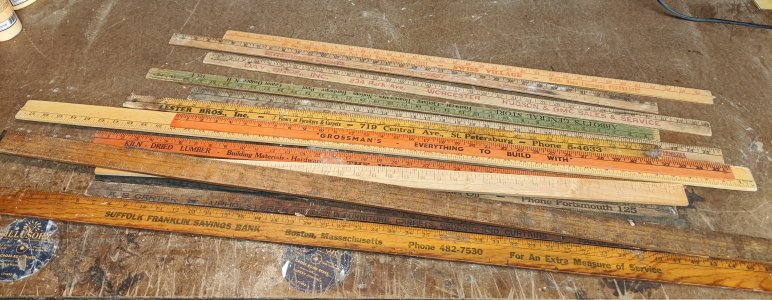
maybe one these would do... 🙄 😛Apparently it is just loosing molecules on it's own. It is a slow process but the "powers that be" are getting worried about it.
I suppose if it gets to bad it would invalidate the metric system, then we might have to adopt something else. Better dust off the old yardstick. he, he, he.😎
Attachments
Loosenut
Member
Of a specific wavelength, travel distance measured by a nanosecond. Again, real use full😉meter is a constant precise length that is (by definition) directly related to the speed of light in a vacuum.
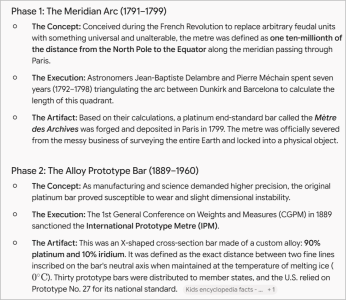
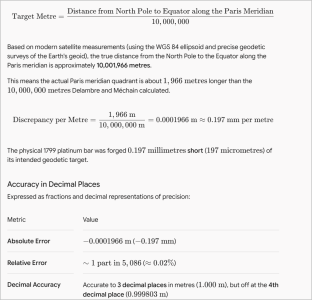
Well, the current definition of a meter is only the latest definition. It has had various definitions, starting out attempting to relate it to partial meridian arc length of the planet we live on. Noble intentions, 7 years of toil & all that entailed. The platinum bar stuff was mostly about selecting a material with minimal deviation given the technology of that time to reflect that length basis. Now with the benefit of modern satellite technology we know they were within 0.197 mm/m. In the end it doesnt matter, it was a glorified gauge block by which everyone else 'calibrated their sticks'. And that is actually no differnt than other so-called standards.
The English foot came from human anatomy (super reliable!). It got more defined with yard (3x foots). But really followed a similar path, just less effort to tie it to anything meaningful. A chunk of material (brass > bronze > bailey's metal?>...) finished to some length, given a label & stored in THEIR vault. Another glorified gage block by which others shall follow, at least in areas of their domain which was substantial when they cooked up their definition. In 1893 (Mendenhall Order) the Americans said, well we like the word 'yard', but we dont trust the English bar, so we are going to base our yard on the French meter just by using a conversion factor. It took Canada until 1951 to come to the same conclusion, severing the London yard, making our yard = 0.9144 metres (exactly). At this time our yard was different to USA yard but only because of different conversion factor to the same metre. Then in 1959 we (including the British) all agreed on common inch/yard/related lengths by agreeing on a common conversion factor to a meter. Hopefuly in this convoluted history, the Standard vs Metric argument is really rather silly since (USA/Canada/Britain) Standard has been BASED on metric for a very long time, at least for length.
As physics & technologies evolved, along come a better recipies to define length without upsetting the metre applecart too significantly. 1960: Krypton-86 wavelength standard, 1m =1,650,763.73 wavelengths, now accurate within a fraction of a micron. Then 1983 Speed of Light Shift: chose the exact integer 299,792,458 metres per second because it matched the existing Krypton-86 metre standard to within experimental error. All this means is anyone (with the right equipment) can replicate the standard. It doesnt effect a carpenter using a tape measure or machinist using highest grade gauge blocks available. That was never the point, our low level requirements & buy-in are inconsequential. But as you work up or down the distances from micro to macro used in modern day physics & industry, you run into the same old 'what constitutes the standard stick' syndrome.
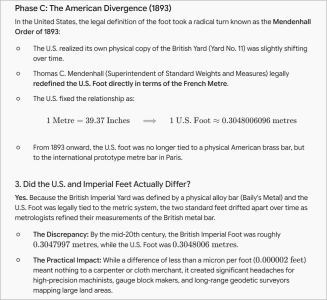
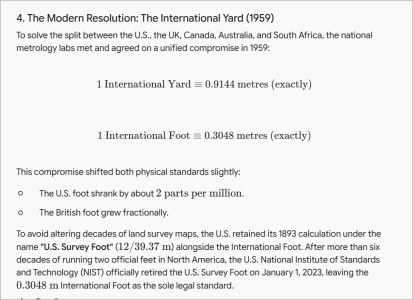
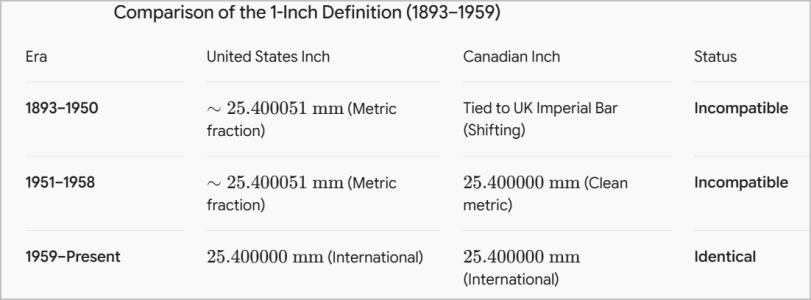
The English foot came from human anatomy (super reliable!). It got more defined with yard (3x foots). But really followed a similar path, just less effort to tie it to anything meaningful. A chunk of material (brass > bronze > bailey's metal?>...) finished to some length, given a label & stored in THEIR vault. Another glorified gage block by which others shall follow, at least in areas of their domain which was substantial when they cooked up their definition. In 1893 (Mendenhall Order) the Americans said, well we like the word 'yard', but we dont trust the English bar, so we are going to base our yard on the French meter just by using a conversion factor. It took Canada until 1951 to come to the same conclusion, severing the London yard, making our yard = 0.9144 metres (exactly). At this time our yard was different to USA yard but only because of different conversion factor to the same metre. Then in 1959 we (including the British) all agreed on common inch/yard/related lengths by agreeing on a common conversion factor to a meter. Hopefuly in this convoluted history, the Standard vs Metric argument is really rather silly since (USA/Canada/Britain) Standard has been BASED on metric for a very long time, at least for length.
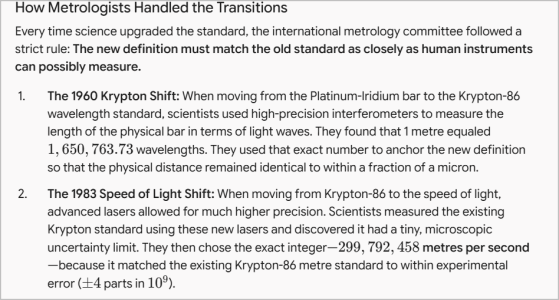
As physics & technologies evolved, along come a better recipies to define length without upsetting the metre applecart too significantly. 1960: Krypton-86 wavelength standard, 1m =1,650,763.73 wavelengths, now accurate within a fraction of a micron. Then 1983 Speed of Light Shift: chose the exact integer 299,792,458 metres per second because it matched the existing Krypton-86 metre standard to within experimental error. All this means is anyone (with the right equipment) can replicate the standard. It doesnt effect a carpenter using a tape measure or machinist using highest grade gauge blocks available. That was never the point, our low level requirements & buy-in are inconsequential. But as you work up or down the distances from micro to macro used in modern day physics & industry, you run into the same old 'what constitutes the standard stick' syndrome.
Loosenut
Member
And handy, everybody has two. Just whip out the old size twelve and measure away.😀came from human anatomy (super reliable!)
Unless you are the poor sap that has to make Part-A fit Part-B & realize its just circular silliness Q) how long is a size-12? A) 12 inches. Q) Whats an inch? A) One 12th of a foot Q) how long is a foot? A) well 3 of the King's feet (left one I think) placed end to equal The Royal Yard, but first you must sail to London to measure the offocial brass one, hopefully not a cold rainy day when it will actually be just a tad shorter.....And handy, everybody has two. Just whip out the old size twelve and measure away.

historicalarms
Ultra Member
Your wrong man...Just the government in both those countries is metric...but the "country" is still imperial.Technically we are a metric country as is Britain. While yes we use some imperial we are by no means an imperial country.

Your wrong man...Just the government in both those countries is metric...but the "country" is still imperial.
Good point. Especially the country folks in those countries!